


Art Deco Stepped Table
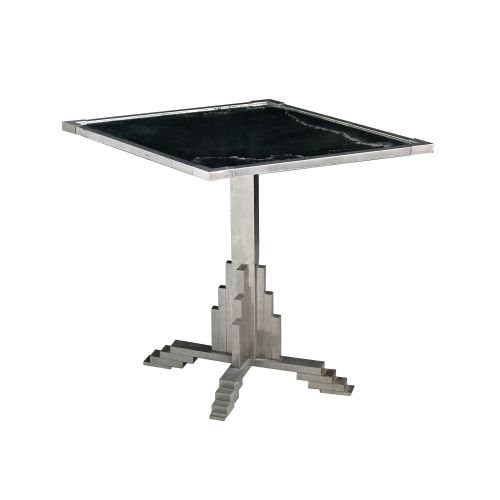
An art deco stepped table brings architectural geometry into a room through tiered surfaces and industrial materials.
Art Deco Stepped Table
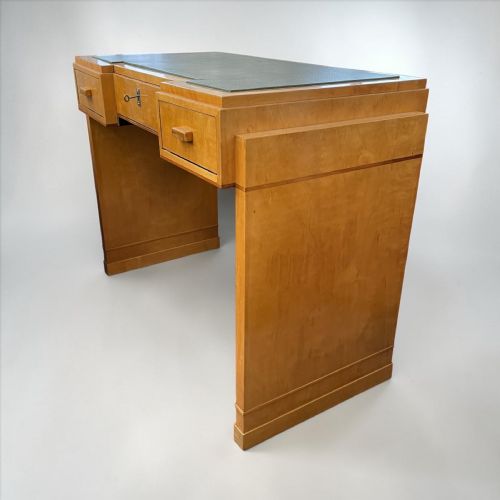
When you search for an art deco stepped table, you enter a world of modernist architecture translated into domestic furniture. The pieces on this page span the 1910 to 1930 periods, showing how designers applied geometric progression to everyday objects. While the term brings tiered tables specifically to mind, the listings also reveal related forms such as desks, side tables, and dressing tables that share the same vocabulary.
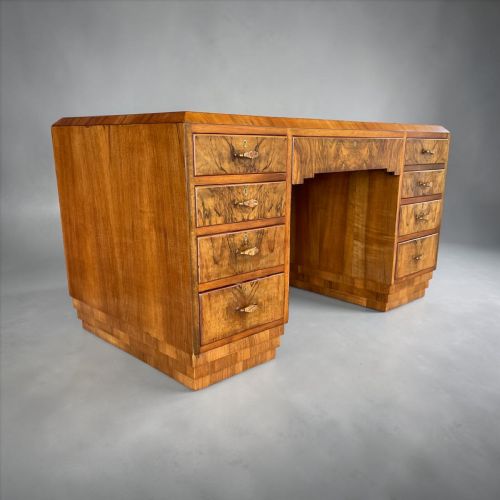
The most direct examples of tiered design appear in pieces like the matched modernist tables by Hille, which utilise distinct levels to create a sense of vertical movement. Other items incorporate similar architectural stacking, reflecting the skyscraper aesthetic popularised during the 1920 and 1930 decades. Walnut, burr walnut, and mirrored glass frequently define these tiered surfaces, anchoring the stepped profile in rich texture.
Materials and construction
Makers of this era combined traditional cabinet woods with modern industrial metals to achieve striking visual contrasts. Walnut and burr walnut provide warm, figured foundations, while chrome, brass, and cast iron introduce sharp reflective highlights. Bakelite and glass also appear across the listings, demonstrating how manufacturers embraced synthetic and moulded components alongside natural materials.
Construction techniques balanced sturdy joinery with sleek surface plating and polished finishes. Wood elements rely on precise cutting to form geometric tiers, while metal frames utilise welding and casting to maintain clean lines. Glass and mirrored tops are integrated directly into the wooden or metallic structures, securing the stepped profiles without obscuring the grain or reflectivity.
Distinctions in quality
Quality in these pieces rests upon the precision of the geometric assembly and the integrity of the materials. Superior examples display seamless transitions between tiers, where wood veneers or metal mounts align with exact architectural proportion. Lesser pieces may rely on simpler construction that lacks the rigorous symmetry defining the best modernist work.
The choice of facing materials further separates standard production from finer output. Richly figured burr walnut and heavy gauge chrome or brass elevate an object's presence, whereas plain secondary timbers and thin plating indicate more commercial manufacture. Original components, such as specialised glass panels or signed clock movements, also distinguish master workshops from anonymous output.
Hille·Whytock & Reid·P.M. Favre·Blangy Clockmakers·A.L. Davenport
The Art Deco Stepped Table Glossary
- Art Deco
- A design style spanning the 1920s and 1930s characterised by streamlined geometric shapes, modern industrial materials, and lavish ornamentation. It succeeded the floral motifs of Art Nouveau.
- Bauhaus
- A German art school operational from 1919 to 1933 that influenced modernist design through functionalism and industrial methods. Pieces in this style strip away ornamentation in favour of stark utility.
- Bakelite
- An early thermosetting plastic invented in 1907, prized during the 1930s for its durability and vibrant colours. It appears frequently in clock cases and decorative fittings.
- Burr Walnut
- A specialised wood cut from walnut tree growths, yielding intricate, swirling grain patterns. It was favoured by high-end cabinet makers for luxury furniture surfaces.
Art Deco Stepped Table: Frequently Asked Questions
How do I style a stepped table at home?
Place a stepped table where its architectural profile can be appreciated from multiple angles, such as beside a low sofa or in an open hallway. Keep objects on the tiers minimal to let the cascading wood or metal lines remain visible.
Pair the table with complementary lighting or clocks from the same era to reinforce the modernist interior scheme. The varying heights naturally create display zones for single statement objects.
What periods do these pieces date from?
The listings span the early twentieth century, with items primarily originating from the 1920 and 1930 decades alongside occasional 1910 roots. This era captured the height of the modernist movement across Britain, France, America, and Germany.
During this period, designers rapidly transitioned from traditional historical revivals to industrial, streamlined forms. The resulting furniture and decorative objects reflect a society embracing technological progress.
Which materials are most common?
Wood and metal dominate the construction of these items, particularly walnut, burr walnut, chrome, and brass. These materials provided the necessary contrast between warm organic grains and cold industrial shine.
Secondary materials such as Bakelite, glass, and leather also appear frequently in details and top surfaces. Each material was chosen to highlight clean geometry and modern manufacturing techniques.