
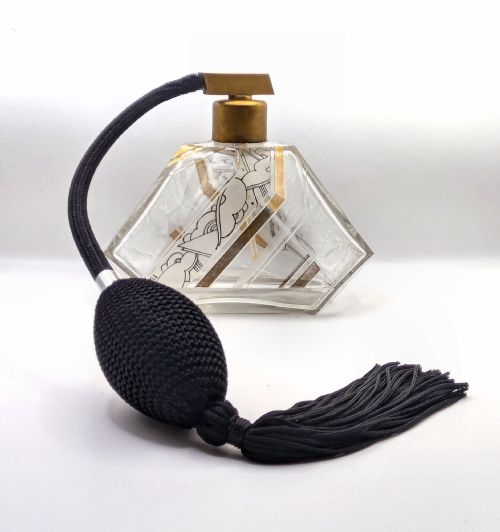


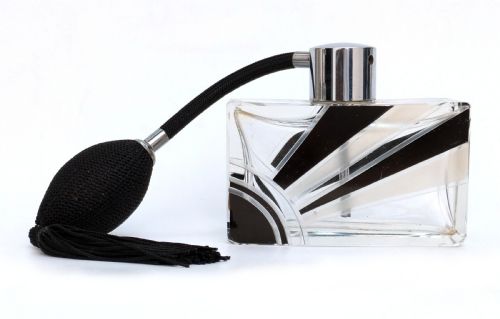


Art Deco Perfume Atomiser
An art deco perfume atomiser is a dressing table essential combining geometric glass and metal hardware for the modern dressing table.
Art Deco Perfume Atomiser
An art deco perfume atomiser brings together the styling of the 1920s and 1930s in functional vanity items. These objects survive as scent bottles, perfume bottles, and atomisers mounted on stands.
The pieces you encounter most frequently on this page date from around 1930 and originate from French, Czech, and Bohemian workshops. They utilise moulded and cut glass forms paired with metallic mounts.
Makers and designers of the period applied geometric patterns, sunray motifs, and streamline silhouettes to create vessels designed for daily vanity use. Surviving examples range from simple glass bottles to elaborate pieces mounted on chrome stands.
Materials and construction methods
Glass forms the primary body of these objects, utilising clear, frosted, amber, and black glass often shaped with geometric cuts or moulded sunray patterns. Crystal and occasionally fabric or enamel also appear in the historical record of these items.
Hardware components rely heavily on chrome, brass, and silver to house the spray mechanism and collars. Bakelite appears alongside these metals, particularly in the fittings and decorative mounts characteristic of the period.
Some bottles are so large they earned the designation 'huge' in the records, proving that vanity storage in the thirties meant business.
Factors that distinguish quality
Quality in an art deco perfume atomiser rests on the precision of the glass cutting, the weight of the material, and the integration of the metal hardware. Heavy glass vessels with sharp geometric facets or distinct moulding show superior manufacture compared to plain utilitarian bottles.
The sophistication of the metalwork, whether chrome, brass, or silver, and the presence of named maker attribution elevate certain pieces. Complete assemblies that retain their original stands or branded mechanisms represent the upper end of what survives from the period.
Karl Palda·Rudolf Hlousek·René Lalique·Hermanova·Marcel Franck·DeVilbiss
The Art Deco Perfume Atomiser Glossary
- Atomiser
- A device fitted to a perfume bottle that turns liquid fragrance into a fine mist via a bulb and tube mechanism. These mechanisms are often mounted in chrome or brass collars.
- Bakelite
- An early synthetic plastic utilised for closures, bases, and decorative elements during the 1920s and 1930s. It offers a dense, tactile quality distinct from later plastics.
- Frosted glass
- Glass treated to achieve a matte, translucent surface texture through acid etching or sandblasting. This technique was widely employed to highlight sculptural reliefs on art deco vessels.
- Sunray motif
- A decorative pattern radiating outward in straight lines, characteristic of the 1930s design vocabulary. It frequently appears cut or moulded directly into the glass body of scent bottles.
Art Deco Perfume Atomiser: Frequently Asked Questions
How do I use an art deco perfume atomiser?
These pieces function by pumping a connected bulb that forces air through a metal tube inside the bottle, drawing the liquid fragrance upward to disperse a fine mist.
Modern users often display them on dressing tables as decorative objects, though original mechanisms should be handled with care due to the age of the rubber components.
How can I tell a 1920s piece from a 1930s piece?
Pieces from the 1920s often reflect early modernist transitions and more delicate proportions, while objects from around 1930 frequently embrace heavier geometric forms, streamline shapes, and bolder chrome mounts.
Maker signatures and regional styles, such as those from Bohemian or French workshops, also help contextualise the production date within the interwar period.
What materials are typical for these atomisers?
Glass is the dominant material, appearing in clear, frosted, black, and amber varieties alongside crystal. Metal fittings in chrome, brass, or silver provide the structural housing for the spray mechanism.
Bakelite and enamel additionally appear as accent materials in mounts, stands, and closures during this era.
Did these atomisers come with stands?
Certain examples were manufactured as part of a matched set that included a chrome or metal display stand holding the perfume bottle in place.
Standalone bottles were equally common, designed to sit directly on a mirrored vanity tray or dressing table surface.