





Art Deco Mantelpiece
An art deco mantelpiece brings geometric rhythm and striking period materials to a room, anchoring a chimney breast with distinctive 1920s and 1930s character.
Art Deco Mantelpiece
When searching for an art deco mantelpiece, buyers encounter architectural fireplace surrounds constructed from oak, walnut, and marble, often paired with matching garnitures or clocks. These pieces capture the streamlined aesthetic of the interwar period, spanning oak and walnut woods alongside polished stone.
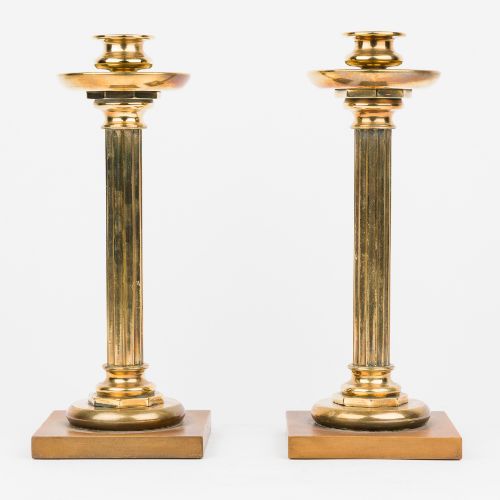
The version most commonly met on this page is the fireplace surround itself, alongside structural garniture sets featuring clocks and candlesticks designed to sit atop the mantel shelf. These objects originate predominantly from the 1920s and 1930s, utilising the distinctive geometric vocabulary of the era.
Materials and construction methods
Surrounds and clocks rely on solid timber, rich veneers, and contrasting stones, combining oak, walnut, marble, and onyx. Metal elements utilise chrome plating, brass, bronze, and painted spelter to create sharp highlights.
Horology and decorative objects incorporate specialised components like bakelite casings, green and coloured art glass, and ceramic bodies with gilded highlights. Movements range from eight-day mechanical mechanisms to early electric systems.
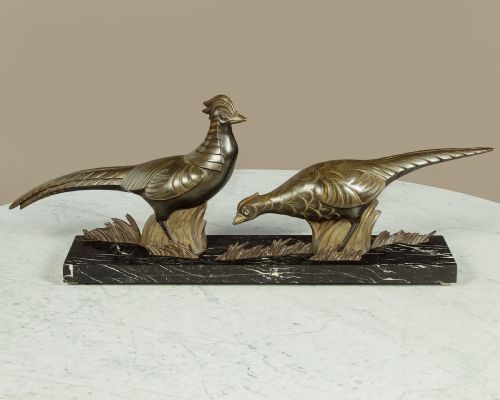
Golden pheasants, elephants, and deer keep watch over the clocks.
Distinctions in craftsmanship
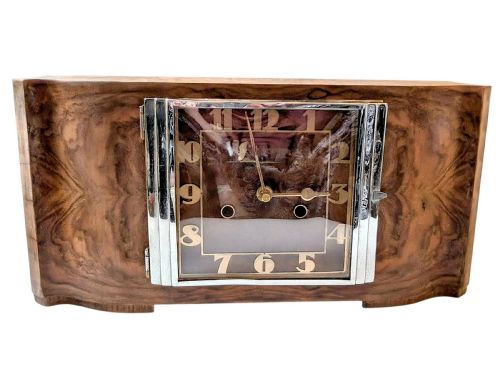
The upper tier of pieces exhibits refined material selection, such as deep-figured walnut veneers, substantial veined marble and onyx bases, and genuine foundry-cast bronze rather than cast spelter. Superior clocks feature named makers with precision eight-day movements and integrated chromatic elements like mirrored glass.
Simpler examples utilise painted metal, standard oak, or lighter ceramic bodies with less complex finishing. The distinction lies in the integrity of the materials and the precision of the geometric assembly.
Sibylle May·Junghans·GEC·JAZ·Blangy
The Art Deco Mantelpiece Glossary
- Spelter
- A zinc alloy commonly cast into figurative sculptures and animal groups during the period, often painted or bronze-finished to imitate more expensive metalwork.
- Garniture
- A set of matching decorative objects, typically comprising a central mantel clock flanked by matching candlesticks or urns designed for display on a mantelpiece.
- Bakelite
- An early synthetic thermosetting plastic utilised for clock cases and radio cabinets, prized for its deep colour saturation and characteristic interwar finish.
- Ormolu
- Gilt-bronze decorative mounts and details applied to furniture and clock cases, providing a rich golden contrast against dark timber or marble.
Art Deco Mantelpiece: Frequently Asked Questions
What is an art deco mantelpiece?
An art deco mantelpiece is an architectural fireplace surround or a decorative display arrangement from the 1920s and 1930s defined by geometric lines and period materials.
These pieces combine wood, marble, and metal to create a strong horizontal focal point above a fireplace hearth.
How do I style a mantel clock?
Mantel clocks from this era work best as central anchors on a mantel shelf, often flanked by matching garnitures, bronze figures, or art glass vases.
Ensure the proportions of the clock match the width of the mantel surround and the objects placed beside it.
What materials were used?
Makers utilised a distinct mix of natural and industrial materials, including walnut veneer, oak, marble, onyx, chrome, brass, and bakelite.
Figurative elements commonly employ cast bronze or painted spelter mounted on stone bases.
How do I date a piece?
Dating relies on stylistic markers such as stepped ziggurat forms, stylized figural motifs, and the presence of period materials like bakelite and chrome plating.
Many clocks and surrounds carry maker marks, patent stamps, or movement signatures from the interwar decades.