


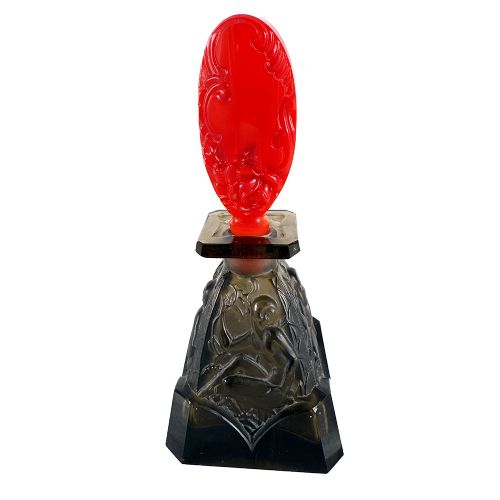


Art Deco Glass Perfume Flask
An art deco glass perfume flask holds the spirit of the interwar dressing table, combining geometric form with tactile moulded or frosted surfaces.
Art Deco Glass Perfume Flask
An art deco glass perfume flask brings together the clean lines and stylised motifs characteristic of the interwar period. These pieces function as both dressing table ornaments and functional vessels for holding scent.
The versions most commonly encountered on this page originate from the nineteen twenties and nineteen thirties, often taking the form of perfume bottles or scent bottles with decorative stoppers.
Geographical origins span French makers and Czech workshops, frequently pairing coloured or opalescent glass bodies with silver mounts and enamel details.
Materials and production methods
Makers utilised glass, moulded glass, frosted glass, cut glass, and opalescent glass to achieve varying levels of transparency and texture. These glass bodies were frequently shaped into geometric or stylised botanical forms typical of the era.
Metalwork and decoration formed a crucial part of the construction, incorporating sterling silver, enamel, and guilloche enamel mounts. Paper labels and coloured staining sometimes added further visual contrast to the finished vessel.
Several bottles retain traces of dried scent from nearly a century ago, holding onto the ghost of a forgotten perfume.
Factors of distinction
The calibre of an art deco glass perfume flask rests upon the crispness of the moulded relief and the depth of the glass finish, whether frosted, opalescent, or deeply cut. Superior examples display precise symmetry and harmonious proportions.
The integration of metalwork dictates quality at the upper end, where hallmarked silver and hand-applied guilloche enamel mountings fit the glass body precisely. Maker signatures on the base or stopper also elevate the standing of the piece.
Karl Palda·Henry Perkins·Rene Lalique·Barnsley and Co·Sabino
The Art Deco Glass Perfume Flask Glossary
- Moulded glass
- Glass shaped by being pressed into a metal or wooden mould while hot. This technique allowed makers to produce sharp reliefs and complex sculptural designs.
- Opalescent glass
- Glass containing ingredients that cause it to milky-blue scatter light, appearing pale blue in transmitted light and warm amber or orange against a dark background. It was favoured for its luminous quality.
- Guilloche enamel
- Enamel applied over a metal surface that has been mechanically engraved with a repetitive geometric pattern. This creates a translucent decorative layer with shimmering depth.
- Atomizer
- A perfume bottle fitted with a spray mechanism rather than a traditional stopper. These items often incorporated metal mesh bulbs or pump hardware.
Art Deco Glass Perfume Flask: Frequently Asked Questions
How do I clean an old perfume bottle?
Residue inside can often be gently dissolved using warm water and mild detergent without soaking any silver mounts. Care must be taken around paper labels or delicate enamel work.
Allow the vessel to dry naturally upside down on a soft cloth to protect the rim and stopper.
Were these bottles meant for display?
These flasks were designed to sit upon dressing tables and boudoir trays as decorative objects as well as functional containers. Their sculptural stoppers and coloured glass made them centrepieces of the vanity.
Many survived because owners treated them as ornamental art rather than daily toiletries.
How can I tell French pieces apart?
French examples often rely on sculptural opalescent or frosted glass forms by prominent studios, sometimes featuring moulded signatures. The emphasis rests heavily on the glass itself rather than metal mounts.
Czech productions frequently lean towards geometric cut glass combined with vibrant enamel and silver collars.
What is guilloche enamel?
Guilloche enamel involves laying translucent coloured enamel over machine-turned metal. The underlying engraved pattern shines through the glossy surface in repeating waves or sunbursts.
This technique was widely used on silver bottle caps and atomizers of the period.