
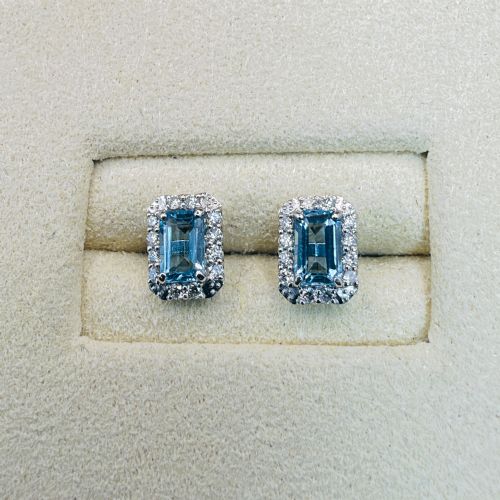

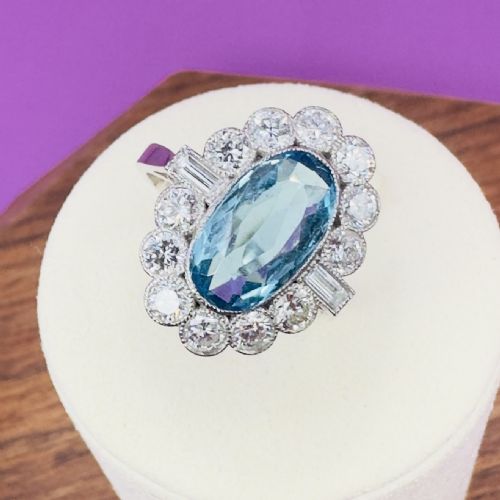


Art Deco Aquamarine
Art deco aquamarine pieces combine icy beryl stones with crisp platinum and gold settings, offering a striking geometric elegance that collectors prize.
Art Deco Aquamarine
Art deco aquamarine items comprise rings, pendants, brooches, and earrings that showcase pale blue beryl stones predominantly set in geometric arrangements. The pieces most commonly met on this page span the 1920s and 1930s, reflecting the signature design motifs of that era.
Makers frequently paired large emerald-cut or oval aquamarines with brilliant-cut and baguette diamonds, anchoring them in platinum or white gold. Alongside rings and cluster pendants, the selection includes substantial brooches and drop earrings originating from the early decades of the twentieth century.
Materials and Working Methods
Platinum serves as the primary metal for many mountings, allowing for delicate, strong settings that securely hold large centre stones alongside smaller accent diamonds. Artisans also utilised yellow gold, white gold, and rose gold, occasionally incorporating onyx or blue spinel for stark colour contrast.
Stones were typically emerald-cut, oval-cut, or baguette-cut to emphasise linear geometry and maximise light refraction through the pale blue material. Metalwork often featured fine millegrain edges and openwork galleries typical of early twentieth-century jewellery fabrication.
Some brooches carry over forty carats of aquamarine, proving that certain historical owners preferred wearing small glaciers on their lapels.
Judging Quality and Execution
Quality separates pieces by the saturation and clarity of the central aquamarine, with deeper blue tones and clean tables commanding greater attention. The precision of the surrounding diamond work and the crispness of the platinum or gold geometry further distinguish finer examples.
The harmony between the scale of the central beryl stone and the delicacy of the mounting determines the overall success of the design. Superior items maintain structural integrity while presenting expansive stone weights without heavy or clumsy claw work.
Leach and Miller
The Art Deco Aquamarine Glossary
- Aquamarine
- A pale blue variety of the mineral beryl, prized in jewellery for its transparent, sea-water hue. It shares a mineral family with emerald and morganite.
- Platinum
- A dense, ductile, and malleable silver-white precious metal used extensively in early twentieth-century jewellery for its strength in fine settings.
- Millegrain
- A decorative technique featuring a line of tiny raised metal beads along the edges of a setting, common in period pieces.
- Baguette
- A rectangular cut for gemstones, particularly diamonds, characterised by step cuts and straight parallel sides that suit linear mountings.
- Trilogy
- A ring style featuring three principal gemstones set in a row, often symbolising the past, present, and future.
Art Deco Aquamarine: Frequently Asked Questions
How do I style an art deco aquamarine ring?
These rings work well as standalone statement pieces on the hand due to their substantial stone sizes and geometric framing. Their pale blue colour allows them to pair easily with both silver and gold accessories.
When wearing them daily, consider pairing them with simple bands so the intricate platinum settings remain the visual focal point.
What periods do these pieces typically come from?
The majority of pieces date from the 1920s and 1930s, embodying the classic design principles of the art deco movement. You will also encounter items from the Edwardian era, the 1940s, and mid-century decades.
Stylistic shifts between these periods appear in the transition from delicate Edwardian filigree to bolder, more architectural art deco geometry.
How were aquamarine and diamond pendants worn historically?
Pendants from this era were suspended from delicate platinum or white gold chains, designed to rest near the collarbone or lower on the chest depending on the scale of the drop. They served as versatile dress ornaments for evening wear and formal occasions.
Many larger pendant designs functioned simultaneously as brooches, featuring hidden bails and pin mechanisms on the reverse.
Are these stones natural aquamarines?
The listings feature natural beryl aquamarines, often accompanied by accent diamonds in platinum or gold settings. Paste alternatives also exist in specific cocktail items from the period.
Examining the facets under magnification reveals the natural inclusions and growth lines characteristic of genuine mined beryl.