



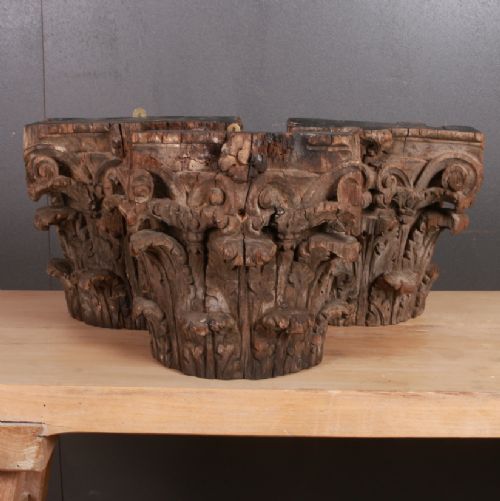
Architectural Salvage Capitals
Architectural salvage capitals are structural fragments and decorative elements brought inside from buildings, offering immediate historical weight and classical presence to a room.
Architectural Salvage Capitals
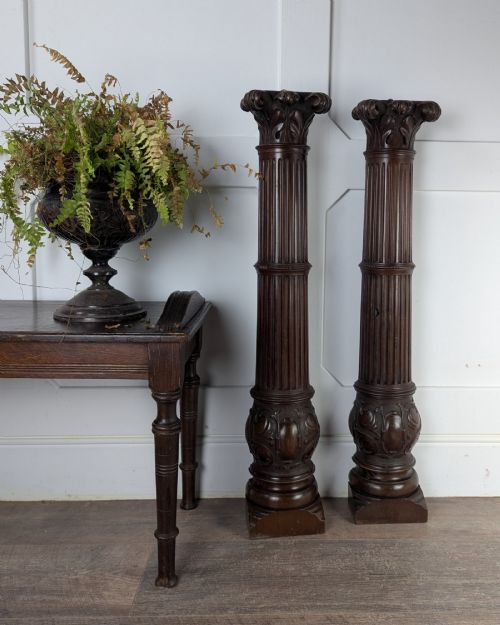
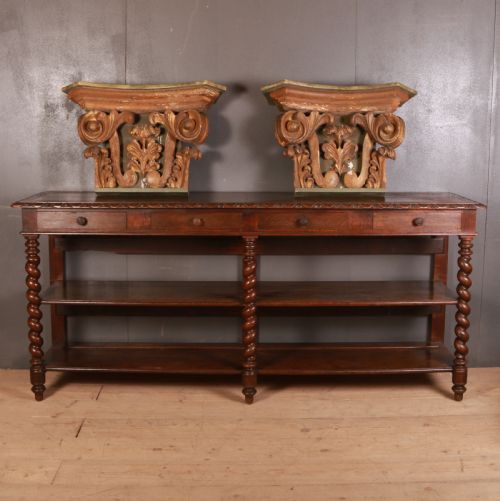
Architectural salvage capitals span the seventeenth, eighteenth, and nineteenth centuries, taking the form of stone or carved wood elements taken from larger buildings. These pieces appear as pairs of mahogany reeded Corinthian half columns, limestone Corinthian capitals, and large Italian capitals.
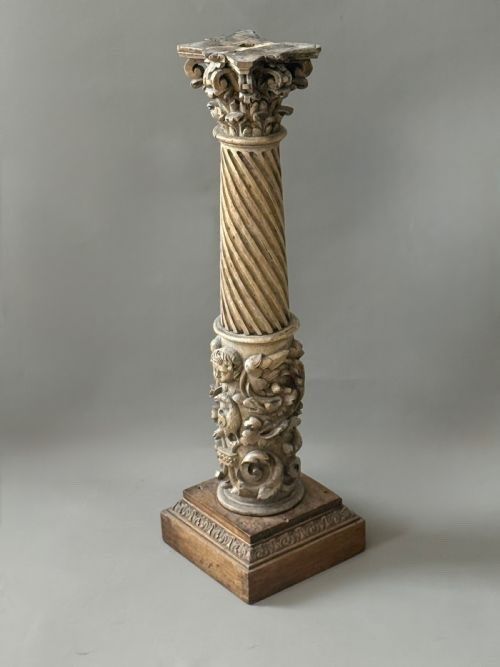
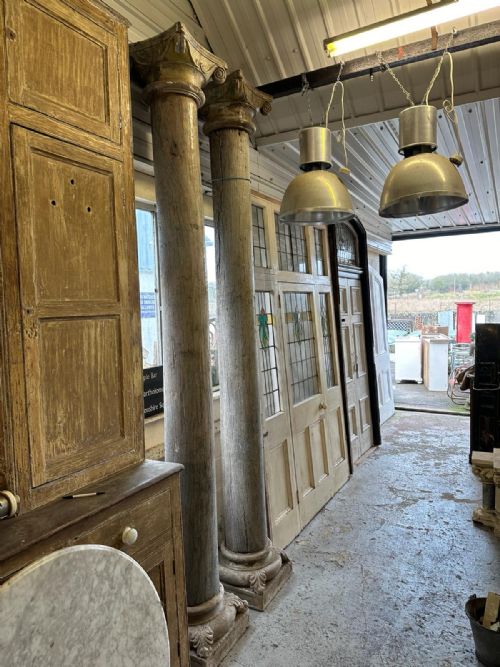
The selection includes sandstone fragments, carved chestnut herms, and massive Continental Baroque wooden pillars converted into lamp bases. Buyers also encounter large columns featuring carved hardwood Ionic capitals with carved stone bases, alongside large wall brackets.
Styles range across Gothic Revival, Continental Baroque, Georgian, and Neoclassical Revival, reflecting the architectural ambitions of their original settings. Most examples originate from the nineteenth century, though earlier eighteenth-century and seventeenth-century survivals surface regularly.
How they were made
Carvers shaped these components from dense hardwoods like mahogany and chestnut, alongside durable sandstones, limestone, and miscellaneous timber. Artisans applied gesso, paint, and gilt surfaces to enrich the carved wood and stone elements.
Masons and woodcarvers employed deep chisel work to render intricate acanthus leaves, fluting, and classical orders such as Corinthian and Ionic. Structural fragments retain the tool marks of their period, demonstrating hand-hewn execution across columns, brackets, and herms.
Several pieces escaped their original buildings only to find second careers as monumental table lamps or stony sentinels guarding modern hallways.
What varies in quality
Depth and crispness of the carving distinguish finer capitals from simpler or worn versions, particularly in the rendering of foliage and classical volutes. The choice of material elevates a piece, as dense carved mahogany or fine limestone commands greater visual authority than softer timbers or weathered sandstone.
Scale and completeness dictate the impact of these objects, with matched pairs and monumental proportions holding significantly more presence than isolated fragments. The survival of original painted, gilded, or gesso surfaces adds layers of historical character that lesser, stripped examples lack.
The Architectural Salvage Capitals Glossary
- Corinthian
- A classical order of architecture characterised by slender columns and ornate capitals decorated with acanthus leaves. This style remains prominent among the nineteenth-century stone and wood pieces.
- Herm
- A bust or figure carved on a square pillar, originating in ancient Greece as boundary markers. Examples in chestnut appear among the early nineteenth-century items.
- Gesso
- A plaster mix applied to wood surfaces as a base for painting or gilding. It provides a smooth ground for decorative finishes on carved wooden capitals.
- Reeded
- Decorated with parallel convex mouldings resembling bundled reeds. This technique appears on the shafts of mahogany half columns.
Architectural Salvage Capitals: Frequently Asked Questions
What are architectural salvage capitals used for today?
These pieces function primarily as decorative sculptural objects, mantel supports, or architectural focal points within modern interiors. Some larger wooden pillars and capitals are also adapted directly into substantial lamp bases.
They bring historical texture and classical proportion to both traditional and contemporary spaces. Collectors often display them on bespoke mounts or integrate them into architectural schemes.
How do you identify a Corinthian capital?
A Corinthian capital is readily identified by its distinctive bell-shaped core enveloped in carved rows of acanthus leaves. Small spiral scrolls, known as volutes, project outward at the four corners.
This ornate design stands apart from the simpler scrollwork of the Ionic order or the plain cushion shape of the Doric. Stone and wood versions on this page adhere to these classical proportions.
Are architectural salvage capitals always made of stone?
No, makers produced these pieces in a wide variety of materials including carved mahogany, chestnut, hardwood, and miscellaneous timbers. Sandstone and limestone are equally common among the heavier architectural fragments.
Surfaces are frequently enhanced with applications of gesso, paint, or gilt. The choice of material generally depended on whether the capital was meant for an interior wooden structure or an exterior stone facade.
How can you tell the age of a carved wood capital?
Age is determined by the tool marks left by the carver, the choice of timber species typical of specific periods, and the natural patina of the wood. Eighteenth-century and seventeenth-century pieces display different carving rhythms and wear patterns compared to Victorian revivals.
Original surface treatments like early paint or gesso layers also offer strong chronological clues. Structural joinery and weathering help separate nineteenth-century interpretations from earlier work.