





Architectural Interior Painting
Architectural interior painting captures spaces built for grandeur, offering a direct view into stately rooms and historic halls.
Architectural Interior Painting
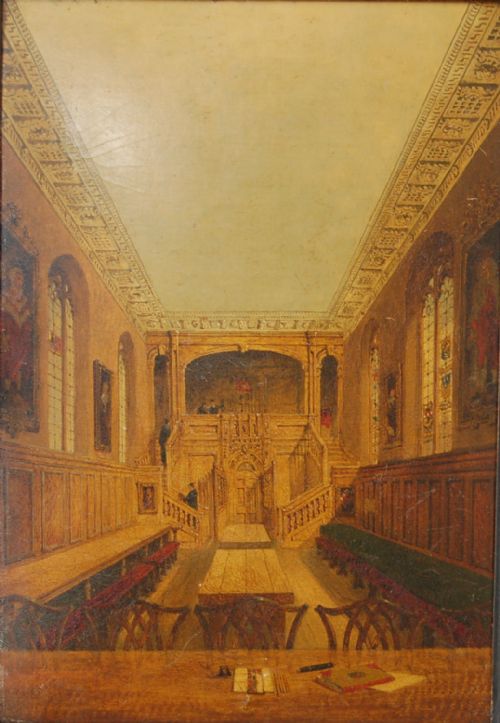
When you search for architectural interior painting, you look at works depicting rooms, galleries, and structural details from the nineteenth and twentieth centuries. These pieces record historic spaces like Hatfield House, Kelston Park, and Magdalene College, preserving the interior architecture and decoration of past eras.
You are most likely to meet watercolours on paper and oil paintings on board or canvas across this selection. Subjects range from grand formal halls and chimneypieces to modernist factory scenes and cathedral interiors.
Works span from the Victorian period through to the 1950s, capturing shifts in style from classical reception rooms to industrial constructivism. Each piece provides a window into how historic domestic and public spaces were arranged and decorated.
Materials and technique
Artists employed oil paint on canvas or board, alongside delicate watercolour on paper, to capture light and shadow within large rooms. The choice of medium dictates the texture of the work, with oils offering rich depth for panelled walls and watercolours providing crisp precision for stonework.
Substrates vary from traditional stretched canvas and wooden boards to heavy paper. Watercolour works often rely on precise pencil underdrawings to map out complex perspective lines in cathedral and hall interiors.
Materials recorded across these listings include paper, watercolour, glass, wood, paint, canvas, oil, and oil paint.
Assessing quality
Quality rests on the precision of perspective and the artist's ability to render complex interior geometry, such as decorative wall panels and chimneypieces. Superior works demonstrate a confident handling of light falling across architectural surfaces.
The sophistication of the composition distinguishes finer examples, where the scale of figures relates harmoniously to the surrounding room. Signed works by recorded artists command greater attention through their documented provenance and technical skill.
Frank Moss Bennett·Margaret Thompson·Elinor Margaret Charteris·Joseph Murray Ince·W H Sweet
The Architectural Interior Painting Glossary
- Watercolour
- A paint consisting of pigment suspended in a water-based solution, typically applied to paper to create transparent washes. It is frequently seen in detailed architectural studies of cathedrals.
- Oil on board
- A painting technique where oil paint is applied to a rigid wooden or composition board rather than canvas. This surface provides a firm support often utilised for modernist interior scenes.
- Neoclassical
- A style reviving classical Roman and Greek motifs, visible in interior architectural elements such as columns and decorative wall panels. It prioritises symmetry and proportion.
- Constructivism
- An artistic and architectural approach originating in Russia that emphasises industrial materials and geometric forms. In painting, this translates to structured factory scenes and factory interiors.
- Provenance
- The documented history of a piece, establishing its origin and past ownership. A clear record adds context to works depicting specific historic houses.
Architectural Interior Painting: Frequently Asked Questions
What periods do these paintings cover?
The works span from the nineteenth century through the 1950s, capturing Victorian, Edwardian, and modernist eras.
This timeline shows a progression from traditional academic watercolours of cathedrals to twentieth-century oil paintings of industrial and modernist spaces.
How were these interior spaces chosen?
Artists selected significant domestic and ecclesiastical spaces, including stately homes, Oxford colleges, and great halls.
These subjects allowed painters to showcase elaborate decorative wall panels, chimneypieces, and complex interior architecture.
Are these works signed by the artist?
Many pieces feature signatures or attribution to specific English and French schools of painting from the period.
Signed works often connect to documented painters who exhibited their architectural studies during the nineteenth and twentieth centuries.
What materials support these artworks?
Painters utilised paper for detailed watercolours and canvas or wooden board for heavier oil compositions.
These varied supports suit different environments, from delicate cathedral studies on paper to robust industrial factory scenes on board.