
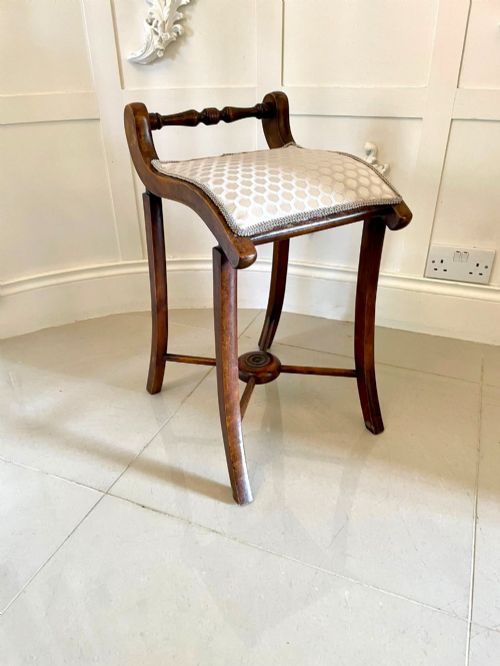
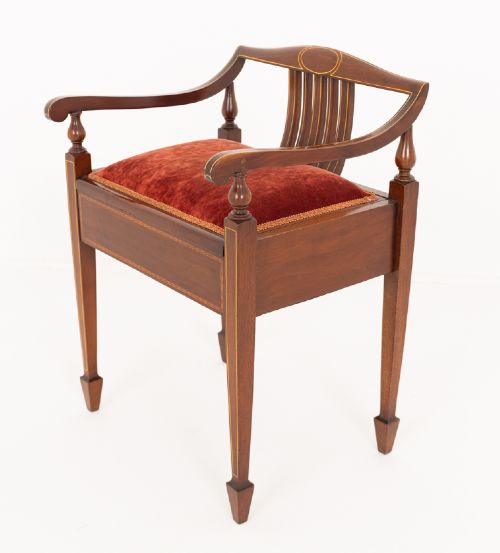


Antique Wooden Piano Chair
An antique wooden piano chair gives the player a steady seat at the keyboard while offering a proper twist of period character.
Antique Wooden Piano Chair
When searching for an antique wooden piano chair, you are looking at sturdy seating built for the keyboard, spanning the 19th century through the Edwardian era. These pieces appear in forms such as music chairs, piano stools, and revolving swivel seats.
The most common versions met here belong to the Victorian period and the late 19th century. They arrive in mahogany or walnut, often featuring adjustable height mechanisms or revolving tops for player comfort.
Makers ranged from notable firms like Gillows during the Regency period to makers of Sheraton Revival and Queen Anne Revival pieces. You will also encounter specialised styles such as Victorian Grotto Revival and Edwardian rise and fall designs.
Materials and construction
The framework relies on hardwoods like mahogany, walnut, and rosewood, shaped with turned supports or carved details. Satinwood inlay frequently enhances Sheraton Revival pieces, adding contrast to the dark timber.
Upholstery forms a key part of the construction, utilising velvet and various upholstery fabrics over padding. Brass components often appear within the mechanical height adjustment screws and swivel joints.
Joinery and mechanical elements work together to create rise and fall movement or stable revolving seats. Carved hardwood provides the structural backbone for ornate pedestal bases and tripod legs.
The listings span the 19th century, Victorian era, Regency period, and Edwardian years, utilising mahogany, walnut, rosewood, and satinwood inlay.
Distinguishing quality
Quality rests in the precision of the timber carving and the smoothness of the mechanical adjustment. A superior revolving or rise and fall mechanism turns evenly without wobble, showing careful metalwork.
The choice of primary wood and the crispness of details like satinwood inlay separate standard workshop output from finer cabinet work. Original upholstery fabric or appropriate period replacement velvet maintains the integrity of the piece.
Gillows
The Antique Wooden Piano Chair Glossary
- Rise and fall
- A mechanical seating adjustment that alters the height of the chair. It utilises a central screw thread operated by turning the seat top.
- Revolving
- A seat design that rotates fully on a central pivot. This allows the player to turn easily toward sheet music cabinets.
- Sheraton Revival
- A late 19th-century design movement inspired by late 18th-century neoclassical furniture. It often incorporates delicate proportions and satinwood inlay.
- Grotto Revival
- A Victorian decorative style featuring rustic, shell, or marine-inspired carved motifs. It produces highly sculptural wooden frames.
- Pedestal stool
- A seat supported by a single central column rather than traditional legs. This pillar frequently stands upon three curved feet.
Antique Wooden Piano Chair: Frequently Asked Questions
How do I adjust the height?
Many of these seats feature a rise and fall mechanism operated by turning the wooden top clockwise or anticlockwise. This screw action raises or lowers the seating platform on a central threaded metal rod.
Other examples use a simple swivel or fixed height design depending on the specific period and intended use at the keyboard.
Were they only used for pianos?
While designed primarily as music chairs and piano stools to assist performers at keyboards, their adjustable height made them versatile. They often served dual purposes at dressing tables or desks.
Their compact footprint and revolving movement suited tight spaces where seated tasks required turning in different directions.
How do I date a piano chair?
Dating relies on observing the combination of timber, upholstery materials, and revival styles present in the piece. Regency examples display clean classical lines, while Victorian pieces often feature heavier carved walnut or pedestal bases.
Edwardian and Sheraton Revival pieces tend to show lighter proportions, sometimes incorporating refined inlay work characteristic of the turn of the 20th century.
Are the swivel mechanisms robust?
The internal iron and brass screws and pivots were built to withstand regular turning and height adjustment during daily practice sessions. Surviving examples generally retain functional metalwork if they have received sensible care.
Checking the action involves gentle rotation to ensure the wooden top moves smoothly along the threaded column without binding.