
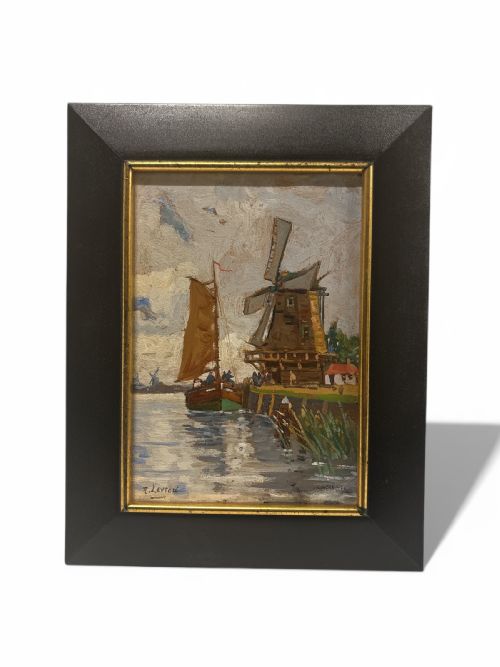
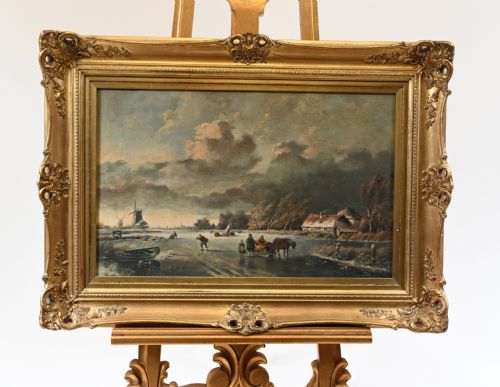
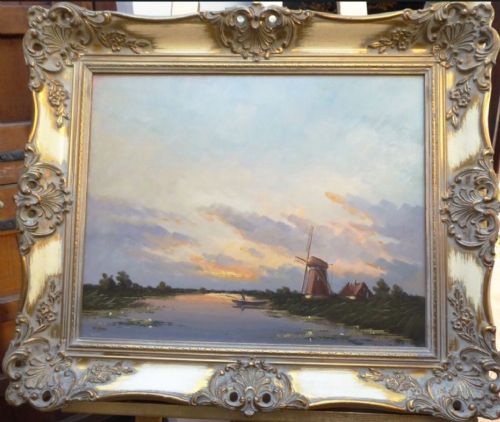


Antique Windmill Landscape
Antique windmill landscape paintings capture the turning sails and flat horizons of the nineteenth and early twentieth centuries, offering a romantic view of rural industry.
Antique Windmill Landscape
An antique windmill landscape presents a rural or coastal scene featuring a working mill, recorded across British, Dutch, and French regional traditions. These works span from the early nineteenth century through the Edwardian era and into the mid-twentieth century.
The most frequent examples on this page are watercolours on paper and oil paintings on canvas or wood panel. They range from small topographical studies to larger framed exhibition pieces depicting Dutch polders and English river valleys.
How They Were Made
Artists applied oil paint or watercolour using traditional brushes onto prepared supports such as canvas, heavy paper, wood panels, or board. Many pieces utilise gold leaf within decorative frames to complement the painted surface.
Wood panels offered a rigid ground favoured by the Dutch School and regional British painters for fine detail, while absorbent paper grounds suited the rapid, fluid washes of nineteenth-century watercolourists.
Listings feature works from the 1860s through the 1960s, executed in oil paint, watercolour, and mixed media on canvas, paper, and wood panel.
What Varies in Quality
Quality rests upon the sureness of the hand and the sensitivity to light and atmosphere across the flatlands or waterways. The most accomplished works capture the movement of the sails and the heavy weather of the coast with economy and directness.
Compositional balance and the handling of the pigment distinguish standard topographical records from the more evocative interpretations produced by established regional schools and named painters.
Thomas Bush Hardy·James Orrock·Ernest Uden·Charles Harmony Harrison·Jan van Couver·John D Walker·William Tatton Winter·Frederick William Jackson·Edward Seago·Pieter Cornelis Dommersen·John Holland Snr·Kershaw Schofield·Henry Samuel Merritt·J Syer·William Woodhouse·Edward Williams·John Falconar Slater·William Manners·John MacPherson·George Sheffield·John Hamilton Glass·Joseph Thors
The Antique Windmill Landscape Glossary
- Watercolour painting
- A method where gum-bound pigments are suspended in water and applied to paper. This medium allows for transparent washes that capture shifting skies.
- Wood panel
- A rigid wooden support used by artists before canvas became universal. It provides a stable surface for detailed oil painting.
- Dutch School
- A collective term for artists working in the Netherlands who focused on local topography, waterways, and atmospheric light. Their works often feature low horizons and expansive skies.
- Polder
- A low-lying tract of land enclosed by dikes that forms an artificial hydrological cycle. These flat agricultural areas frequently appear in continental windmill compositions.
- Gilt frame
- A wooden decorative border coated in gold leaf or metallic paint. These frames enhance the depth and period context of oil paintings.
Antique Windmill Landscape: Frequently Asked Questions
How do I identify a Dutch windmill scene?
Look for low horizons, flat polder landscapes, and distinctive canal or river waterways accompanying the mill structure. These elements often reflect the regional styles of nineteenth-century Dutch painters.
Signatures, framing details, and inscriptions on the reverse can also point towards specific European towns or coastal regions depicted by the artist.
Are watercolours on paper fragile?
Watercolours are sensitive to direct sunlight and high humidity because the paper and pigments can fade or discolour over time. Proper conservation framing with UV-protective glass safeguards the piece.
Keeping them away from bright windows ensures the delicate washes and paper supports remain stable for years to come.
What is the Norwich School?
The Norwich School was a regional group of artists inspired by the Norfolk landscape, including its rivers, broads, and working windmills. They worked primarily in oil and watercolour during the nineteenth century.
Their paintings emphasise naturalism, atmospheric skies, and the everyday rural life of East Anglia.
How should I display an oil painting on panel?
Oil paintings on wood panels benefit from stable indoor environments with moderate humidity to prevent the wood from warping. Hanging them away from direct heat sources protects both the panel and the paint layer.
A secure period-appropriate wooden frame provides structural support while complementing the aesthetic of the artwork.