





Antique Weather Indicator
An antique weather indicator tracks the shifts in our skies, bringing mechanical precision or rustic character into a room.
Antique Weather Indicator
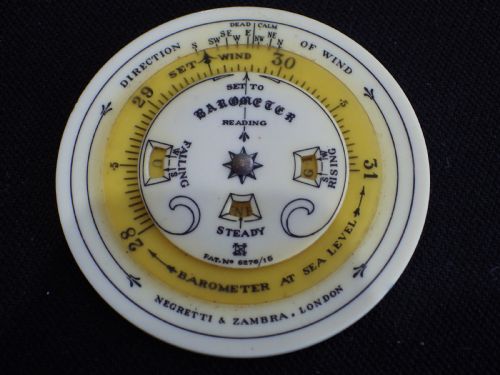
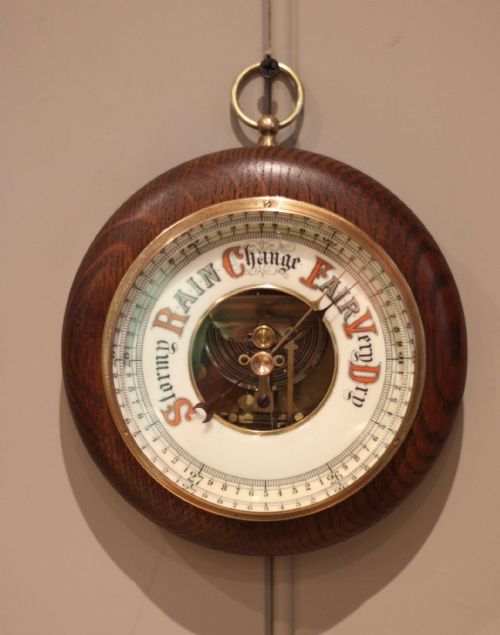
The selections on this page are dominated by nineteenth-century instruments and early twentieth-century examples, reflecting both domestic scientific curiosity and traditional country craftsmanship. Mahogany stick barometers and oak aneroid models sit alongside copper and iron weather vanes shaped as animals or silhouettes.
Indoor pieces range from substantial banjo barometers housed in carved timber cases to compact pocket forecasters and recording rain gauges. Exterior roof furniture tends towards folk art interpretations, utilising durable metals that weather naturally in the elements.
Assessing quality and craftsmanship
Quality in an antique weather indicator lies in the precision of its movement and the crispness of its exterior detailing. Finer barometers house signed mechanisms by notable makers, set within well-proportioned timber cases featuring careful carving or clean veneer work.
Exterior weather vanes derive their appeal from the integrity of the metalwork and the attractiveness of the aged surface patina. Pieces showing direct hand-shaping and purposeful folk art form stand apart from mass-produced utilitarian hardware.
Early twentieth-century rooftops gained personality from copper cockerels and iron horses swinging in the breeze.
Short & Mason·Negretti & Zambra·Maple & Co·Callaghan & Co·M Pillischer·A Rivolta·J Groce·George Dollond
The Antique Weather Indicator Glossary
- Aneroid barometer
- An instrument that measures atmospheric pressure without liquids, using a flexible metal box that expands or contracts.
- Barograph
- A mechanical barometer that records barometric pressure continuously over a week upon a revolving drum of paper.
- Stick barometer
- A tall, narrow wall instrument containing a vertical tube of mercury to show shifts in air pressure.
- Weather vane
- A moveable exterior pointer mounted on a rooftop to indicate the direction of the wind.
- Banjo barometer
- A wall barometer shaped like a traditional musical instrument, housing a circular dial at the base and humidity gauges above.
Antique Weather Indicator: Frequently Asked Questions
How do I read an old barometer?
You read the dial by observing the position of the needle relative to engraved weather predictions like rain, change, or fair. Tapping the glass gently helps settle the mechanism to show the true pressure.
Many instruments feature a secondary manual pointer that you align with the current needle. By checking later whether the main needle has moved above or below your marker, you can track rising or falling pressure.
Where should I place a weather vane?
Weather vanes need to be mounted in an elevated, unobstructed spot where moving air can catch the metal silhouette freely. Traditionally, these sit atop roofs, cupolas, or garden posts.
Ensure the directional arms are aligned accurately to the cardinal points using a compass during installation. This allows the pointer to give a true reading of the wind direction.
Are mercury barometers safe to keep indoors?
Enclosed mercury barometers are stable domestic objects provided the glass tube remains sealed and undamaged. The liquid metal is safely contained within the wooden or brass housing during normal use.
Caution is only required if the instrument undergoes relocation or restoration, where rough handling might crack the glass. Keep them securely mounted on a solid wall away from household traffic.
How do I date a timber barometer?
Dating relies on observing the case style, dial design, and framing methods used by cabinetmakers of different eras. Georgian instruments often feature exposed mercury tubes and simple mahogany trunks, while Victorian examples lean towards heavy carved oak and aneroid dials.
Signatures or maker inscriptions engraved on the brass faceplate provide a reliable guide to the period of production. Comparing the construction details to known records helps narrow down the decade.