


Antique Waist Buckle
These antique waist buckle designs span periods from Victorian heart shapes to Edwardian Art Nouveau enamels.
Antique Waist Buckle
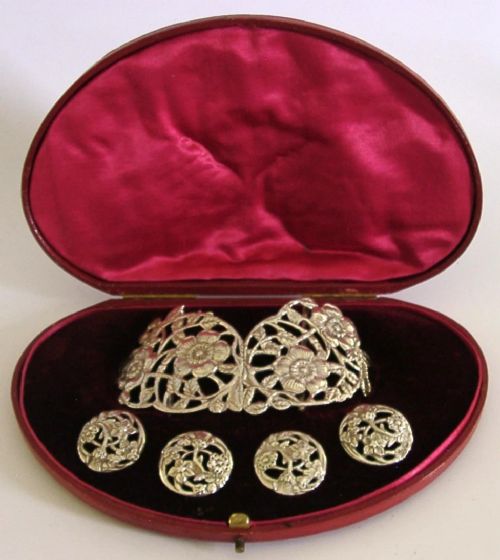
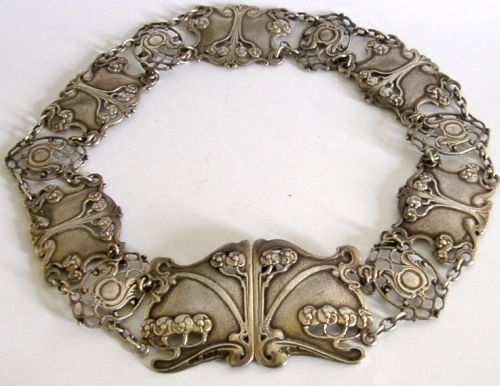
An antique waist buckle serves as a decorative fastening for belts, often appearing alongside matching buttons or integrated into complete silver belt assemblies.
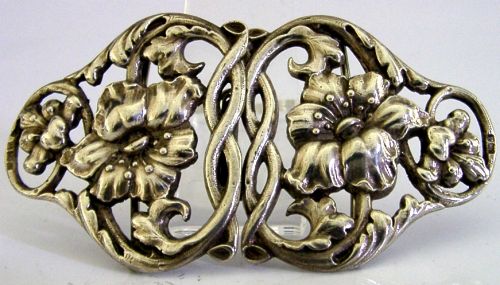
The selections available here range from Victorian heart-shaped designs and Edwardian Art Nouveau pieces to Straits Chinese Peranakan gilt silver items and Ottoman folk styles.
Buyers will encounter various forms, including nurse buckles and military clasps, reflecting the diverse costume requirements of the nineteenth and twentieth centuries.
Materials and construction
Makers utilised sterling silver and solid silver as the primary foundations for these accessories, often enhancing them through casting and detailed metalwork.
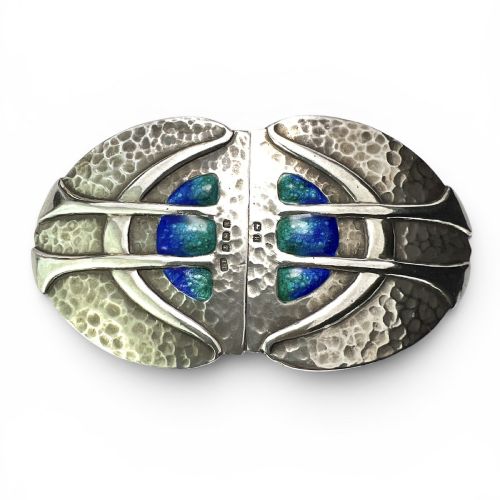
Vitreous enamel and coloured enamel additions provide vibrant decoration, particularly on pieces exhibiting fluid Art Nouveau plant motifs and insect designs.
Alternative constructions involve gilded metal combined with textile elements such as velvet and leatherette, alongside traditional Telkari wirework techniques.
An enamelled scarab beetle forms the striking centrepiece of one French Art Nouveau belt fastening.
Distinctions in quality
Quality differences emerge through the crispness of cast details and the precision applied during the hand-enamelling processes of specific workshops.
The inclusion of hallmarks and maker marks provides definitive proof of origin, separating standard commercial production from documented maker output.
James Fenton·Henry Matthews·Piel Freres
The Antique Waist Buckle Glossary
- Sterling silver
- An alloy comprising ninety-two point five percent silver by mass, frequently utilised in British belt fastenings. Hallmarks often verify its standard.
- Vitreous enamel
- A material made by fusing powdered glass to a metallic substrate through firing. This technique creates a glossy, durable coloured surface on metalwork.
- Art Nouveau
- An international style of art and architecture prominent around nineteen hundred, characterised by organic lines and plant-inspired motifs. It heavily influences Edwardian buckle designs.
- Telkari
- A traditional wirework technique involving fine silver or gold threads soldered together. Examples originate from regional Anatolian and Black Sea craft traditions.
- Peranakan
- Pertaining to the descendants of Chinese immigrants to the Straits Settlements, known for distinct decorative arts. Straits Chinese gilt silver belt components illustrate this tradition.
Antique Waist Buckle: Frequently Asked Questions
How do I date a silver buckle?
Dating relies primarily on official hallmarks stamped into the metal, which record the assay office, standard, and specific year letter.
Stylistic cues such as symmetrical Victorian shapes versus flowing Edwardian lines also help assign pieces to broad periods.
What is a nurse buckle?
A nurse buckle is a specialised two-piece fastening historically worn by medical staff on duty uniform belts during the mid-twentieth century.
These items are typically cast in solid silver and often feature openwork designs related to nursing institutions.
Can these buckles be worn today?
Many examples can be adapted for modern wear by mounting them onto compatible fabric belts or specialised textile straps.
Careful handling is advised to preserve delicate enamel work and antique silver patination during use.
How do I clean antique silver?
Standard silver dips and abrasive cloths should be avoided as they remove desirable age-related patination and can damage soft enamel.
Gentle dusting with a microfibre cloth usually suffices to maintain the metal safely.