

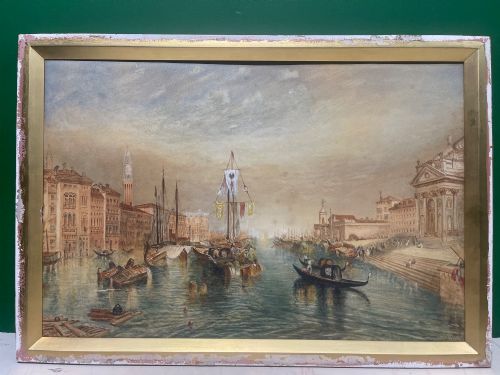
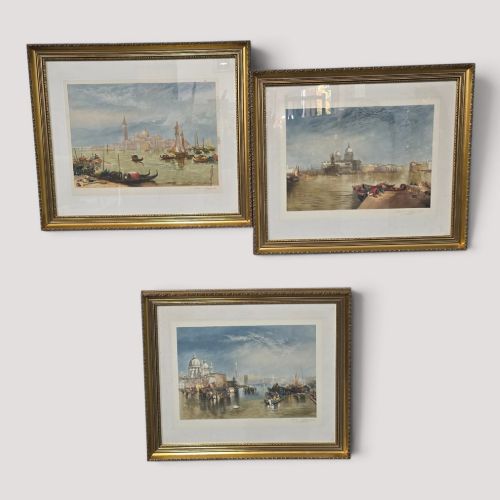


Antique Venetian Watercolour
These antique venetian watercolour works capture the light and architecture of the lagoon through delicate pigment applied directly to paper.
Antique Venetian Watercolour
An antique venetian watercolour brings the historic canals, grand palazzos and bustling waterways of Italy into a domestic interior. These paintings portray famous sights such as the Grand Canal, the Guidecca Canal, and the Bridge of Sighs through the specific eyes of nineteenth and early twentieth-century artists.
The pieces on this page span the Victorian and Edwardian eras, stretching into the nineteen-thirties and nineteen-forties. Buyers regularly encounter depictions of iconic landmarks like Santa Maria della Salute alongside quieter scenes of gondoliers navigating the smaller channels.
Works originate from both British artists travelling to Italy and Italian painters recording their native city. This dual perspective means compositions vary from atmospheric impressionistic washes to precise architectural renderings.
Materials and technique
Watercolour pigment is suspended in water-soluble binders and brushed onto sheets of paper to create these delicate lagoon views. Artists utilise the natural white ground of the paper to render the bright Venetian sunlight gleaming off the water and stone facades.
Framing typically incorporates wood and glass to protect the vulnerable paper surface from moisture and atmospheric dust. These traditional mountings preserve the fugitive pigments from fading over the decades.
Antique Venetian Watercolour Retail Price Guide 2026
Typical asking prices for venetian watercolour among the pieces listed under this phrase on Sellingantiques today, from the lower quarter to the upper quarter. They describe what is for sale here now, not the wider market.
Even the pigeons of St Mark's Square occasionally sneaked onto nineteenth-century paper when artists left their paintboxes unattended.
Assessing the pieces
The strength of a composition lies in how effectively the artist manages the translucency of the pigment. Superior examples demonstrate a confident handling of water and light, capturing the shifting reflections of the lagoon without overworking the paper.
Provenance and attribution strongly influence desirability. Signed works by noted painters carry greater weight than unsigned or follower pieces, while the accuracy of the architectural perspective and the vibrancy of the remaining colour define the overall merit.
Thomas Ellison·Richard Henry Wright·Clara Montalba·Frank Wasley·Hercules Brabazon Brabazon·William Knox
The Antique Venetian Watercolour Glossary
- Watercolour pigment
- Finely ground colour matter mixed with a binder for application with water onto paper. This medium allows for luminous washes that simulate the hazy atmosphere of the lagoon.
- Grand Canal
- The main thoroughfare of Venice, frequently featured in nineteenth-century paintings. Artists often painted its sweeping curves and famous bridges from the water level or adjacent steps.
- Gondolier
- A traditional Venetian rowing boat operator often depicted navigating the narrow canals. Their inclusion adds human scale and narrative detail to cityscapes.
- Impressionism
- An art style focused on accurate depiction of light in its changing qualities. British and Italian artists applied this approach to capture the transient reflections of Venetian water.
Antique Venetian Watercolour: Frequently Asked Questions
How should I hang my watercolour?
Keep works away from direct sunlight to prevent the delicate pigments from fading over time. Consistent indoor temperatures help protect both the paper and the original wooden frame.
Use UV-filtering glass if possible when re-framing to provide an extra layer of conservation care for the painting.
Are these paintings signed?
Many pieces carry the signature or monogram of the artist, often placed neatly in a lower corner. Some works remain unattributed or are recorded in the manner of established painters.
Signatures help establish the provenance and connect the view directly to a specific hand from the Victorian or Edwardian period.
What periods do these paintings cover?
The selection spans from the nineteenth century through the Edwardian era and into the nineteen-forties. Victorian and early twentieth-century interpretations dominate the available selection.
Different decades bring subtle shifts in technique, moving from detailed architectural studies towards more atmospheric impressionistic washes.
How do I identify a Victorian view?
Victorian watercolours often combine precise topographical draftsmanship with a romanticized atmosphere. The palette frequently reflects the mid to late nineteenth-century interest in Italian travel.
Look at the framing and paper characteristics alongside the clothing of any figures depicted to help confirm the era.