
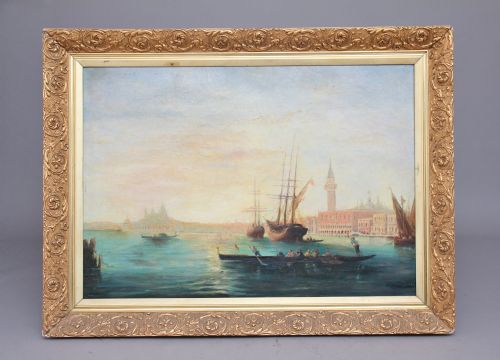

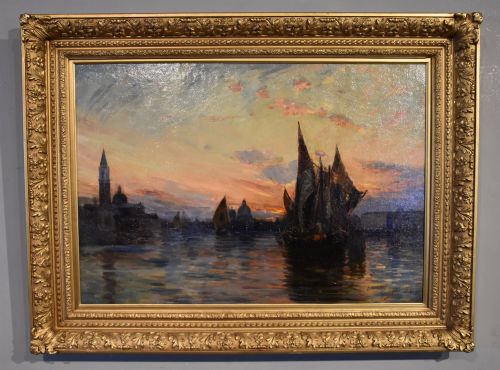


Antique Venetian Canvas Painting
An antique venetian canvas painting brings the light and architecture of the lagoon directly into a room.
Antique Venetian Canvas Painting
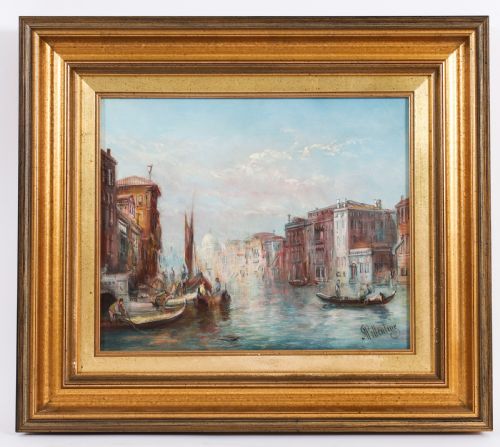
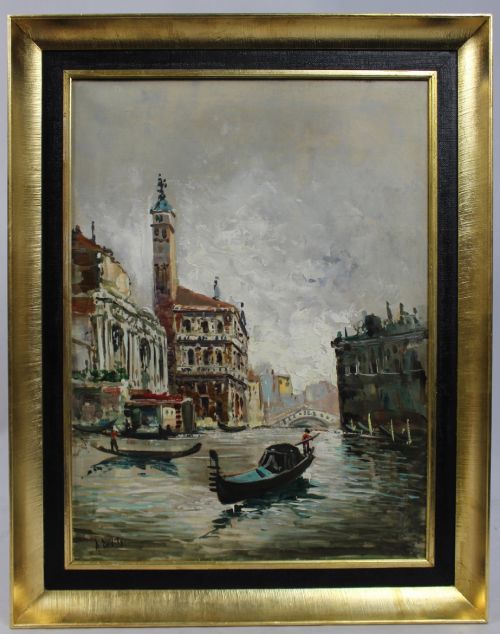
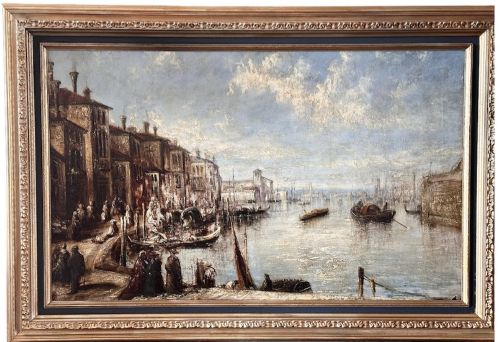
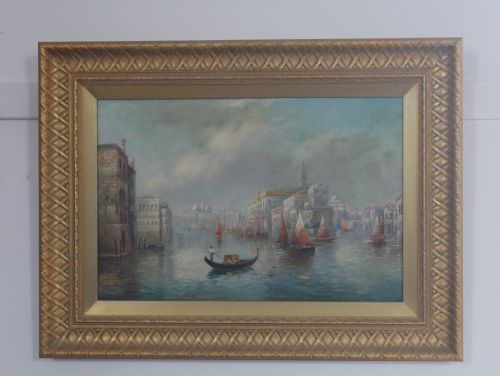
When someone searches for an antique venetian canvas painting, they encounter works capturing the canals, palaces, and lagoon scenes of Venice. These pieces range across centuries, documenting famous landmarks like the Grand Canal, the Doge's Palace, and Santa Maria della Salute. The selection on this page relies heavily on nineteenth-century townscapes and romantic depictions of Italian life.
The most frequent items met here are nineteenth-century oils executed by British and continental artists who travelled to Italy for inspiration. Painters such as Alfred Pollentine and Jane Vivian dominate the surviving record with their detailed townscapes of the Venetian waterfront. Alongside these topographic views appear portraits, still lifes, and classical subject matter linked to the Venetian school.
Works stretch from eighteenth-century religious and theatrical compositions down to mid-twentieth-century interpretations of the lagoon. Buyers encounter both signed cabinet paintings and larger canvases intended for prominent display. The persistent focus remains the interplay of water, stone, and southern light.
Materials and construction
The foundation of these works is woven canvas stretched across a wooden support, prepared with a gesso or primer layer before the application of pigment. Artists utilised oil paint, valued for its slow drying time and capacity to build luminous glazes over light grounds. This combination allowed painters to render the shimmering surface of the water and the weathered texture of brick and stone.
Frames play a vital role in the physical structure, frequently constructed from wood and finished in gilt wood or gilded wood. Gilt frames range from simple moulding to ornate Victorian designs that complement the scale of the painting. The canvas sits within this protective wooden housing, secured by original or later tacks and wedges.
Artworks include townscapes, portraits, and still lifes created within Victorian, impressionist, and classical traditions.
Factors of quality
Quality in these works rests upon the precision of the draughtsmanship and the artist's handling of atmospheric light. A superior canvas achieves depth in the water and structural clarity in architectural facades without relying on rigid, mechanical lines. The best nineteenth-century townscapes capture the specific humidity and colour of the lagoon rather than offering a mere postcard record.
The condition of the paint layer and the integrity of the canvas support dictate the standing of an individual piece. Works that retain their original unlined canvas and stable, uncracked pigment hold greater integrity than those burdened by heavy historical restoration. Additionally, the presence of a well-matched period gilt frame enhances the overall aesthetic standard.
Alfred Pollentine·Francis Moltino·Thomas Hodgson Liddell·Claude Jousset·Calzolari·F.D. Campo·August Heinrich Riedell·Antoine Bouvard Senior·E. Perez Senet·Jane Vivian·Andrea Celesti·William Raymond Dommersen·Richard Geiger·Charles Clement Calderon·James Salt·Frans Pourbus II·Luigi Pastega
The Antique Venetian Canvas Painting Glossary
- Canvas
- A heavy woven fabric, usually linen or cotton, used as a support for oil paintings. It provides a flexible and textured surface that responds to the tension of the stretcher frame.
- Giltwood
- Wood carved and covered with a thin layer of gold leaf or metal powder. This finish appears frequently on the decorative frames housing nineteenth-century paintings.
- Townscape
- A painting depicting an urban landscape, focusing on streets, canals, architecture, and public squares. In Venetian art, this genre records specific palazzos and waterways.
- Lagoon
- The shallow body of water enclosed by a barrier island system in which Venice sits. Artists frequently paint its specific flat horizons and reflective surfaces.
- Ground
- The initial layer of opaque paint applied to a canvas before the artist begins the composition. It seals the fabric and establishes a baseline tone for the subsequent oil layers.
Antique Venetian Canvas Painting: Frequently Asked Questions
How do I identify a nineteenth-century Venetian painting?
Nineteenth-century Venetian works usually show famous sites like the Grand Canal or the Doge's Palace rendered with atmospheric brushwork. Look at the treatment of the water and light, which often reflects the romantic style popular among European travellers of that era.
Signatures, artist biographies, and framing styles help confirm the period. Many pieces from this time bear signatures of prolific painters who specialised in Italian townscapes.
Where should I hang a large oil painting?
Large oil paintings require a wall with stable humidity and protection from direct sunlight to prevent the canvas and pigments from degrading. A prominent spot in a reception room or hallway allows the scale of the architecture and water views to register properly.
Ensure the wall structure can support the weight of the canvas and its heavy giltwood frame safely. Hanging the centre of the painting at eye level provides the most natural viewing angle.
What is the difference between a townscape and a landscape?
A townscape focuses primarily on architectural elements, buildings, streets, and canals rather than purely natural scenery. In the context of Venice, townscapes record specific palazzos, bridges, and quays along the water.
Landscapes, by contrast, prioritise open country, trees, and skies. Venetian views combine the urban townscape with the natural expanse of the lagoon.
How do I care for an oil painting on canvas?
Keep the canvas away from extreme temperature fluctuations and damp environments to avoid warping the wooden stretcher and cracking the paint. Dust the surface gently with a soft, dry brush without applying pressure to the pigment.
Avoid using water or cleaning solutions on the paint surface. Consult a professional conservator if the canvas shows signs of sagging or the varnish discolours.