


Antique Scroll End Settee
An antique scroll end settee brings classical grace to a room, offering generous seating framed by sweeping wooden arms.
Antique Scroll End Settee
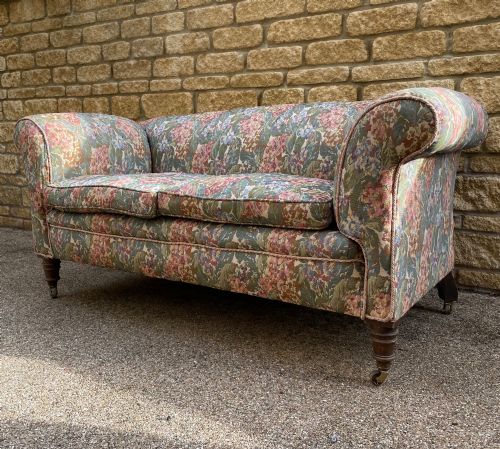
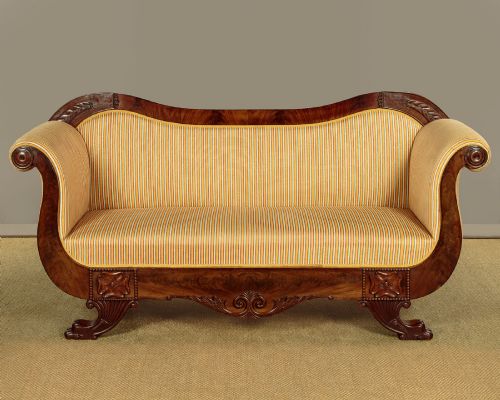
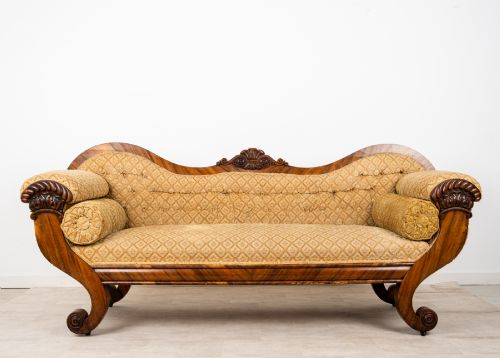
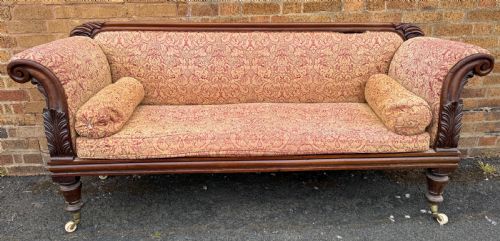
An antique scroll end settee is a substantial seating form defined by its distinctive outcurved wooden or upholstered arms, built to anchor principal reception rooms and libraries. When you search for this phrase, you encounter grand nineteenth-century designs that trace their lineage through the Regency, William IV, and Victorian periods.
The pieces on this page span several closely related seating types, including double-ended sofas, lyre-shaped couches, and chaise longues. Mahogany and simulated rosewood frame these large forms, often accompanied by brass inlays and elaborate carved wooden details that echo ancient classical motifs.
While the Regency period provides the earliest examples with their crisp architectural lines, later Victorian iterations soften these profiles while retaining the signature scrolled architecture. Whether you select a compact two-seater or a large four-seater model, these settees function as the definitive focal point of a traditional interior scheme.
Materials and construction
Makers built the structural frames of these settees using solid mahogany and simulated rosewood, sometimes applying ebony finishes to achieve a dark, formal surface. These dense timbers supported the heavy outward curve of the scroll arms and the deep joinery required for long bench seats.
Upholstery formed an integral part of the construction, utilising materials such as damask, fabric, and hessian over traditional webbing and stuffing. Brass details, including fine inlays and castors, completed the composition by adding metallic contrast to the polished wooden frames.
Some nineteenth-century makers designed drop-arm mechanisms so tired aristocrats could nap without ruining their posture.
Judging quality and craftsmanship
The refinement of the carved wooden scroll ends largely determines the distinction between standard production and exceptional craftsmanship. Superior examples display crisp, deeply carved foliate or scroll motifs executed directly into the solid mahogany or rosewood frame rather than relying on applied moulded decoration.
Proportion and symmetry separate the finest pieces from simpler regional interpretations, particularly in double-ended sofas where both arms must balance precisely. The integration of high-status decorative elements, such as intricate brass inlay work or sophisticated lyre-shaped end supports, elevates the status of the piece within its period.
The Antique Scroll End Settee Glossary
- Scroll end
- An arm that curves outward and downward in a spiral volute resembling a scroll of parchment. This architectural form defines the silhouette of the entire piece.
- Double-ended sofa
- A seating form featuring identical scroll ends at both extremities, allowing a person to recline comfortably from either direction. These pieces often lack a traditional distinct back and front.
- Simulated rosewood
- A painted or stained wood finish designed to imitate the rich grain and deep colour of genuine rosewood. Craftsmen often applied this technique to native timbers during the Regency period.
- Lyre-shaped
- A structural support or arm profile formed in the symmetrical outline of an ancient Greek lyre instrument. This classical motif appears frequently on Regency furniture.
- Chaise longue
- An upholstered sofa in the form of a chair with a long seat large enough to support the legs. Some examples combine this reclining form with the distinctive scroll end architecture.
Antique Scroll End Settee: Frequently Asked Questions
How do I place a scroll end settee in a modern room?
These large settees demand generous floor space and sit best away from walls where their sculptural mahogany or rosewood frames remain fully visible. Positioning them in a high-ceilinged drawing room or a wide hallway allows the sweeping scroll arms to establish the visual balance of the space.
Because many examples feature double-ended designs or low backs, they work effectively as floating room dividers. Pairing them with understated contemporary furnishings lets the classical nineteenth-century woodwork stand out without cluttering the interior.
What is the difference between a Regency and a Victorian settee?
Regency settees, generally dating from the early nineteenth century, rely on crisp classical proportions, clean architectural lines, and decorative elements like brass inlay and simulated rosewood. Their forms often directly imitate ancient Greek and Roman prototypes with restrained, elegant carving.
Victorian settees tend to be heavier in scale, introducing softer upholstery profiles and more robust, deeply carved mahogany frames. While both utilise the signature scroll end, Victorian pieces frequently reflect a revivalist approach that reinterprets earlier classical standards with increased padding and comfort.
How should I care for the wood and upholstery?
Protect the polished mahogany and simulated rosewood surfaces by keeping them away from direct sunlight and strong heat sources that can dry out the timber. Dust the carved scroll ends regularly with a soft cloth and apply a quality beeswax sparingly to nourish the antique polish.
Upholstery fabrics, whether damask or simpler weaves, require gentle vacuuming using a low-suction attachment to remove trapped particles. Professional textile cleaning is recommended for antique fabric to preserve the underlying Hessian and traditional stuffing materials.
Can these settees be used for everyday seating?
These pieces were originally built for formal entertaining and relaxation in nineteenth-century homes, and many retain sufficient structural integrity for modern daily use. However, the internal webbing and traditional stuffing in unrestored examples may require reinforcement to support regular weight over time.
For heavy daily lounging, buyers often inspect the frame stability and consider professional reupholstery using supportive modern materials hidden beneath traditional exterior fabrics. Lighter use in a quiet reading room preserves the historical integrity of delicate antique frames and original upholstery.