


Antique Satire Artwork
Antique satire artwork brings social commentary, caricature and biting wit onto the wall through period prints, engravings and watercolours.
Antique Satire Artwork
Antique satire artwork captures political commentary, social critique and caricature across the eighteenth, nineteenth and early twentieth centuries. These pieces take the form of framed prints, engravings, pen and ink sketches and watercolour paintings.
The material on this page leans heavily toward eighteenth-century copperplate engravings and nineteenth-century caricatures. Buyers will find works representing Georgian life, political scenes and military subjects.
Pieces range from single hand-coloured prints to sets of social satires and framed double prints. Origin periods span from Georgian and Regency eras through to the Victorian period and early twentieth century.
Materials and techniques
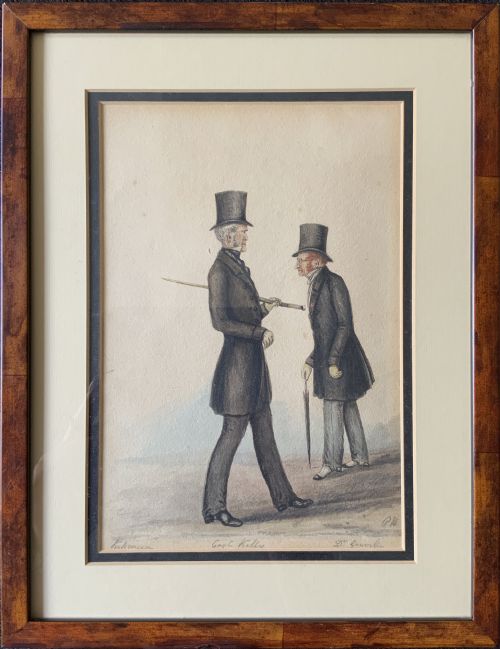
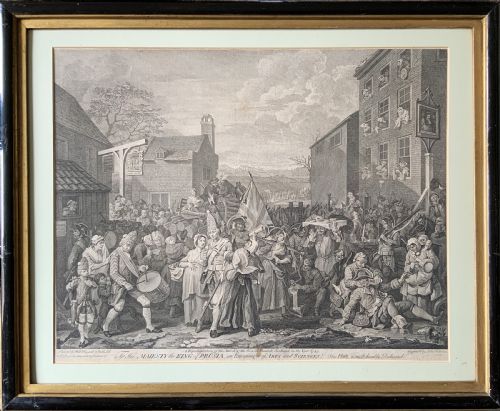
Makers produced these works on paper using ink, pen and watercolour, often enhanced with hand colouring. Printmakers employed copperplate engraving to achieve fine, durable lines suitable for detailed caricatures.
Framing materials such as maple secured the artwork for display. Original sketches utilised pen and watercolour directly on paper, while engravings relied on skilled printmakers translating initial designs.
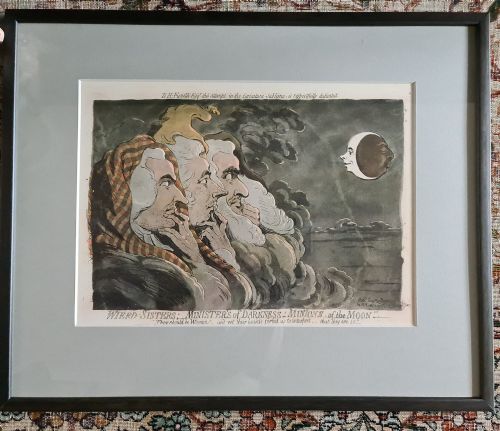
First World War German generals share space here with Georgian periwigs and satirical ministers of the moon.
Markers of quality
Quality rests in the sharpness of the original copperplate impression and the precision of the ink work. Finer examples retain crisp lines and vibrant hand colouring without fading.
The reputation of the artist or engraver dictates the standing of the piece. Contemporary framing in materials like maple also contributes to the overall presentation and survival of the work.
William Hogarth·Luke Sullivan·Gilray·Riepenhausen·Thomas Rowlandson·Thomas Worth
The Antique Satire Artwork Glossary
- Copperplate engraving
- A printmaking technique where an artist incises an image into a copper plate to hold ink. This method allows for fine detail in satirical prints.
- Caricature
- A rendered portrait or scene exaggerating peculiarities or defects. It forms the core of many satirical works on this page.
- Hand colouring
- The application of watercolour pigment by hand onto a printed monochrome sheet. This enhances specific details within satirical artwork.
- Framed print
- An artwork mounted behind glass within a border structure. Maple frames often accompany these period pieces.
Antique Satire Artwork: Frequently Asked Questions
How do I date an antique engraving?
Dating relies on the paper type, plate markings and historical context of the subject matter. Period engravings often carry publication dates or stylistic clues from the Georgian and Victorian eras.
Examining the framing materials, such as period maple wood, also helps narrow down the timeframe when the artwork was prepared for display.
What is the difference between a sketch and an engraving?
An original sketch is a unique hand-drawn work executed directly in pen, ink or watercolour by the artist. These pieces exist as singular items.
An engraving is a printed reproduction created from an incised metal plate. While the image is multiplied, individual prints often feature unique hand colouring.
How should I display satirical art at home?
These framed prints and watercolours suit studies, libraries and living spaces where the historical commentary can be appreciated up close. Ensure they hang away from direct sunlight to protect the paper and ink.
Pairing pieces within matching frames creates a cohesive wall display, especially for sets depicting social or military themes.
Are these works original period pieces?
The listings comprise original nineteenth-century watercolours, eighteenth-century engravings and period prints. Each item dates from its respective historical era, such as the Georgian or Victorian periods.
Checking the medium, including ink, watercolour and copperplate prints, confirms the period production methods used by the makers.