
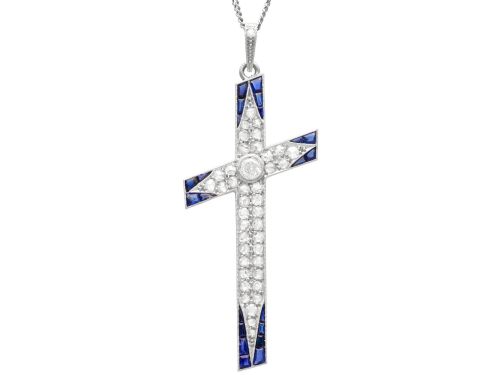
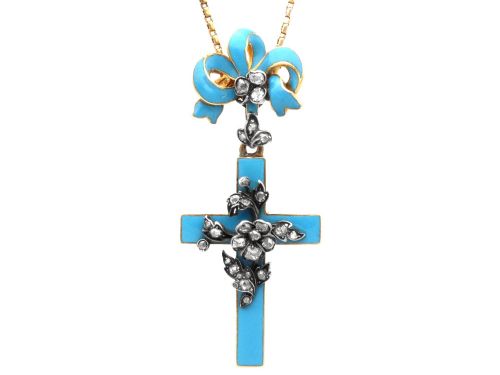
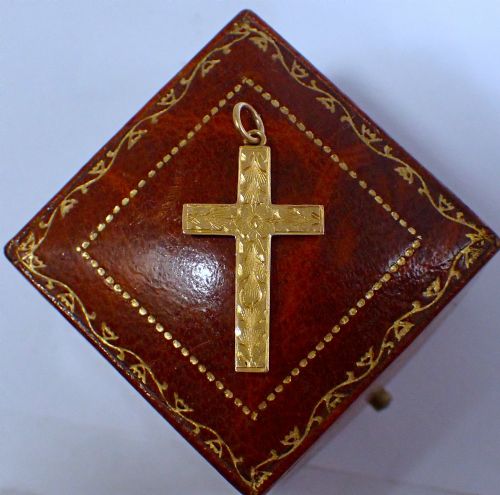
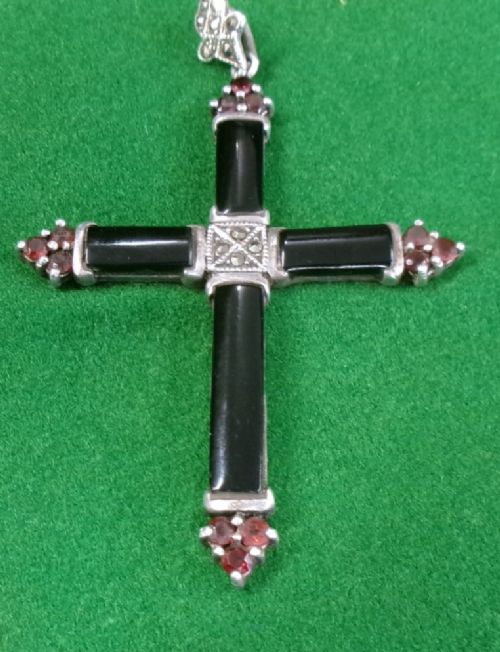
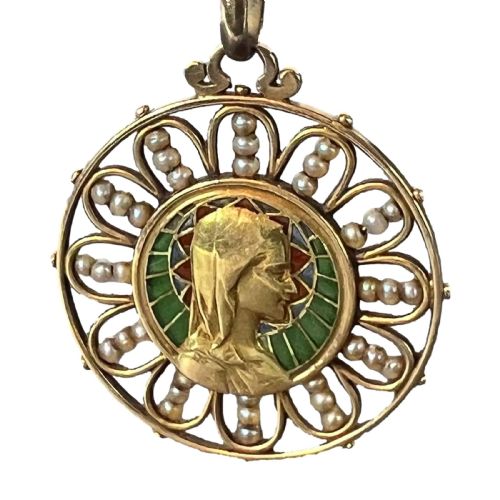


Antique Religious Necklace
These antique religious necklace pieces carry centuries of devotion in gold, silver, enamel and gemstones.
Antique Religious Necklace
An antique religious necklace takes the form of a pendant, medal, or cross suspended from a chain, serving as a personal devotional object. You will frequently encounter French religious medals depicting the Virgin Mary, Jesus Christ, or saints alongside traditional gold and silver crosses.
The pieces span several distinct eras, stretching from the Georgian period through the Victorian and Edwardian decades into the Art Deco years of the early twentieth century. Makers fashioned these wearable items in 15ct gold, 18ct yellow and rose gold, silver, and platinum to display sacred imagery.
French examples dominate the selection, often featuring specific iconography such as Notre Dame of Lourdes, the Sacred Heart, or Saint Christopher. These items combine personal faith with the refined metalwork and enamelling techniques characteristic of their respective periods.
Materials and Craftsmanship
Goldsmiths utilised 18ct yellow and rose gold alongside 9ct and 15ct gold to cast and engrave cross pendants and devotional medals. Silver also appears in Continental designs, providing a contrasting metal for detailed crucifixes and crosses.
Enamelling techniques, notably plique-a-jour, add translucent colour to the robes of the Virgin Mary and the floral motifs surrounding sacred figures. Artisans further embellished these works using seed pearls, turquoise, coral, sapphires, and diamonds set directly into the gold or silver frames.
Listings feature 18K yellow gold, rose gold, silver, plique-a-jour enamel, seed pearls, diamonds, and sapphires across Georgian, Victorian, and Edwardian periods.
Distinctions in Quality
The presence of translucent plique-a-jour enamel or carefully matched seed pearls and diamonds elevates a piece above simpler cast medals. Maker marks stamped onto the gold or silver surface also indicate workshop origin and add historical weight to the jewellery.
Paul Brandt·Pageli Perriat·Sellier·Dropsy·Mazzoni·Tairac·Monet·Henry Cook
The Antique Religious Necklace Glossary
- Plique-a-jour
- An enamelling technique where the enamel is fired without a backing, allowing light to shine through the transparent or translucent cells like stained glass.
- Seed pearl
- A very small, natural or cultured pearl used in clusters or borders to accent religious pendants and crosses.
- Medal
- A small metal disk bearing a religious image or inscription, often worn as a pendant for protection or devotion.
- Religious travel medal
- A portable devotional token, such as a Saint Christopher medal, designed to offer protection during journeys.
Antique Religious Necklace: Frequently Asked Questions
What periods do these necklaces come from?
The pieces span the Georgian, Victorian, and Edwardian eras, extending into the Art Deco period of the 1920s and 1930s. Each era brings distinct metal alloys and artistic styles to the devotional pendants.
French workshops created many of the listed medals during the early twentieth century, while English and Continental makers contributed earlier Victorian and Georgian crosses.
What materials were used to make them?
Goldsmiths worked primarily in 18ct yellow and rose gold, alongside 9ct and 15ct gold variations. Silver also appears in Continental religious crosses.
Decorations frequently include plique-a-jour enamel, seed pearls, turquoise, coral, sapphires, mother-of-pearl, and diamonds set into the precious metal.
How do I identify French religious medals?
French medals typically feature specific iconography such as the Virgin Mary, Notre Dame of Lourdes, or the Sacred Heart of Jesus. They often incorporate maker marks and delicate plique-a-jour enamel work.
The suspension loops and rings on these pieces frequently bear French poinçon hallmarks indicating the gold or silver purity.