




Antique Ratchet Reading Table
An antique ratchet reading table provides a clever mechanical surface for a book or portfolio, offering adjustable heights and angles for study.
Antique Ratchet Reading Table
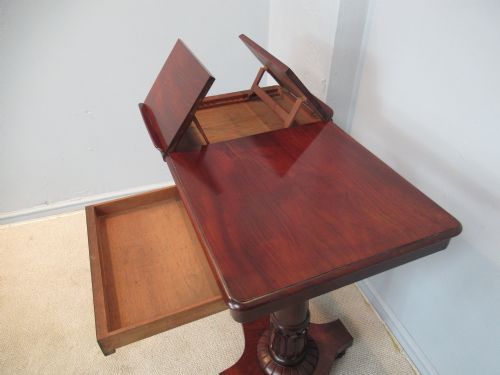
An antique ratchet reading table combines a steady timber surface with a mechanical rising mechanism designed to support books, folios, or writing materials at a comfortable angle. These pieces serve scholars, draughtsmen, and readers by lifting the page to the eye rather than forcing the user to bend down.
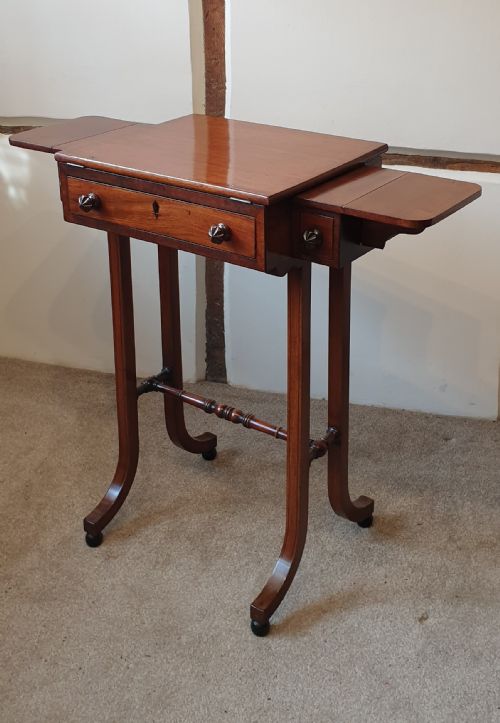
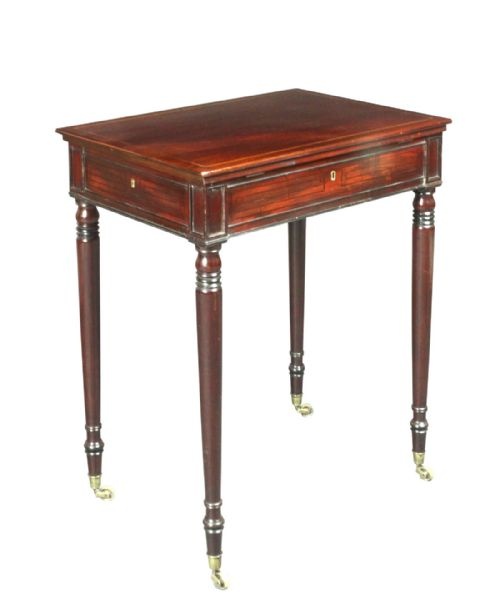
The versions appearing here span the Georgian, Regency, and Victorian periods, with mahogany standing out as the primary timber. Examples range from simple occasional tables with adjustable reading stands to elaborate architect's desks, cartographer's risers, and military or campaign pieces.
Makers adapted the form for various specialist tasks, resulting in music stands, drafting tables, and double-sided reading desks. Mahogany forms the backbone of these listings, often paired with brass fittings and leather inserts.
How they were made
Cabinetmakers constructed these tables primarily in solid and veneered mahogany, frequently incorporating secondary timbers like boxwood, ebony, and rosewood for decorative contrast. The mechanical ratchet mechanism relies on sturdy brass components, which allow the reading surface to lift and lock securely at multiple angles.
Many examples integrate tooled leather writing surfaces set into the timber tops, requiring precise joinery to house both the leather and the moving ratchet framework. Structural cleverness defines the construction, particularly in metamorphic and patent designs such as Carter's patent reading tables.
Victorian readers enjoyed adjustable comfort so much they patented bed-mounted versions for reading comfortably while remaining horizontal.
What varies in quality
Quality rests upon the sophistication of the mechanism and the integrity of the timber framing. Finer examples display smooth mechanical action in the ratchet supports, robust brass fittings, and thoughtful secondary details like ebony stringing or double-sided drawers.
The distinction between standard reading tables and high-tier architect's or metamorphic desks lies in the complexity of the internal engineering. Tables attributed to prominent workshops demonstrate superior cabinetmaking and refined proportions compared to simpler provincial workshop output.
Carter’s Patent·Gillow·Marsh & Tatham
The Antique Ratchet Reading Table Glossary
- Ratchet
- A mechanical device consisting of a notched bar and catch that allows a reading surface to be raised and held at various angles. This movement forms the central functional feature of the furniture group.
- Metamorphic
- Furniture designed to transform from one form or use into another, such as a table converting into a desk or reading stand. Such pieces rely on concealed hinges and folding leaves.
- Architect's desk
- A specialised form featuring an adjustable sloping top designed for drawing plans, reading large folios, or drafting. These often include pull-out candle slides and pigeonholes.
- Stringing
- A narrow inlay of contrasting wood, such as boxwood or ebony, set into the surface of the mahogany to create linear borders. This technique highlights the geometric form of the table top.
Antique Ratchet Reading Table: Frequently Asked Questions
How do I adjust the reading surface?
The timber reading slope lifts by hand, engaging an internal metal ratchet mechanism that catches at various set intervals. To lower the surface again, you lift the flap fully to release the catch before guiding it back down to the flat position.
This concealed brass or iron hardware requires smooth operation without excessive force. Regular gentle use keeps the teeth of the ratchet engaging properly within the wooden frame.
What is the difference between a reading table and an architect desk?
A reading table focuses primarily on an adjustable book rest or sloping top meant for holding volumes at a readable angle. An architect desk incorporates deeper drawers, pigeonholes, and sometimes double-sided workspace designed for technical drawing and map work.
Both forms utilise the same adjustable ratchet technology, but architect desks usually offer a larger overall surface area and dedicated stationery storage.
Can I use these tables for normal writing?
Many examples feature flat sections alongside the adjustable ratchet slope, or leather-lined surfaces suitable for daily correspondence. The moving section can be locked flat when a conventional writing surface is required.
Care should be taken not to lean heavy body weight directly onto the raised ratchet mechanism, as the support braces are engineered to hold books and papers rather than heavy loads.
How do I care for the mahogany and leather?
Mahogany surfaces benefit from occasional application of quality wax polish to nourish the timber and maintain a soft sheen. Leather inserts require minimal moisture and should be kept away from direct sunlight to prevent drying and cracking.
Brass ratchet components can be cleaned gently with a dry cloth to avoid disturbing the surrounding timber or patinated metalwork.