




Antique Paper Press
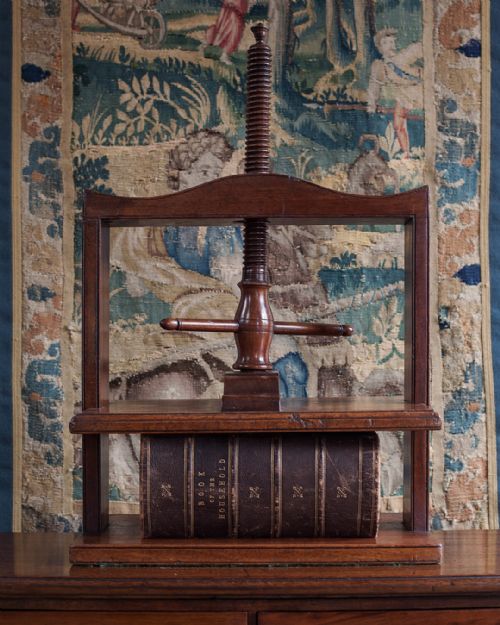
An antique paper press brings heavy mechanical utility to your desk, offering the satisfying density of Victorian and Georgian engineering.
Antique Paper Press
When you search for an antique paper press, you encounter sturdy mechanical presses primarily designed for binding books, flattening sheets, or drying flowers. These items served functional roles in offices, binderies, and studies during the Georgian and Victorian eras.
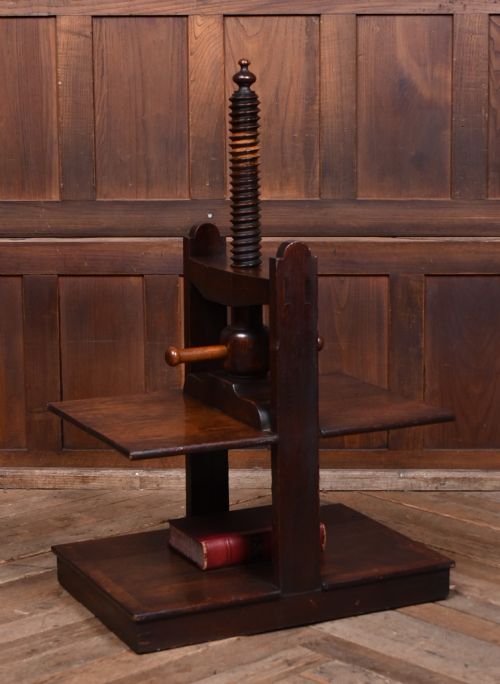
The versions you are most likely to meet on this page take the form of table-top book presses or combined desk accessories. They combine heavy timber frameworks with substantial metal screws and platens.
The selection ranges from early Georgian examples in rich mahogany to robust Victorian designs in oak and heavy cast iron. Occasional variations include French provincial flower presses and related desk furniture.
How they were made
These presses rely on dense hardwoods like oak, mahogany, and elm for their structural frames and stable table bases. Cabinetmakers joined these timbers with sturdy joints to withstand the immense downward pressure exerted by the mechanism.
The working mechanism typically employs cast iron, bronze, and brass for the threaded screws, nuts, and pressing plates. This metalwork delivers the necessary mechanical advantage to apply even pressure across the bed.
Antique Paper Press Retail Price Guide 2026
Typical asking prices for paper press among the pieces listed under this phrase on Sellingantiques today, from the lower quarter to the upper quarter. They describe what is for sale here now, not the wider market.
One press doubles as a Victorian botanical apparatus, ready to clamp down on yesterday's wildflowers with industrial severity.
What varies in quality
Quality in these presses rests upon the integrity of the timber frame and the smooth operation of the screw mechanism. Superior examples feature well-seasoned hardwoods with deep, rich grain patination and tight joinery that resists warping under sustained tension.
The refinement of the metal components further distinguishes the range. Well-cast brass or bronze fittings and smoothly threaded iron screws operate with precision, separating utilitarian workshop tools from finer library furnishings.
The Antique Paper Press Glossary
- Platen
- The flat heavy plate or board that presses down onto the paper or book. It distributes the screw's force evenly across the surface.
- Book press
- A mechanical device utilising a threaded screw to apply downward pressure on books or paper. These were essential equipment for binders and stationers.
- Georgian
- A period spanning the reigns of the first four Georges, noted for proportion and solid timber construction. Pieces from this era often utilise figured mahogany.
- Victorian
- The period of Queen Victoria's reign, characterised by industrial expansion and diverse stylistic revivals. Oak and heavy cast iron frequently feature in items from this time.
Antique Paper Press: Frequently Asked Questions
What is an antique paper press used for?
These presses were originally used by bookbinders, stationers, and scholars to press newly bound books, flatten folded documents, or dry botanical specimens.
Today, collectors use them as striking desk accessories, for craft projects, or to display dried flora within domestic interiors.
How do you date an antique book press?
Dating relies on examining the timber species, construction methods, and hardware materials used in the frame. Georgian pieces often display mahogany or elm with hand-cut joinery.
Victorian iterations frequently incorporate cast iron components alongside oak and feature heavier industrial styling from the mid-nineteenth century onward.
Are these presses heavy to move?
Yes, they are exceptionally heavy objects constructed from dense hardwoods and solid cast iron or bronze mechanisms. Their weight was necessary to prevent the frame from flexing under pressure.
When placing one on a desk or table, ensure the surface can support significant downward force and dead weight.
Can I still use an antique press today?
Most surviving presses remain fully operational if the threaded screw and wooden frame are sound and well-maintained. Turning the handle still lowers the platen with considerable mechanical force.
Users should check that the metal threads move smoothly and apply pressure gradually to protect the antique timbers.