
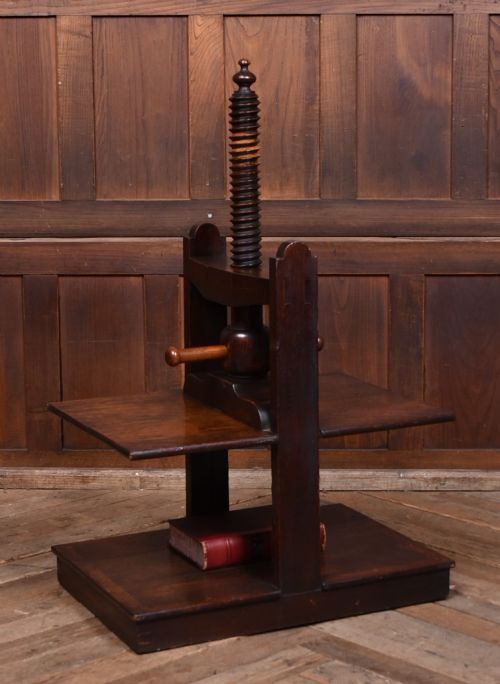


Wooden Bookbinding Press
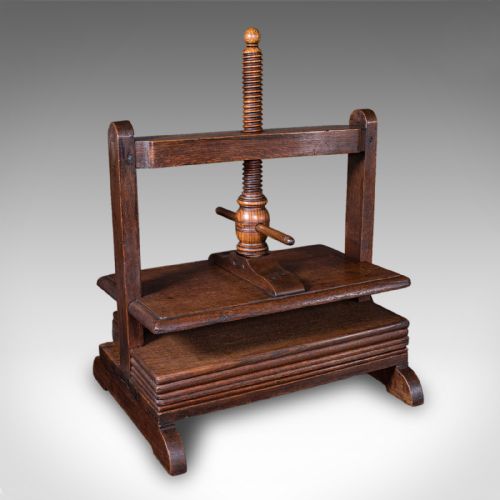
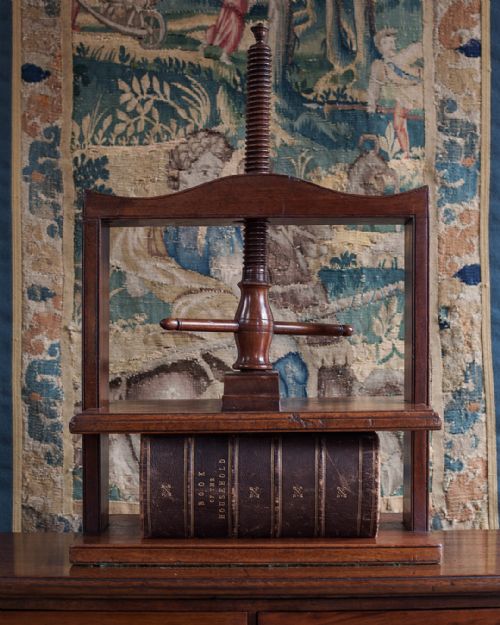
These heavy wooden bookbinding press examples are robust workshop implements designed to flatten pages and hold volumes firm.
Wooden Bookbinding Press
A wooden bookbinding press is a sturdy mechanism designed to apply steady pressure to folded signatures and bound volumes during construction and repair. When you search for a wooden bookbinding press, you encounter practical table-top devices intended for heavy binding and pressing tasks.
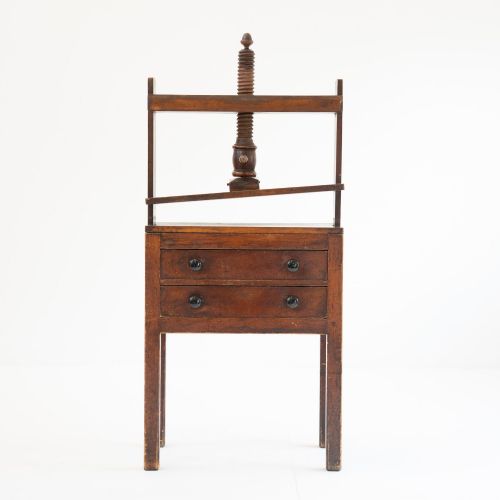
The pieces appearing here span the Georgian, Regency, and Victorian eras, alongside mid nineteenth-century examples and provincial French models. These items frequently take the form of table-top book presses, with some crossover into flower presses and linen presses sharing identical screw mechanisms.
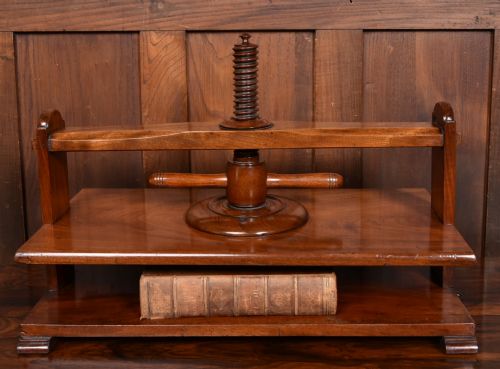
Most examples rely on a central threaded wooden spindle turned by a handle to drive a heavy platen downwards onto the base. Buyers seeking these items typically find robust utility combined with handsome joinery suited to both working craft spaces and period interiors.
How they were made
Cabinet makers built these presses using dense hardwoods such as mahogany, oak, and elm to withstand the immense mechanical pressure required during binding. Secondary woods like pine occasionally appear in internal or structural components, while iron and brass provide reinforcement for screws and handles.
The construction relies on solid timber frames joined securely at the base and top beam to house the wooden screw mechanism. Surfaces were typically finished with simple oils or polishes that allowed the natural grain of the oak and mahogany to endure decades of workshop use.
Some presses worked hard all day in dusty binderies before retiring to polite parlour tables.
What varies in quality
Quality in these presses rests upon the integrity of the timber and the precision of the wooden screw thread. Fine examples feature tightly grained mahogany or quarter-sawn oak with smooth-turning threads that distribute pressure evenly across the entire platen surface.
Country house and provincial workshops produced simpler utility versions using elm and pine with coarser joinery, which possess a different kind of rustic charm. The presence of maker stamps or specialised brass fittings elevates an ordinary utility press into a piece of finer craftsmanship.
Johnston’s of London
The Wooden Bookbinding Press Glossary
- Platen
- The heavy flat block of wood that descends under pressure to flatten the pages or book block.
- Spindle
- The vertical threaded wooden rod turned to drive the platen up and down within the frame.
- Georgian
- A stylistic period spanning the eighteenth and early nineteenth centuries, characterised by classic proportions and substantial timber construction.
- Victorian
- A nineteenth-century era known for robust manufacturing and diverse domestic and workshop furnishings.
- Country House
- A term denoting sturdy, functional items made for large rural estates rather than urban workshops.
Wooden Bookbinding Press: Frequently Asked Questions
What is a wooden bookbinding press used for?
These presses were originally utilised in binderies and studies to flatten folded paper sections, set glues, and keep newly bound books square while drying.
Today, they serve both a decorative purpose in studies and a practical role for modern bookbinders and crafters working with paper.
How do I operate a table-top book press?
You place the book block or paper between two boards on the base platform and turn the top handle to lower the wooden platen evenly.
Turning the handle clockwise applies steady downward force, which should be increased gradually to prevent warping the timber or damaging the paper.
How can I tell Georgian presses from Victorian ones?
Georgian models often display simpler, cleaner lines and rich mahogany or oak surfaces, reflecting earlier cabinet-making traditions.
Victorian presses frequently feature heavier iron reinforcement, distinct moulding details, and a broader range of secondary woods like pine.
Can I use an antique press for modern bookbinding?
Most antique presses remain fully functional and perform modern binding and pressing tasks effectively if the wooden screw threads are sound.
Checking that the screw turns smoothly and the platen lowers levelly ensures the press will handle contemporary paper and glue without issue.