


Antique Needlework Casket
An antique needlework casket gathers the tools of sewing inside a fitted container of wood, papier-mâché or shell.
Antique Needlework Casket
An antique needlework casket serves as a container for sewing implements, threads and accessories. The pieces on this page span the Regency, William IV and Victorian periods, showcasing domestic craft containers from the nineteenth century.
Most examples take the form of sewing boxes, workboxes and occasional work tables. Makers constructed these items from woods such as rosewood, mahogany, coromandel, satinwood and walnut, alongside papier-mâché and leather.
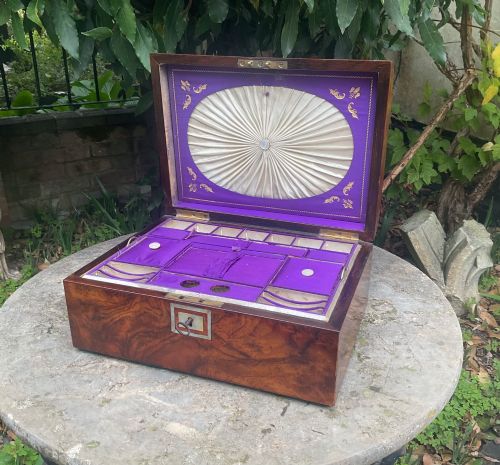
Interiors typically feature lift-out trays, compartments and miniature lidded boxes designed to organise needles, reels and thimbles. Certain variants incorporate writing slopes or jewellery storage within the same footprint.
Materials and Construction
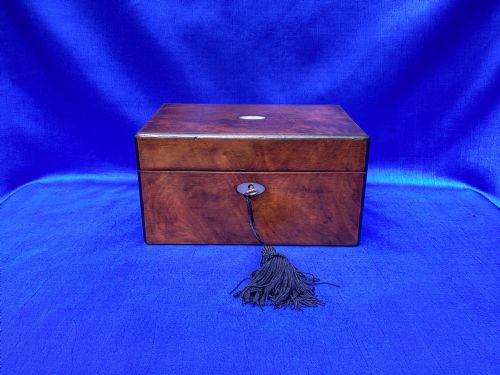
Cabinetmakers utilised dense tropical hardwoods as carcases, often applying veneers of figured rosewood, walnut or satinwood across the exterior surfaces. Marquetry, penwork and Tunbridge Ware surface decoration demand precise geometric arrangement of native and exotic timber veneers.
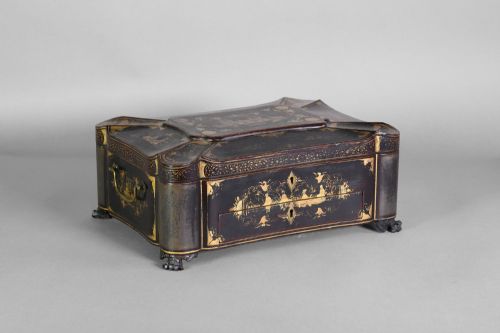
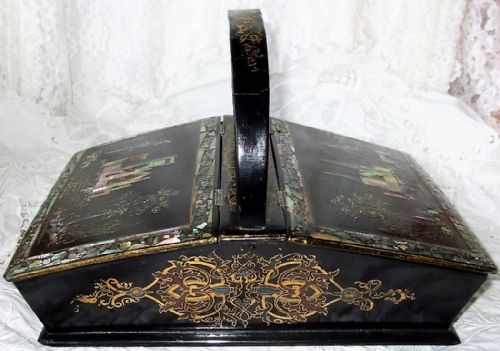
Inlaid mother-of-pearl, bone and brass escutcheons punctuate the exterior lids and keyholes. Papier-mâché boxes employ layered paper pulp pressed in moulds, dried and finished with black lacquer and painted or inlaid motifs.
Delicate interior fitments rely on silk linings, paper-covered compartments and turned wooden spool holders. Hinges, locks and keyplates consist of cast brass fitted flush into the timber edges.
The listings on this page span the 19th century, featuring Regency, William IV and Victorian periods alongside Anglo-Indian designs.
Judging Quality
The degree of refinement in the interior arrangement distinguishes standard containers from superior pieces. Complete original fitments, including matching bone or mother-of-pearl winders, needle cases and thimble holders, elevate a piece considerably.
Surface embellishment reveals the artisan's skill through the tightness of Tunbridge mosaic tesserae or the precision of penwork detailing. Well-figured timber veneers matched across the lid and sides demonstrate deliberate planning by the cabinetmaker.
Structural integrity depends on the stability of the wood joints and the secure adhesion of mother-of-pearl or brass inlays. Original working locks with matching keys indicate careful preservation of the container over time.
The Antique Needlework Casket Glossary
- Tunbridge Ware
- A type of woodworking produced in Kent featuring intricate mosaics made from thousands of tiny dyed wood blocks. These form pictorial or geometric designs across the lid and sides.
- Workbox
- A portable container fitted with compartments for storing sewing tools, threads and needlework materials. These boxes often feature a removable tray resting above a deeper well.
- Marquetry
- An art form where thin veneers of different coloured woods are applied to a carcase to create decorative pictures or patterns. Cabinetmakers use this technique to adorn the tops of fine boxes.
- Penwork
- A surface decoration technique involving ink applied directly to a prepared wood or ivory ground to create fine linear drawings. Artisans often tinted these designs with subtle watercolours.
- Papier-mâché
- A composite material made from paper pulp mixed with glue and resin, pressed into moulds and hardened. Makers finished these surfaces with lacquer, mother-of-pearl inlay or painted scenes.
- Escutcheon
- A protective brass plate surrounding a keyhole on a box lid or front panel. It prevents the surrounding wood from wearing away through repeated use of the key.
Antique Needlework Casket: Frequently Asked Questions
How were these boxes used?
Owners stored needles, spools, scissors, thimbles and pins within the fitted trays and compartments of the box.
Many boxes also served as miniature writing desks or storage for precious trinkets alongside needlecraft supplies.
How do I tell Regency from Victorian boxes?
Regency boxes often display neoclassical restraint with satinwood veneers, brass stringing and sleek geometric outlines.
Victorian examples frequently introduce heavier woods like rosewood and walnut, bolder marquetry, mother-of-pearl inlay and elaborate Tunbridge Ware mosaics.
How do I care for a wooden sewing box?
Keep wooden and papier-mâché boxes away from direct sunlight and extreme humidity changes to prevent veneer cracking.
Apply a light wax polish occasionally to maintain the sheen of the timber without damaging delicate inlay or silk interiors.