
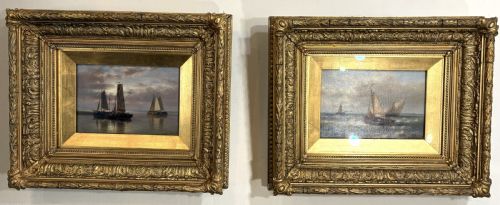


Antique Nautical Art Pair
An antique nautical art pair brings the movement and weather of the nineteenth and early twentieth centuries directly to your walls.
Antique Nautical Art Pair
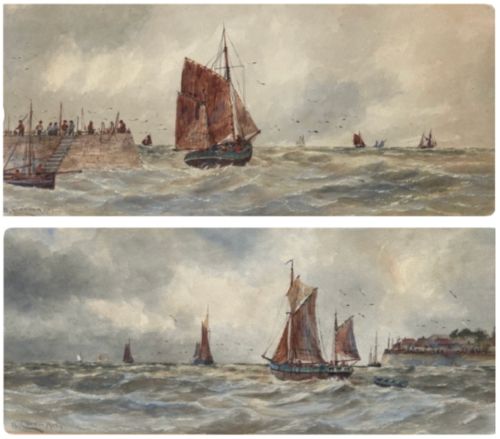
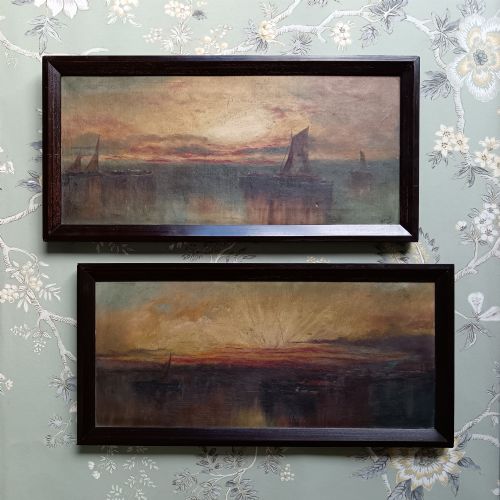
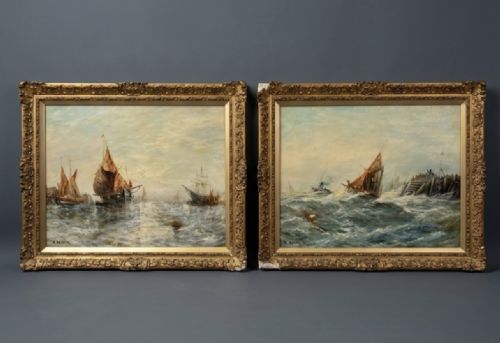
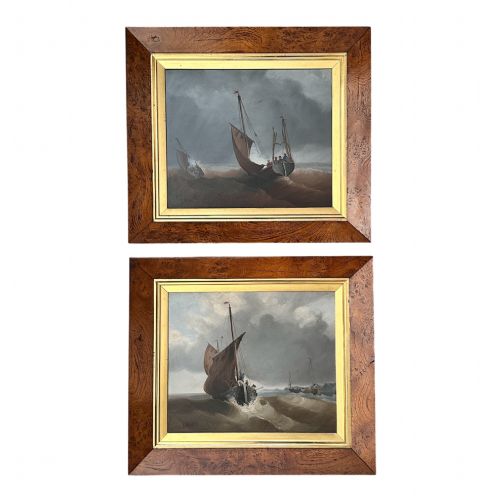
When you search for an antique nautical art pair, you are looking at matched sets of maritime and coastal scenes produced across the nineteenth and early twentieth centuries. These pairings most commonly feature framed oil paintings or watercolours depicting fishing boats, choppy seas, and coastal harbours.
The selections available here lean heavily into Victorian maritime art and Edwardian coastal scenes. You will find works executed in oil on canvas, oil on board, and watercolour pigment on paper, often preserved within period giltwood frames.
Materials and construction methods
Artists of these periods worked primarily with oil paint upon stretched canvas or wooden boards, alongside watercolour pigment applied to paper sheets. Canvases and watercolours required protective glazing and substantial wooden or giltwood framing to survive coastal dampness.
The physical build of these pieces relies on traditional joinery for the wooden frames and stable primed supports for the paint layers. Enamel plaques also appear, fired with vitreous pigments to depict narrative maritime scenes.
One set records the Sailor's Departure and Return upon glossy enamel plaques.
Distinctions in execution and condition
Quality rests upon the handling of light, atmosphere, and maritime detail by the artist. Stronger works capture the specific motion of waves and rigging convincingly, whereas lesser pieces rely on formulaic repetition.
The preservation of the paint surface and the originality of the matching frame heavily influence the standing of a pair. Clean, stable surfaces without excessive overpaint and contemporaneous giltwood surrounds elevate the whole.
John Moore of Ipswich·Abraham Hulk I·Gustave De Bréanski·Pieter Cornelis Dommersen·Thomas Bush Hardy·Hubert Thornley
The Antique Nautical Art Pair Glossary
- Seascape
- A work of art depicting the sea, ships, or coastal views. These subjects formed a major focus for Victorian and Edwardian painters.
- Giltwood
- Wood that has been covered with a thin layer of gold leaf. Frames finished this way were standard for exhibiting important nineteenth century oil paintings.
- Barque
- A sailing vessel with three or more masts. This specific ship rig appears frequently in maritime paintings of the nineteenth century.
- Watercolour
- A painting method where fine pigment is suspended in a water-based solution. These works on paper require protection behind glass to prevent fading.
Antique Nautical Art Pair: Frequently Asked Questions
How should I hang an antique nautical art pair?
Hang the two pieces side by side at eye level to preserve the visual balance intended by matched pairs. Keep them away from direct sunlight and damp walls to protect the canvas, paper, and gilt frames.
Ensure the weight is supported securely by appropriate fixings rather than relying on old picture wire alone. This prevents strain on the original wooden frames.
Were these paintings originally sold together?
Many pairs were conceived, painted, and framed together as companion pieces, often depicting contrasting conditions like sunrise and sunset. Others have been matched together later by dealers due to matching sizes and subjects.
Examining the frames, signatures, and canvas dimensions helps determine whether a pair originated from the same artistic session.
What subjects are most common in these pairs?
Fishing boats operating in coastal waters and shipping scenes on rivers like the Thames feature frequently in these works. Artists also favoured dramatic coastal views and maritime traffic under changing skies.
These subjects reflected the strong maritime trade and naval interests of Britain during the nineteenth and early twentieth centuries.