
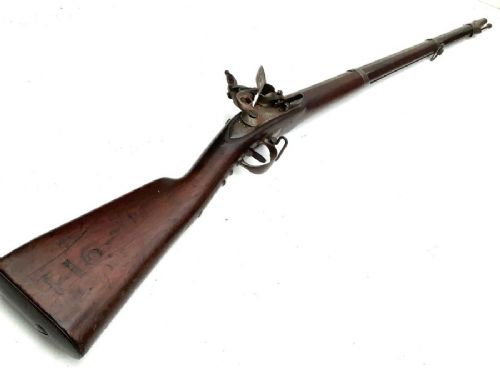


Antique Military Flintlock Firearm
An antique military flintlock firearm is a historical arm powered by a flint ignition mechanism, valued by collectors for its tactical heritage and mechanism.
Antique Military Flintlock Firearm
An antique military flintlock firearm represents a category of historic weaponry encompassing muskets, holster pistols, blunderbuss arms, and dragoon service pistols. When exploring this selection, buyers encounter pieces originating primarily from the eighteenth century, the Napoleonic era, and the early nineteenth century.
Collectors searching for an antique military flintlock firearm frequently find service pieces issued to infantry, cavalry, and naval forces during the Georgian and Napoleonic periods. These arms record the standard military technology utilised by European armies prior to the general adoption of percussion systems.
Construction and materials
Makers constructed stocks using timber such as walnut and general wood, paired with barrels, locks, and mechanisms forged from steel, iron, and brass. Furniture components including trigger guards, butt caps, and ramrod pipes frequently utilise cast brass or iron.
The ignition system relies on a flintlock mechanism designed to strike a spark into a priming pan upon pulling the trigger. Barrels were smooth-bored, and certain pieces incorporated specialised engineering such as sprung bayonets or brass barrels.
The listings feature walnut and wood stocks equipped with steel, iron, and brass components across eighteenth-century and Napoleonic service arms.
Assessing quality and authenticity
Quality in these arms relates to the clarity of maker signatures, military inspection stamps, and government ownership marks such as crown and Tower cyphers. Crisp stamping on the lock plate and barrel indicates a higher grade of original military manufacture.
The preservation of the stock timber and the operational condition of the flintlock action determine the standing of an individual arm within its period. Pieces retaining untouched surface characteristics and clear proof marks command greater attention from serious collectors.
T. Potts·Sargant and Son·Wilson·A.W Spires
The Antique Military Flintlock Firearm Glossary
- Flintlock
- A firearm ignition mechanism that uses a piece of flint held in a cock to strike a steel frizzen, creating sparks to ignite gunpowder. This system dominated military weaponry from the seventeenth into the nineteenth century.
- Musket
- A muzzle-loading long gun carried by infantry soldiers. These arms formed the primary firepower of armies during the eighteenth and Napoleonic wars.
- Holster pistol
- A large handgun designed to be carried in a saddle holster by cavalry troopers. They served as secondary weapons in close combat.
- Blunderbuss
- A muzzle-loading firearm with a flared barrel designed to scatter shot at close range. Naval and coach personnel frequently utilised them.
- Miquelet
- A form of flintlock ignition mechanism featuring an external mainspring and a combined steel and frizzen, common in Spanish and Mediterranean arms.
Antique Military Flintlock Firearm: Frequently Asked Questions
What is an antique military flintlock firearm?
An antique military flintlock firearm is a historical muzzle-loading weapon utilising a flint and steel ignition system, produced for government or military service during the eighteenth and early nineteenth centuries.
These pieces include muskets, dragoon pistols, and sea service arms bearing military proofs and contractor markings.
What is a Brown Bess musket?
The Brown Bess is the colloquial term for the standard British smooth-bore flintlock musket used by infantry forces across various conflicts, including the Revolutionary Wars and the Napoleonic period.
These long-barrelled arms were manufactured in large quantities by contractors such as Sargant and Son and at government facilities like the Tower of London.
Were these firearms used in combat?
Yes, these pieces were manufactured for active deployment by infantry, cavalry, and naval units during major European conflicts of the eighteenth and nineteenth centuries.
Service arms bear the marks of military acceptance, proof house testing, and regimental allocation suited to the campaigns of the Napoleonic era.