


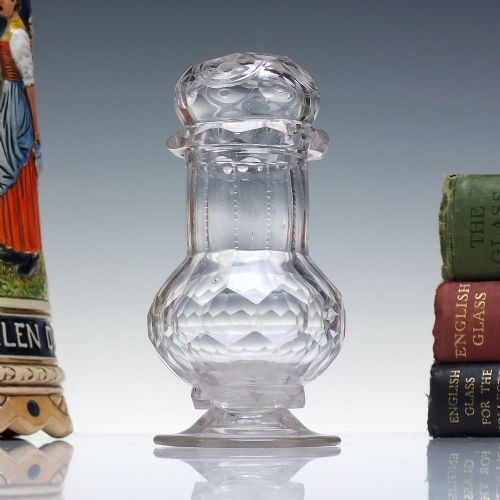


Antique Lead Crystal Tableware
These antique lead crystal tableware pieces bring heavy, refractive brilliance to the table, and you are looking for genuine period glass with genuine age.
Antique Lead Crystal Tableware
When you search for antique lead crystal tableware, you encounter functional dining and display objects forged from heavy glass compositions. The selections on this page span the eighteenth, nineteenth, and early twentieth centuries, encompassing Georgian, Regency, Victorian, and Edwardian eras.
The objects take diverse forms designed for the dining room and sideboard, including salt cellars with fitted saucers, condiment jars, sugar casters, decorative and fruit bowls, decanters, celery vases, and ice plates. Many pieces showcase British or Irish origins from historical periods such as the eighteen-twenties and seventeen-eighties.
You are most likely to meet cut glass items featuring intricate facets and patterns. These range from single condiment vessels and pairs of decanters to matched sets of salts and larger serving bowls intended for formal dining.
How they were made
Makers utilised heavy lead crystal glass and crystal compositions, shaping pieces through free blowing techniques before applying deep wheel cuts. This method produced thick walls capable of sustaining sharp geometric and decorative facets that catch and bend light.
Artisans executed specific construction details by hand, such as screw feet on sugar casters and draped swag designs on salt cellars. The incorporation of fitted saucers and multi-piece sets required precise glassblowing and grinding to ensure uniform thickness and stable bases.
Listings span the eighteenth, nineteenth, and early twentieth centuries, featuring Georgian, Regency, Victorian, and Edwardian styles in lead crystal.
What varies in quality
The clarity and weight of the crystal establish the primary baseline for quality. Heavier lead content yields superior refractive power and a resonant ring when struck, distinguishing finer service pieces from simpler utility glass.
The precision and crispness of the cutting define the visual hierarchy. Deep, clean facets with sharp edges require advanced skill, whereas shallow or blurred cutting indicates rapid production for broader markets.
Asprey & Co.
The Antique Lead Crystal Tableware Glossary
- Lead crystal
- Glass containing metallic oxide of lead, which increases weight, brilliance, and workability for cutting. This material allows artisans to carve deeper facets than are possible with standard soda-lime glass.
- Cut glass
- Glass decorated by holding the surface against rotating abrasive wheels to grind patterns into the material. The process creates sharp-edged facets that reflect and refract ambient light.
- Celery vase
- A tall vessel elevated on a stem or foot, historically used on the dining table to hold stalks of celery. These tall forms showcase the refractive quality of heavy period crystal.
- Sugar caster
- A small tabletop container with a pierced lid used for sprinkling sugar over food. Eighteenth-century examples often incorporate threaded screw feet joining the body to the base.
- Free blown
- Glass shaped by blowing air through a blowpipe into the molten gather without the aid of a multi-part mould. This technique results in subtle wall thickness variations unique to each vessel.
Antique Lead Crystal Tableware: Frequently Asked Questions
How do I clean antique crystal?
Wash pieces by hand in lukewarm water using a mild detergent, lining your sink with a towel to prevent accidental impacts against hard porcelain.
Avoid hot water and dishwashers entirely, as thermal shock and harsh detergents cause cloudiness or crazing on historical glass surfaces.
Were these pieces used daily?
Dining forms such as salts, decanters, and fruit bowls served active functions during formal meals in Georgian and Victorian households.
Heavier tableware was built for regular service on dining tables, though surviving sets often indicate careful preservation in sideboard cabinets over generations.
How do I date Georgian glass?
Examine the weight, pontil mark on the base, and cutting style to determine the likely era of manufacture. Georgian pieces frequently display heavy lead content and deeper, hand-polished facets compared to later machine-pressed items.
Look also for specific construction traits, such as threaded screw feet found on eighteenth-century casters or the specific form of celery vases from the eighteen-twenties.
Can I use antique decanters?
Period decanters remain functional for serving wine and spirits provided they are cleaned thoroughly before use. Check the interior for staining and use appropriate bottle brushes without abrasive agents.
Ensure that stoppers are paired correctly to the neck, as eighteenth and nineteenth-century stoppers were individually ground to fit specific bottles.