


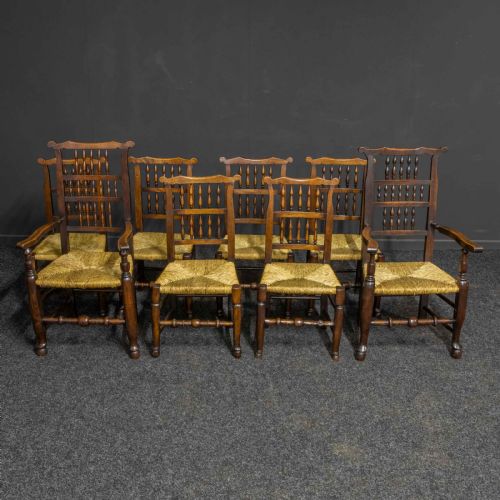


Antique Lancashire Spindleback Chair
An antique lancashire spindleback chair brings honest country craft into a room, offering sturdy construction and woven seating that ages with deep character.
Antique Lancashire Spindleback Chair
You will encounter various formats on this page, ranging from single dining chairs to sets of six or eight, alongside occasional armchairs and rocking chairs. The construction relies on regional turning traditions that developed across the north of England over successive generations.
Periods span from the Georgian era through the Victorian period, showing how regional makers adapted traditional forms across more than a century. Elm, oak, and ash form the primary timber framework, often paired with rush seating to create a resilient daily seat.
Materials and construction
Local hardwoods provide the structural integrity for each antique lancashire spindleback chair, with elm, oak, and ash selected for their strength and grain. Turners shaped the vertical spindles and upright posts on a lathe, fitting the components together using traditional pegged joints.
Rush forms the traditional seating material, woven tightly across the seat frames to provide a resilient and flexible support. Craftsmen utilised local timber sources directly, meaning the choice of wood often reflects the immediate woodland materials available to the regional workshop.
Antique Lancashire Spindleback Chair Retail Price Guide 2026
Typical asking prices for lancashire spindleback chair among the pieces listed under this phrase on Sellingantiques today, from the lower quarter to the upper quarter. They describe what is for sale here now, not the wider market.
Current listings feature chairs spanning the Georgian era and the Victorian period, constructed from elm, oak, and ash with rush seating.
Assessing craftsmanship and condition
The distinction between standard examples and finer pieces lies in the crispness of the turned spindles and the balance of the overall frame. Superior chairs maintain tight joints and retain their original timber surfaces without excessive replacement of structural components.
The regularity and tightness of the rush weaving also indicate the skill level of the maker, as does the careful selection of matching timber for sets of chairs. Subtle details in the turning profile separate utilitarian workshop production from more considered regional craftsmanship.
The Antique Lancashire Spindleback Chair Glossary
- Spindleback
- A chair back constructed from a series of vertical turned wooden rods fitted between horizontal rails. This design distributes weight evenly while keeping the overall frame lightweight.
- Rush
- Dried marsh grass twisted into cords and woven to form a supportive seat base. It offers natural flexibility and durability for daily use.
- Vernacular
- Architecture and furniture made by local craftsmen using traditional methods and native materials, rather than following metropolitan high-style fashions.
- Turned
- Shaped on a rotating lathe using chisels and gouges to create rounded or faceted wooden components such as legs and spindles.
- Elm
- A tough, interlocking hardwood native to Britain, frequently used for chair seats and components because it resists splitting under stress.
Antique Lancashire Spindleback Chair: Frequently Asked Questions
What periods do these chairs come from?
The pieces span the eighteenth and nineteenth centuries, encompassing both Georgian and Victorian periods.
Craftsmen continued to produce these regional designs using traditional methods long after metropolitan styles had shifted.
How were these chairs used originally?
They served primarily as functional seating around farmhouse dining tables and hearths throughout daily domestic life.
Armchairs and rocking chairs provided more relaxed seating options in the main living spaces of the home.
Are rush seats durable for daily use?
Rush seating is surprisingly resilient and can withstand regular use when kept in a stable environment away from excessive moisture.
Traditional weavers create a dense lattice that supports weight comfortably while retaining natural flexibility.
How do I care for an elm and ash frame?
Maintain the timber by applying occasional traditional wax polish to nourish the grain and protect the surface from drying out.
Keep the furniture away from direct heat sources and sudden temperature fluctuations to preserve the stability of the pegged joints.