
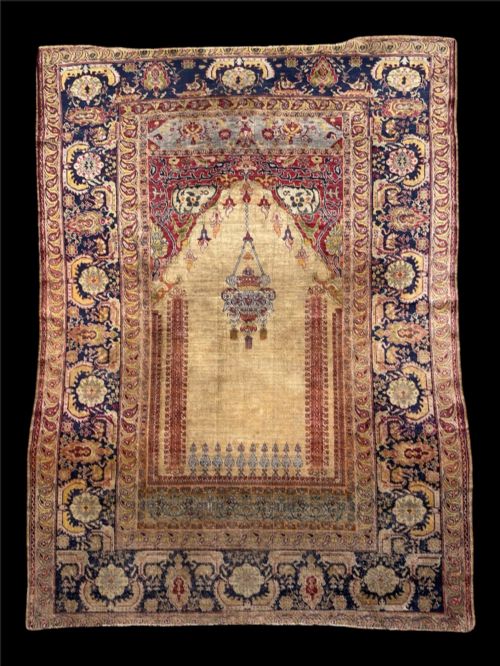


Antique Islamic Carpet
These antique islamic carpet selections bring centuries of skilled weaving directly to your floor, offering rich colour and pattern.
Antique Islamic Carpet
An antique islamic carpet covers woven floor coverings and prayer rugs originating from regions such as Turkey, the Caucasus, Persia, and Afghanistan. You will frequently encounter prayer rugs featuring architectural niches, columns, and floral lattices.
The pieces available span several centuries, including examples from the eighteenth, nineteenth, and early twentieth centuries. Styles range from Ottoman and Anatolian designs to Turkmen, Caucasian, and Afghan tribal works.
Makers utilised distinct regional motifs, producing formats that vary from small area rugs to larger floor coverings and paired sets. Each region imparted specific character through traditional borders, medallions, and symbolic double lanterns.
Indicators of quality
Knot density and precision of execution dictate the crispness of geometric and floral patterns. Tighter knotting allows complex lattices and inscriptions to remain sharp and legible across the surface.
The integrity of the pile, the stability of the foundation, and the retention of original borders distinguish well-preserved examples. Age-related wear alters the nap, yet skilled execution ensures structural longevity.
Some prayer rugs include subtle woven inscriptions in Ottoman script or specific numerical dates that quietly record the exact year of their creation.
The Antique Islamic Carpet Glossary
- Prayer rug
- A small format rug featuring a mihrab or arch design used traditionally for daily devotions. These pieces often direct the eye toward a central lamp or niche.
- Mihrab
- The arched niche in a prayer rug that mimics the prayer halls of mosques, pointing toward Mecca. Its shape varies distinctly between Anatolian, Caucasian, and Persian traditions.
- Warp
- The vertical foundation threads stretched lengthwise on the loom before knotting begins. Cotton and wool serve commonly as warp materials in these pieces.
- Weft
- The horizontal threads passed alternately over and under warp threads to secure each row of knots. They stabilise the structural grid of the rug.
- Lattice
- An open, repeating network of crisscrossing lines or floral motifs forming a geometric grid across the ground. This design frequently appears in Caucasian and Anatolian weaving.
Antique Islamic Carpet: Frequently Asked Questions
How do I date an antique islamic carpet?
Dating relies on stylistic analysis, structural characteristics, and sometimes woven dates or inscriptions. Comparing knotting styles and regional motifs helps narrow the period.
Changes in dye palettes and wool preparation also guide the assessment of age. Examining the wear patterns provides further clues regarding the century of production.
Where were these rugs and carpets made?
The pieces originate from diverse weaving centres across Anatolia, the Caucasus, Persia, and Afghanistan. Specific towns and tribal groups each developed recognisable local patterns.
Villages and nomadic tribes used regional symbols, whilst court workshops produced formal architectural designs. Geography thus dictates the visual language of each textile.
What is a prayer rug?
A prayer rug is a portable textile designed with a specific directional niche indicating the orientation for prayer. They were laid upon the floor during daily observances.
Their compact size distinguished them from larger room carpets. The central arch remains their most defining visual feature.
How should I care for an antique wool carpet?
Protect the textile by placing it in areas with low direct sunlight to prevent colour fading. Regular gentle vacuuming without a beater bar removes trapped dust.
Professional cleaning suited for antique textiles preserves the natural lanolin in the wool. Proper padding underneath prevents unnecessary friction against hard floors.