
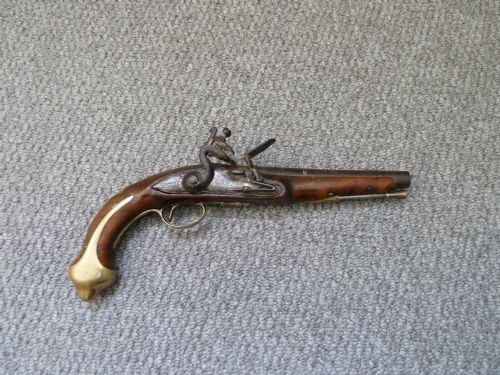
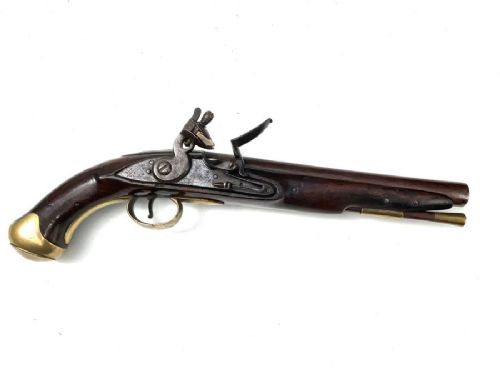


Antique Holster Handgun
These antique holster handgun pieces are historic firearms from the eighteenth and nineteenth centuries, sought after by collectors for their period craftsmanship and martial history.
Antique Holster Handgun
When searching for an antique holster handgun, collectors encounter British, European, and Ottoman firearms designed for military and civilian use on horseback or travel. The selection spans the eighteenth century through to the mid nineteenth century, encompassing flintlock and percussion ignition systems.
The dominant forms include British cavalry holster pistols, ornate Ottoman miquelet pieces from regions such as Bosnia and the wider Balkans, and elegant Georgian or Queen Anne pocket and holster arms. Makers and regional styles range from London workshops to provincial Irish centres and continental European centres.
Many examples display distinct regional characteristics, such as brass mounts, silver wire inlay, or carved wooden stocks in walnut. These firearms served officers, cavalrymen, and travellers during active military campaigns and civilian transit.
Materials and construction methods
Gunsmiths utilised forged steel for barrels and locks, pairing them with robust stocks of walnut or other dense hardwoods. Metal components frequently received hand-engraved details or proof marks.
Mounts and decorative elements incorporate cast brass, iron, and silver, alongside inlaid mother-of-pearl and silver wire. Stocks often feature shaped grips, sometimes terminating in grotesque butt caps or reinforced caps for durability.
Several Ottoman examples are described as rat-tail or pirate pistols, bringing a distinctly theatrical flair to nineteenth century Balkan firepower.
Distinctions in craftsmanship and preservation
Quality rests in the crispness of the lock mechanism, the integrity of the wooden stock, and the precision of any metal engraving or silver inlay. Superior pieces retain clear maker signatures, original proofs, and unpolished surfaces that show the true age of the metal.
The artistry of the mounts and the complexity of the stock decoration distinguish standard military issue from bespoke officer or presentation grade pieces. Preservation of the original mechanical parts and matching components elevates the standing of an example within a collection.
Harrison of London·T Potts London·Timothy Hughes Cork·Thomas Anelli·R Willoughby Birmingham·Meyer and Mortimer
The Antique Holster Handgun Glossary
- Flintlock
- A firearm ignition mechanism that uses a flint struck against a steel frizzen to create sparks that ignite the gunpowder charge. This system dominated military and civilian arms throughout the eighteenth and early nineteenth centuries.
- Miquelet
- A form of snaplock ignition common in the Ottoman Empire, Spain, and North Africa, featuring an external mainspring and a combined steel and frizzen. It is frequently found on Balkan and Turkish holster pieces.
- Percussion cap
- A later ignition system utilising a small metal percussion cap placed on a nipple, struck by the hammer to detonate the charge. This method superseded the flintlock in the nineteenth century.
- Holster pistol
- A large handgun designed to be carried in a saddle holster rather than on a belt, typically possessing a heavy calibre and robust construction suitable for cavalry use.
- Proof mark
- An official stamp applied to a firearm barrel or action to certify that it has undergone pressure testing for safety. British pieces commonly display London or provincial proof marks.
Antique Holster Handgun: Frequently Asked Questions
How do I care for my antique holster handgun?
Keep the firearm in a stable environment away from excess moisture and extreme temperature fluctuations to protect the wooden stock and steel components. Apply a light museum-grade microcrystalline wax or preservative oil to metal surfaces to prevent oxidation.
Avoid aggressive cleaning or attempting to fire the mechanism, as original parts are fragile. Periodical gentle dusting with a soft, dry cloth preserves the finish without wearing away historic patination or engravings.
What is the difference between flintlock and percussion pistols?
Flintlock pistols rely on a piece of flint striking a steel frizzen to produce sparks that ignite the priming powder in the pan. This technology was standard throughout the eighteenth century and into the early nineteenth century.
Percussion pistols use an enclosed cap containing a detonating compound placed over a hollow nipple, struck directly by the hammer. Introduced in the nineteenth century, the percussion system offered greater reliability in wet weather compared to the earlier flintlock design.
Where were Ottoman holster pistols typically made?
Ottoman holster pistols frequently originated in Balkan workshops such as the Sarajevo region, as well as various centres across Turkey and the broader Ottoman Empire. These regional pieces often feature distinct miquelet locks and ornate metalwork.
Craftsmen in these areas applied intricate brass cladding, silver inlay, and mother-of-pearl mounts to stocks, catering to local military personnel, irregular forces, and affluent collectors of arms.
How can I identify a British military pistol?
British military holster pistols from the Georgian and Victorian eras generally feature standardised steel and brass construction with government ownership marks or private maker signatures from contractors in London or Birmingham. Service arms often display inspector marks and proof stamps on the barrel and lock plate.
Cabinetry on military pieces prioritises sturdy walnut stocks built for field service rather than excessive ornamentation, though officer variants frequently incorporate finer finishing touches like silver mounts.