
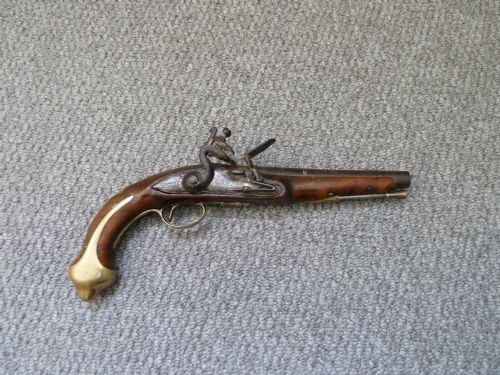
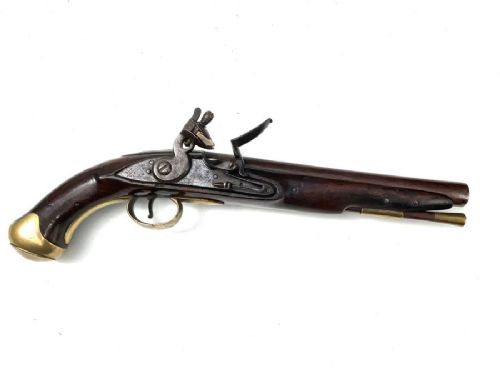


18th Century Holster Pistol
An 18th century holster pistol is a large, heavy sidearm carried in a saddle holster by cavalrymen and travellers.
18th Century Holster Pistol
The 18th century holster pistol appears in several distinct regional styles across this page, ranging from British military and civilian flintlocks to ornate Ottoman miquelet pieces from the Balkans and French or Dutch examples. Buyers seek these pieces for their robust construction and historical association with mounted travel and military campaigns of the period.
Most entries belong to the 18th century or around 1800, featuring flintlock ignition systems designed to be carried on horseback rather than tucked into a belt. British makers from London, Birmingham, and Cork sit alongside Italian, French, and Ottoman workshops in the selection.
How they were made
Stocks are shaped from walnut or other dense wood, often carved around the tang and sometimes inlaid with silver wire or mounted with brass furniture. Barrels and lock plates are forged from steel or brass, paired with mechanical internal components designed for the flintlock mechanism.
Decorative elements include cast brass side plates, butt caps, and silver inlays executed by regional gunsmiths and regional metalworkers. Proof marks on British barrels indicate official testing of the steel before the arm left the workshop.
Some Balkan holster pistols feature mother-of-pearl grips so slick they must have required a very firm hand on a charging horse.
What varies in quality
The distinction between ordinary and superior pieces rests on the crispness of the lock engraving, the quality of the timber grain in the walnut stock, and the integration of metal mounts. Finer examples retain clear maker signatures on the lock plate and well-preserved silver or brass furniture.
Originality of components also dictates standing, with matching barrel and lock signatures holding greater appeal than assembled pieces. The precision of the flintlock mechanism and the delicacy of any wire inlay or carving separate standard military issue from bespoke civilian work.
Harrison of London·T. Potts·Timothy Hughes·Thomas Anelli·R. Willoughby·Richards·Ezekiel Baker
The 18th Century Holster Pistol Glossary
- Flintlock
- A lock mechanism that uses a piece of flint held in a cock to strike a steel frizzen, creating sparks to ignite the priming powder. This system dominated firearms design throughout the 1700s.
- Holster pistol
- A large firearm intended to be carried in a leather holster attached to a horse's saddle. These weapons are heavier and longer than pocket or belt pistols.
- Miquelet lock
- A form of flintlock ignition common in Spain, Italy, and the Ottoman Empire, characterised by an external mainspring and a combined steel and frizzen. It differs mechanically from the standard English or French lock.
- Brass furniture
- The decorative and protective metal mounts on a firearm, including the trigger guard, side plate, butt cap, and ramrod pipes. On these pieces, they are cast and chased in brass.
- Bore
- The interior diameter of the barrel, often measured in gauge or bore size in British tradition. This measurement relates to the size of lead ball the pistol fires.
18th Century Holster Pistol: Frequently Asked Questions
How do I care for an 18th century pistol?
Keep the piece in a dry, stable environment away from direct sunlight and damp air to protect the wooden stock and steel components. Light applications of microcrystalline wax or gun oil help preserve the metal surfaces.
Avoid using harsh chemical cleaners on the wood or brass mounts. Gentle dusting and occasional inspections of the lock mechanism keep the piece stable without altering its surface.
Were these pistols used by the military?
Many holster pistols served military cavalry units, where troopers carried them in saddle holsters for close combat after discharging their muskets. British proof marks and standard military forms indicate official army contracts.
Other examples were built for civilian travellers and officers who purchased private arms from high-end gunmakers in London, Dublin, or regional towns.
How do I tell an English pistol from an Ottoman one?
English pistols typically feature standard flintlock mechanisms with flat lock plates, walnut stocks, and cast brass or silver mounts. Makers often sign their names clearly on the lock plate alongside London or Birmingham proof marks.
Ottoman and Balkan pieces frequently utilise miquelet locks, intricate silver wire or sheet inlays, and distinctive rat-tail pommels. Their decoration reflects regional styles of the Adriatic and Sarajevo rather than British workshop traditions.
Can I fire an 18th century holster pistol?
Firing antique firearms from the 18th century is generally discouraged due to the degradation of metal and wood over centuries. Structural weaknesses in the barrel or lock can cause catastrophic failure under pressure.
These pieces are intended for historical study and display rather than modern use. Anyone considering firing an antique firearm must have it inspected by a qualified professional gunsmith first.