
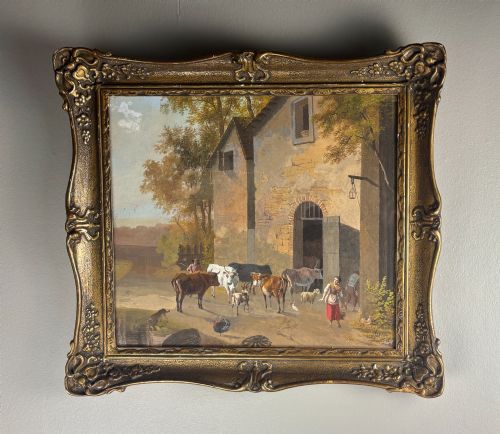
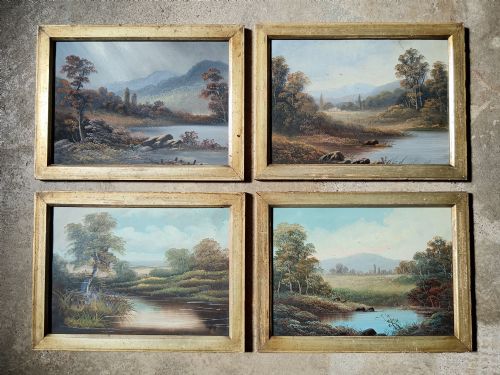


Antique Gouache Landscapes
Antique gouache landscapes capture scenic views with opaque pigments on paper, offering vibrant colour and fine detail that decorators and collectors cherish.
Antique Gouache Landscapes
When you search for antique gouache landscapes, you encounter works spanning the eighteenth century through to the mid-twentieth century, encompassing British, French, Italian and Mughal schools. These pieces frequently depict rural scenes, coastal views, and architectural ruins rendered with distinctive opacity.
The selection ranges from intimate sets of Neapolitan views and Grand Tour souvenirs to large framed works by named artists like Joseph Knight and Gaston Cornil. You meet works paired as sets or mounted individually within period frames of gilded wood or simple glass fronts.
Subjects stretch from Devon moorlands and Scottish lochs to Arabian deserts and Venetian canals, reflecting diverse regional aesthetics from Victorian, Edwardian, and Orientalist traditions. Many employ mixed media, combining gouache with watercolour, pastel, or ink.
How they were made
Artists painted primarily on paper surfaces using heavy opaque gouache, frequently augmenting the compositions with watercolour, pastel, ink, or pencil to build depth and texture. The density of the medium allowed makers to apply light highlights over darker washes.
Many surviving examples are housed in period frames constructed from wood, gilded wood, or gilt wood, protected beneath glass to preserve the delicate pigment from atmospheric damage. Mounts and frames often reflect the specific decorative tastes of the Georgian, Victorian, or Edwardian eras.
Listings feature works spanning the eighteenth to the mid-twentieth century, executed in gouache, watercolour, pastel, and ink on paper.
What varies in quality
The distinction between standard works and exceptional pieces rests upon the surety of the brushwork, the preservation of the opaque pigment, and the vibrancy of the colour palette. Strong compositions with clear atmospheric perspective elevate individual paintings above routine topographical records.
The quality of the framing also influences the piece, with original gilded wood frames adding significant historical context compared to later replacements. Signed works by documented artists or complete sets demonstrate greater artistic ambition than anonymous student exercises.
Joseph Knight·Gaston Cornil·AJ Thornton·Milton Drinkwater
The Antique Gouache Landscapes Glossary
- Gouache
- An opaque water-based paint consisting of pigment, water, and a binding agent such as gum arabic, often producing a matte finish. It differs from transparent watercolour through its ability to reflect light from its heavier pigment layer.
- Grand Tour
- A traditional trip through Europe undertaken by upper-class European young men in the eighteenth and nineteenth centuries to accumulate cultural artefacts. Travellers frequently purchased local gouache paintings as portable records of Italian views and classical ruins.
- Mughal School
- A style of miniature painting originating in the South Asian imperial court, noted for its fine detail and vibrant pigments. Works from this tradition often incorporate landscape elements executed in opaque water-based media.
- Orientalist
- A nineteenth-century artistic style depicting scenes from the Middle East, North Africa, and Asia. Painters working in this mode utilised gouache to capture intense regional sunlight and exotic architecture.
- Gilt Wood
- Wood that has been coated with a thin layer of gold leaf or gold paint for decorative effect. This finish is frequently found on the frames enclosing nineteenth-century landscape paintings.
Antique Gouache Landscapes: Frequently Asked Questions
Are these paintings watercolours?
Gouache shares similarities with watercolour because both utilise water-soluble binders, but gouache contains larger pigment particles and chalk, making it opaque. This opacity allows artists to paint light colours over dark washes, achieving a solid, matte finish quite unlike transparent watercolour.
Many period artists combined both mediums within a single composition to balance luminous sky washes with dense, solid foliage or architecture. Examining the surface under magnification often reveals where opaque highlights sit distinctly above transparent base layers.
How should I hang these framed paintings?
Select an interior wall that receives stable indirect light, as prolonged exposure to direct sunlight will fade the delicate pigments over time. Maintain a consistent room temperature and avoid hanging pieces near radiators or in humid spaces like kitchens.
Ensure the hanging wire and wall fixings are rated to support the weight of the timber and glass frame. Professional picture hooks suited to your wall type provide the security necessary for heavier gilded frames.
How can I tell the period of the frame?
Period frames often display construction methods typical of their era, such as hand-carved wooden corners, gesso preparation layers, and traditional gold leaf application. Early nineteenth-century frames frequently feature distinct compositional moulding patterns that differ from Edwardian or later replacements.
Inspect the reverse of the frame for old framer labels, handwritten inscriptions, or rusted iron fixings which offer clues to the age of the mounting. A frame that appears contemporary to the painting usually retains better contextual harmony than a mismatched later setting.