

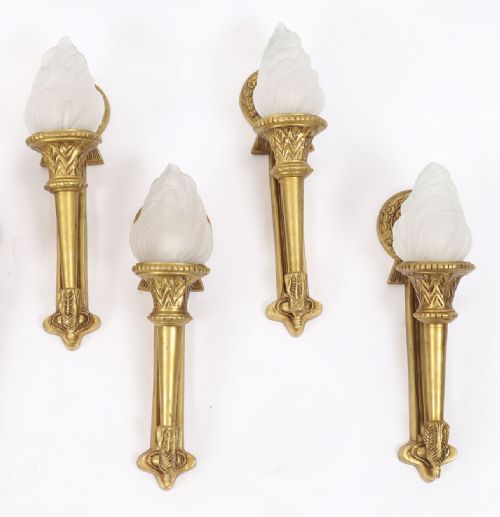


Antique Glass Wall Lamp
These antique glass wall lamp designs bring period illumination to hallways and drawing rooms, ranging from sleek Art Deco chrome to heavy Victorian brass.
Antique Glass Wall Lamp
When searching for an antique glass wall lamp, buyers encounter a variety of forms including wall lights, sconces, lanterns, carriage lamps and converted oil lamps. These pieces span periods from the eighteenth century through the Victorian, Edwardian and Art Deco eras, reflecting shifting domestic lighting needs.
The most common examples on this page are matched pairs from the Art Deco period, combining moulded or frosted glass with chrome or metal fixtures. Single pieces and larger sets also appear, originating from English, French and Bohemian workshops in styles ranging from Neo-Classical to Art Nouveau.
Lighting fixtures alter significantly by room placement, with exterior wall lights and carriage lamps built for weather resistance, while boudoir and drawing room sconces focus on decorative glass work and polished metal frames.
Materials and construction methods
Makers constructed these wall fittings using combinations of clear, frosted, cut crystal or coloured glass paired with structural metals such as brass, bronze, chrome, copper and wrought iron. Gilt bronze, or ormolu, and gold leaf frequently appear on decorative mounts from nineteenth century and Neo-Classical pieces.
Glass components were blown, moulded, cut or etched, seen in items featuring cloud shapes, skyscraper profiles, tubular shades and etched angelic motifs. Metalwork frames were cast, forged or spun to hold the glass securely against the wall bracket or arm.
Several carriage lamps and castle wall lights retain the imposing heft required to withstand centuries of wind, weather and stubborn draughts.
Assessing quality in period wall lighting
Quality rests in the weight and clarity of the glass and the crispness of the metal casting, distinguishing mass-produced items from finer studio or foundry work. Thicker moulded glass panels and hand-cut crystal prisms reflect light with greater depth and brilliance.
The integrity of the structural joints, the originality of the glass shade, and the detailing on mounts - such as chased bronze or hand-gilded surfaces - separate standard domestic fittings from high-tier decorative pieces.
F. & C. Osler·Dugué·Lalique·Hinks
The Antique Glass Wall Lamp Glossary
- Ormolu
- Gilt bronze mounts used extensively on Neo-Classical and nineteenth-century light fittings to add golden decorative highlights. This technique involved applying finely ground gold to a bronze base.
- Sconce
- A wall-mounted light fixture designed to hold candles or electric bulbs, often featuring a decorative backplate and projecting arms. They were traditionally placed in pairs along corridors and reception rooms.
- Frosted glass
- Glass treated by acid-etching or sandblasting to create a diffuse surface that softens the glare from the light source. It is particularly prominent in Art Deco and Edwardian designs.
- Carriage lamp
- An exterior or robust wall lantern originally designed for horse-drawn transport or building entrances. These pieces utilise heavy metal frames and thick glass panels to withstand outdoor conditions.
- Chandelier arm
- A projecting branch of a light fixture designed to hold an individual bulb or candle holder. These arms are often articulated in sets of two or three on larger wall sconces.
Antique Glass Wall Lamp: Frequently Asked Questions
Can these wall lamps be wired for modern electrics?
Many period wall lights and converted oil lamps arrive already rewired for modern electrical standards, while others retain older wiring that requires professional updating before installation.
Buyers should consult a qualified electrician to ensure that historical fixtures meet current safety regulations and fit securely onto wall junction boxes.
How do I clean antique glass shades safely?
Remove delicate glass shades from their metal frames whenever possible and wash them gently in lukewarm water with mild soap. Avoid harsh chemical cleaners that can damage historical etched, frosted or gilded surfaces.
Dry the glass thoroughly with a soft cloth before reattaching it to the brass or chrome bracket.
Where should I mount a pair of wall sconces?
Pairs of wall sconces suit flanking positions around fireplaces, doorways, large mirrors or beds to provide balanced ambient illumination. Height placement typically places the centre of the fixture around eye level.
Consider the weight of the piece, particularly with heavy cast iron or bronze designs, to ensure adequate wall support.
How do I tell an Art Deco wall lamp from a Victorian one?
Art Deco wall lamps from the 1920s and 1930s feature geometric lines, skyscraper silhouettes, chrome plating and frosted or cloud-shaped glass. Victorian and Edwardian pieces favour ornate brass casting, curves, floral motifs and cut crystal.
Examining the construction screws, metal finishes and glass moulding techniques helps confirm the period of manufacture.