



Antique French Salon Suite
An antique french salon suite brings formal seating and reception rooms alive with period craftsmanship, offering matched elegance for entertaining.
Antique French Salon Suite
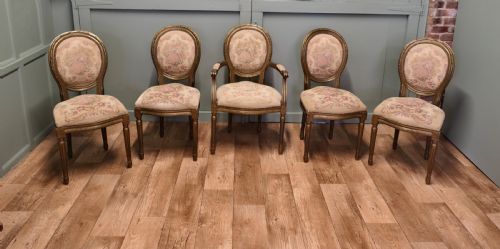
An antique french salon suite comprises coordinated sets of formal seating designed for drawing rooms and reception spaces. These groupings typically include a settee or small sofa paired with matching armchairs and salon chairs.
The selections encountered here span multiple centuries and design movements, with significant representation from the nineteenth century alongside early twentieth-century interpretations. Pieces range from intimate three-piece arrangements to larger five and seven-piece configurations.
Stylistic influences draw heavily upon historical French reigns and revivals, including Louis XVI, Louis XV, and French Empire. Makers interpreted these classical vocabularies through carved woodwork, gilt finishes, and period textiles.
Materials and construction methods
Carpenters utilised sturdy timbers including walnut, mahogany, and oak for structural frames, shaping them through detailed hand carving. Giltwood applications and ormolu mounts added decorative brilliance to select frames, particularly within Empire and revival suites.
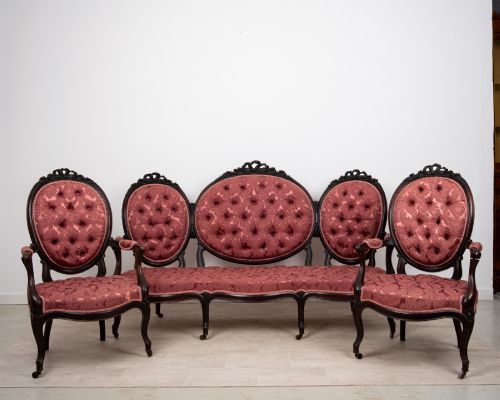
Upholstery formed an integral part of construction, employing textiles such as damask, tapestry, and fabric over traditional stuffing. Deep buttoned upholstery appeared on specific Victorian and nineteenth-century examples to provide structured comfort.
Bending techniques also emerged in certain twentieth-century pieces, utilising bentwood alongside traditional joinery methods. Marquetry inlay decorated specific surfaces, displaying precise wood-working skills across panels and frames.
Suite configurations range from compact three-piece sets to expansive seven-piece arrangements.
Distinctions in quality and execution
The sharpness and depth of the wood carving distinguish finer frames from simpler productions. Crisp detailing on acanthus leaves, fluted legs, and moulded crest rails indicates superior artisan skill.
The selection and preservation of original textiles or period-appropriate re-upholstery dictate the visual harmony of a suite. High-grade damask, tapestry, and silk fabrics complement the underlying timber rather than overwhelming the structural lines.
Cohesion across the multi-piece set remains vital, ensuring that frames, arm styles, and leg turning match precisely as originally conceived by the workshop. Suites retaining their complete original complement demonstrate greater integrity.
Baumann Bentwood
The Antique French Salon Suite Glossary
- Bergère
- An enclosed upholstered armchair with wooden framing visible around the sides and back. This form provides a comfortable seat with solid upholstered armrests.
- Giltwood
- Timber coated with gold leaf or gesso finished to resemble solid gold. This decorative surface reflects light and enhances formal reception rooms.
- Ormolu
- Cast brass that has been mercury-gilded to produce a bright gold finish. These metal mounts decorate the corners and legs of Empire style furniture.
- Marquetry
- The art of applying small pieces of veneer to a structure to form decorative patterns. Craftsmen utilised contrasting wood tones to create geometric or floral motifs.
- Canapé
- A decorative settee or small sofa designed for formal seating. These pieces match the accompanying armchairs to form a unified salon grouping.
Antique French Salon Suite: Frequently Asked Questions
What rooms suit an antique french salon suite?
These matched seating groups function effectively in formal living rooms, reception spaces, and large drawing rooms where coordinated furniture creates a defined conversation area.
Their scale and decorative presence allow them to serve as the visual focal point of an interior while providing practical seating for guests.
How do I identify a Louis XVI style suite?
Louis XVI pieces are characterised by straight, fluted legs, symmetrical frames, and neoclassical motifs such as ribbons, urns, and laurel wreaths.
This aesthetic departs from the curved lines of earlier rococo designs, favouring geometric restraint and architectural clarity.
What does a three-piece suite include?
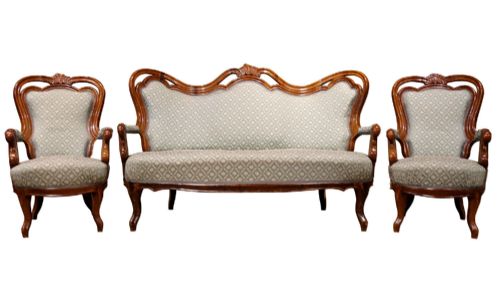
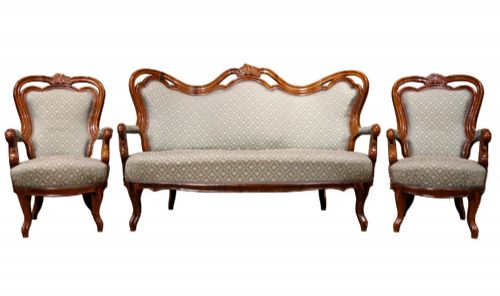
A standard three-piece arrangement typically consists of a small settee or compact sofa accompanied by two matching armchairs.
This configuration offers a balanced grouping for smaller reception spaces without overcrowding the room.
Should I reupholster a salon suite?
Re-upholstery is often necessary when existing fabric has deteriorated beyond conservation, allowing owners to select appropriate period textiles like damask or tapestry.
Retaining original fabric is preferred when condition permits, but professional renewal ensures structural longevity for daily use.
How do I distinguish Empire style pieces?
French Empire furniture displays heavy classical influences, often incorporating dark mahogany timbers, symmetrical forms, and prominent ormolu mounts.
Design elements frequently reference military victories and classical antiquity, reflecting the aesthetic preferences of the early nineteenth century.