
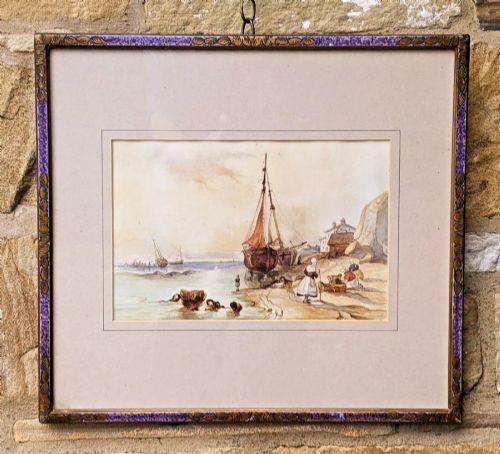


Antique Fishing Prints
These antique fishing prints bring the quiet focus of riverbank and coastal boat to your walls, prized for their traditional charm and historical record.
Antique Fishing Prints
When you search for antique fishing prints, you encounter a range of framed works, engravings, and watercolours capturing maritime and angling scenes. The nineteenth century yields the majority of these pieces, alongside works from around eighteen hundred and nineteen thirty.
The subjects extend from British sporting art and Victorian natural history to Chinese export works on pith paper. You will find single engravings, pairs, and sets depicting coastal boats, harbours, and fish studies.
Framed prints and paintings dominate the selection, often presented behind glass in wood frames such as oak. These items document the history of angling and coastal life through the eyes of various historical artists.
How they were made
Makers produced these works using paper, ink, and watercolour pigments applied by hand or printed from engraved plates. Some pieces utilise specialist surfaces like pith paper for delicate gouache paintings.
Engravers and artists worked with wood frames and glass to protect the delicate paper works from moisture and handling. Embossed prints demonstrate specific nineteenth-century press techniques that raised sections of the paper surface.
Watercolour artists applied pigment in washes to capture coastal scenes and fishing boats with precision. Etchings with aquatint involved acid biting into metal plates to achieve tonal gradations.
Materials in this category include paper, wood, glass, ink, watercolour, oak, and pith paper.
What varies in quality
Quality rests in the clarity of the printed line and the skill of the watercolour application. Skilled artists rendered fish anatomy and maritime rigging with anatomical and technical accuracy.
The preservation of the paper and the vibrancy of the ink or pigment dictate the visual strength of the piece. Period framing and original mounts also contribute to the integrity of the work.
Jonathan Couch·Snaffles·Norman Janes·Thomas Bush Hardy·Henry Alken
The Antique Fishing Prints Glossary
- Engraving
- A print made from an image carved into a metal plate, usually copper or steel, using a sharp tool. This technique allows for fine, precise lines that define the subject.
- Aquatint
- A printmaking method that produces tonal areas resembling watercolour washes by using acid on a copper plate. It often appears alongside standard etching to create depth.
- Pith paper
- A delicate material prepared from the pith of the Tetrapanax papyrifer plant, common in nineteenth-century Chinese export art. It absorbs gouache and watercolour with intense colour saturation.
- Gouache
- An opaque water-based paint that includes a white pigment to create a heavier, more solid finish than traditional watercolour. It was frequently used to highlight details on paper.
- Embossed print
- A paper image pressed into relief without necessarily using ink, creating a raised design. This technique adds tactile dimension to the surface.
Antique Fishing Prints: Frequently Asked Questions
What periods do these prints come from?
The selection spans from the late eighteenth century through the Victorian era up to nineteen thirty. Nineteenth-century examples are the most common.
You will also find pieces originating around eighteen hundred, capturing earlier sporting and natural history traditions.
How should I hang them at home?
Keep them out of direct sunlight to protect the paper and watercolour pigments from fading over time. Pairing smaller works together creates a strong visual group on a wall.
Ensure they are framed behind glass to guard against dust and atmospheric moisture in the room.
How do I spot an engraving?
Engravings show fine, crisp lines under close inspection where the ink sits slightly raised within the paper fibres. They often depict detailed scientific illustrations of fish or maritime scenes.
Examining the margins can reveal plate marks left by the metal edge during the printing process.