
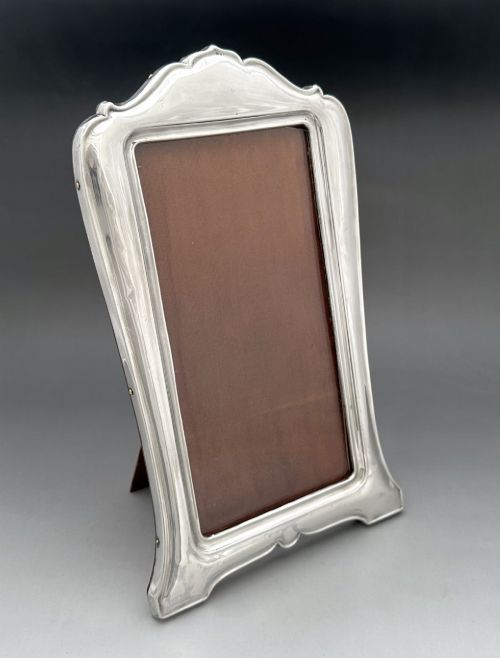


Antique English Silver Frame
When you search for an antique english silver frame, you find domestic display pieces designed to hold portraits, families, and milestones on desks and tables.
Antique English Silver Frame
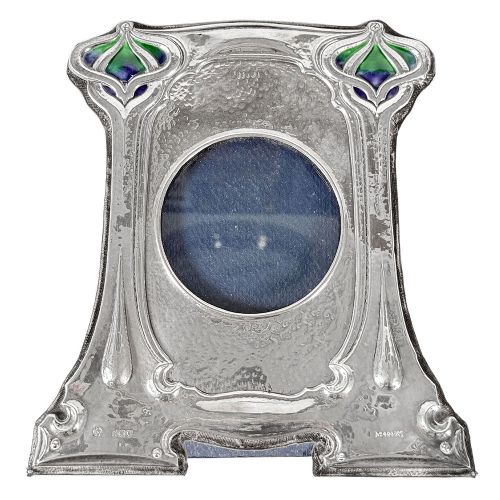
An antique english silver frame encompasses domestic items created to house photographs, miniatures, and paper portraits on desks, mantels, and tables. The pieces on this page span the Victorian, Edwardian, and Art Deco periods, drawing on the George V and Arts and Crafts styles.
Most examples you encounter date from the early twentieth century and late nineteenth century, reflecting industrial and domestic shifts that increased the popularity of personal photography. Makers produced both landscape and portrait orientations, often incorporating wooden backs and easel supports.
Beyond standard rectangular shapes, you discover heart-shaped variants, circular formats, and novelties themed around military subjects or sporting motifs like tennis. Larger variants serve as mirrors or two-way desk objects.
What varies in quality
Quality rests in the weight of the silver sheet, the crispness of the engine-turning or repoussé work, and the structural integrity of the backing support. Thicker gauge silver resists dents and maintains the rigidity of the easel strut.
Makers such as William Hutton and Sons or Walker & Hall applied careful finishing to borders and joints, whereas utilitarian production lines left simpler seams. Enamel work and applied cast motifs demonstrate varying degrees of hand-detailing and preservation.
Listings feature materials including sterling silver, glass, wood, enamel, and brass, spanning the Victorian, Edwardian, and Art Deco periods.
William Hutton and Sons·Walker & Hall·James Dixon & Sons·Deakin & Francis·J C Vickery
The Antique English Silver Frame Glossary
- Sterling silver
- An alloy comprising 92.5 percent silver and 7.5 percent other metals, typically copper, used to provide durability for domestic objects. This standard metal appears across the majority of surviving pieces.
- Engine-turned
- A mechanical surface decoration technique producing precise geometric patterns of engraved lines. This method was widely utilised on Edwardian and Art Deco photograph frames.
- Planished
- A metalworking finish achieved by hammering the surface with a polished round-headed hammer to create a textured, light-reflecting plane. Arts and Crafts silversmiths favoured this technique.
- Assay office
- An official body responsible for testing the purity of precious metals and stamping them with hallmark symbols. Towns such as Birmingham and Chester operated prominent offices.
- Easel back
- A hinged wooden or cardboard prop attached to the rear of a frame to allow vertical display on a flat surface. Many surviving examples retain their original oak or fabric-covered supports.
Antique English Silver Frame: Frequently Asked Questions
How do I date a silver frame?
You determine the production period by reading the hallmarked date letter stamped on the silver border alongside the assay office mark and lion passant.
Style indicators such as Art Deco geometric lines or Edwardian ribbon motifs also help narrow down the decade of manufacture.
What glass belongs in these frames?
Original pieces generally contain thin, clear window glass, occasionally showing minor bubbles or uneven thickness consistent with early twentieth-century manufacturing methods.
Replacements should match the original thickness to fit securely beneath the metal bezel without straining the retaining pins.
Can I polish my silver frame?
You maintain the metal using a soft microfibre cloth and a mild proprietary silver polish designed to remove tarnish without abrading raised details or engine-turning.
Avoid applying liquid polish directly near fabric linings or wooden backs to prevent moisture damage.
What are two-way frames?
Two-way frames feature a swivel mechanism or a reversible easel mount that allows the object to sit horizontally or vertically depending on the photograph.
This functional adaptability proved popular for desk accessories during the Edwardian period.