



Antique English Handgun
These antique English handgun pieces are precision metal and wood mechanisms from past centuries, offering a tangible connection to early personal defence and craftsmanship.
Antique English Handgun
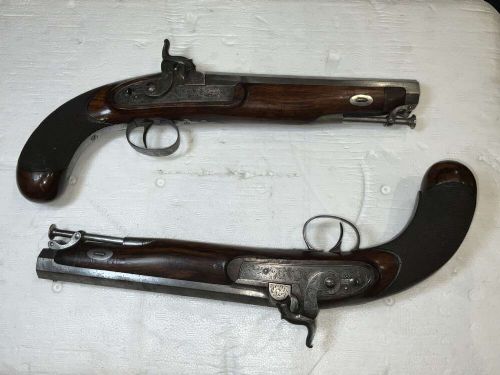
When you search for an antique English handgun, you are looking at functional firearms produced in England primarily across the eighteenth and nineteenth centuries. The examples encountered on this page encompass various configurations, including pocket pistols, duelling pistols, holster pistols, and officer's pistols.
The most likely versions to meet here are flintlock and percussion mechanisms dating from the Georgian, Regency, and Victorian periods. These pieces often feature specific regional origins such as London and Birmingham, reflecting the major centres of British gunmaking during those eras.
Materials and construction
These firearms combine forged steel and iron with dense hardwoods such as walnut and mahogany for the stocks. Metal components involve precise machining for barrels and lock mechanisms, while steel provides the necessary strength for barrels and firing parts.
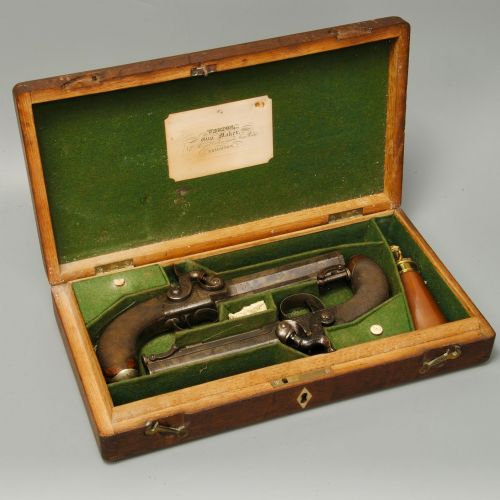
Many stocks exhibit decorative embellishments including silver-wire inlay and cast silver grotesque butt caps. Cases associated with pairs frequently utilise fitted interiors lined with baize or velvet to protect the weapons.
Antique English Handgun Retail Price Guide 2026
Typical asking prices for english handgun among the pieces listed under this phrase on Sellingantiques today, from the lower quarter to the upper quarter. They describe what is for sale here now, not the wider market.
The documented object types include flintlock pocket pistols, duelling pistols, holster pistols, and smooth-bore percussion pistols.
Judging quality and execution
Quality in these pieces is determined by the refinement of the metalwork, the crispness of the maker's signature engraving, and the complexity of the stock decoration. Superior examples display intricate silver wire inlay and finely chased mounts alongside maker signatures from notable workshops.
The integration of the mechanism into the wooden stock and the overall balance of the firearm distinguish standard production arms from workshop masterpieces. The presence of original fitted cases and matching pairs further elevates the standing of an individual piece.
HARRISON OF LONDON·MORTIMER·James Barber·H.W. Mortimer & Son·R. Willoughby·John Rimes·DUTTON·A.W Spires
The Antique English Handgun Glossary
- Flintlock
- An ignition mechanism utilising a flint struck against a steel frizzen to create sparks that ignite the gunpowder. This system dominated firearms technology throughout the eighteenth century.
- Percussion
- A later ignition system using a percussion cap struck by a hammer to detonate the charge. This method replaced the flintlock mechanism during the nineteenth century.
- Turn-off barrel
- A barrel that unscrews from the breech to facilitate loading from the front. This design appears on various pocket pistols of the period.
- Grotesque butt cap
- An ornamental metal end cap on the grip cast in a fantastical or exaggerated human or animal form. These silver caps decorate certain eighteenth-century stocks.
- Bore
- The interior diameter of the barrel. References to bore size denote the gauge of ammunition the weapon was designed to fire.
Antique English Handgun: Frequently Asked Questions
What is an antique English handgun?
An antique English handgun is a historical firearm produced in England during eras such as the Georgian, Regency, and Victorian periods. These pieces operate primarily on flintlock or percussion ignition systems.
They represent historical developments in personal defence and mechanical engineering from the eighteenth and nineteenth centuries.
How do I date an antique English handgun?
Dating relies on stylistic markers, mechanical systems, and maker signatures inscribed on the lockplate or barrel. Flintlock mechanisms generally point to the eighteenth century, while percussion systems align with the nineteenth century.
Specific periods like the Regency or Georgian eras provide broader chronological brackets supported by registered proof marks.
Were these pistols made in pairs?
Many fine pistols from this era were produced as matched pairs intended for duelling or officer use. These matched sets were often housed in dedicated wooden cases lined with baize or velvet.
Single pocket or holster pistols were also common for personal protection during travel.
What materials were used in their construction?
Makers utilised steel and iron for the barrels and firing mechanisms to withstand gunpowder ignition. The stocks were typically carved from walnut or mahogany to provide a durable grip.
Decorative elements frequently incorporated silver wire inlay and silver butt caps.
Where were these firearms manufactured?
Production was centred around major British gunmaking hubs, most notably London and Birmingham. Master gunmakers operating in these cities signed their work on the lockplates or barrels.
Provincial and metropolitan workshops alike contributed to the diverse styles seen today.