
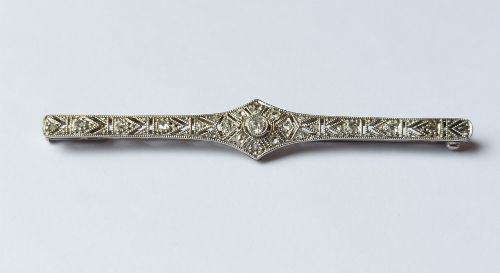
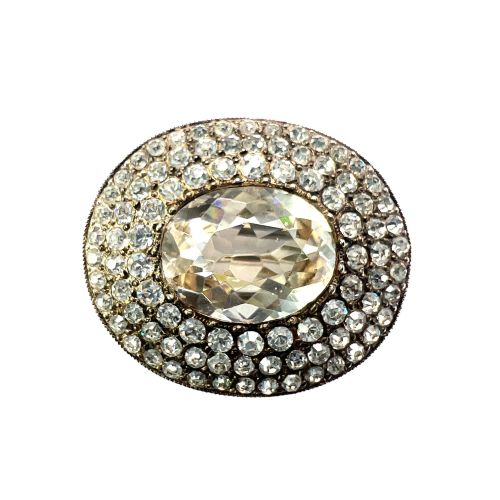


Antique Dress Clip Pin
These antique dress clip pin pieces span the Victorian period through to the 1940s, offering versatile fastening jewellery for lapels and collars.
Antique Dress Clip Pin
An antique dress clip pin functions as both a functional fastener and a decorative accent, appearing across Victorian, Edwardian, and Art Deco periods. These items commonly take the form of brooches and pins fabricated in silver, gold, and platinum.
The selection ranges from delicate paste glass items and enamelled botanical motifs to substantial platinum mountings set with diamonds and sapphires. Pieces from the 1920s and 1930s dominate the selection with distinct geometric lines and white metal settings.
Makers from various regions contributed to this category, including Chinese export workshops, Scandinavian silversmiths, and French jewellers. Formats extend from simple bar brooches to large novelty designs and convertible cape clips.
Materials and construction methods
Platinised and silver settings dominate the high-end pieces, providing a secure, bright foundation for old-cut diamonds and coloured gemstones. Artisans also utilised yellow gold and white gold alongside sterling silver and silver gilt.
Decorative surfaces frequently incorporate enamel work, marcasite settings, and paste glass to achieve colour and texture without relying solely on precious stones. Filigree wirework and pierced galleries demonstrate the detailed metal manipulation typical of the nineteenth and early twentieth centuries.
Period styles span Victorian, Edwardian, Art Deco, Chinese export, and 1940s retro designs across multiple European origins.
Distinguishing quality in period pins
The standard of gem-setting separates standard items from exceptional examples, particularly in how securely stones are flush-set or bezel-set within platinum and gold. Heavier metal gauge and intricate piercing on the reverse indicate superior workshop execution.
The complexity of the design and the integration of diverse materials, such as combining rock crystal quartz, onyx, chrysoprase, and diamonds, demonstrate higher manufacturing ambition. Original patination and intact enamel without loss or restoration preserve the integrity of the piece.
The Antique Dress Clip Pin Glossary
- Paste glass
- Hand-cut glass pieces used to simulate gemstones in period jewellery. It is foil-backed in older items to enhance reflectivity.
- Marcasite
- Small faceted pieces of iron pyrites set into silver to provide a dark, metallic sparkle. This material was favoured in 1930s geometric designs.
- Silver gilt
- Sterling silver that has been coated with a thin layer of gold. This technique provides the appearance of solid gold while utilising a silver base.
- Filigree
- Delicate openwork jewellery created by twisting and soldering fine threads of gold or silver wire. It often creates lace-like patterns in Victorian and continental pieces.
- Cape clip
- A functional fastener designed to secure heavy outerwear or capes at the neck. These items double as ornamental brooches.
Antique Dress Clip Pin: Frequently Asked Questions
How do I wear an antique brooch?
Secure the pin firmly through heavy fabrics such as wool coats, lapels, or structured collars to support the weight of the metal and stones.
Position the piece horizontally on a lapel or vertically down a dress placket, ensuring the safety catch is fully engaged before stepping out.
What periods do these pins cover?
The pieces span from the late nineteenth century through the Edwardian era and into the Art Deco and 1940s Retro periods.
Victorian and Edwardian examples lean towards organic motifs and yellow gold, whilst 1920s and 1930s items favour platinum, geometric lines, and diamond settings.
How do I clean antique silver jewellery?
Use a soft, dry microfibre cloth to gently remove surface dust from silver and platinum mountings without disturbing set stones.
Avoid liquid dips or harsh chemical cleaners, as these substances can damage delicate enamel work, paste glass foils, and marcasite settings.
Are these pieces suitable for daily wear?
Sturdy platinum and gold mountings from the Edwardian and Art Deco eras withstand regular wear when handled with reasonable care.
Items set with fragile paste glass, delicate enamel, or hollow filigree require more mindful placement to prevent accidental impact or bending.