


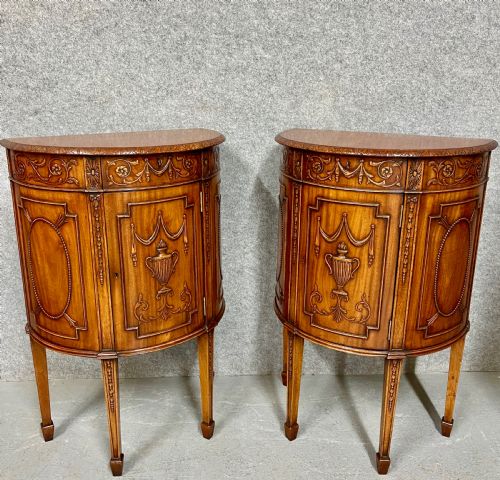
Antique Demilune Cupboard
These antique demilune cupboard pieces bring curved elegance to a room, offering practical storage with a distinctive half-round silhouette.
Antique Demilune Cupboard
An antique demilune cupboard takes the form of a half-circle or half-round cabinet, designed to fit flush against a wall while saving floor space. Buyers searching this phrase encounter side cabinets, commodes, and console cabinets originating from periods such as the eighteenth century, the Regency era, and the nineteenth century.
The pieces appearing on this page span several distinct stylistic revivals, including Louis XV, Sheraton, Adam, and Hepplewhite designs. English and French workshops produced these items using sophisticated forms like side cabinets and chests of drawers to furnish elegant interiors.
Craftsmen built these half-round cupboards to serve as functional focal points in hallways, drawing rooms, and dining spaces. The surviving examples showcase the enduring appeal of curved cabinetry across multiple design epochs.
How these cupboards were made
Cabinetmakers utilised dense primary timbers such as mahogany, satinwood, and rosewood, often pairing them with exotic veneers like burr elm, burr yew, and kingwood. These woods formed the curved carcasses of the commodes and side cabinets.
Surface decoration frequently involved intricate marquetry and hand-painted motifs, sometimes complemented by vernis martin techniques. Tops were finished with polished marble slabs or fine wood, while mounts of ormolu and brass added structural and decorative accents.
Materials recorded across the current inventory include marble, ormolu, brass, paint, and fine hardwoods such as kingwood, rosewood, and satinwood.
What varies in quality
The refinement of the timber and veneer selection sets finer pieces apart, particularly the intricate execution of marquetry patterns on satinwood or the choice of burr woods. Superior examples display seamless alignment across curved drawer fronts and cabinet doors.
The application of decorative elements, from hand-painted details to cast ormolu and brass mounts, dictates the overall standard of craftsmanship. Original marble tops and the integrity of the underlying mahogany or rosewood carcass further distinguish the grade of each piece.
The Antique Demilune Cupboard Glossary
- Demilune
- A half-moon shape or half-round design used for tables and cupboards to allow placement against flat walls.
- Commode
- A low chest of drawers or cabinet, frequently associated with French or Georgian interior styles.
- Marquetry
- Inlaid woodwork forming decorative patterns using various tinted woods and veneers.
- Ormolu
- Gilt bronze mounted onto furniture as a decorative and protective embellishment.
- Vernis Martin
- A type of simulated Japanese varnish developed in France to create translucent painted finishes on cabinets.
Antique Demilune Cupboard: Frequently Asked Questions
Where should I place a demilune cupboard?
These half-round cabinets suit narrow hallways, entryways, and reception rooms where floor space is limited. Their curved profile allows them to sit flat against a wall without obstructing foot traffic.
They also function effectively as serving surfaces in dining rooms or display ledges beneath wall mirrors in drawing rooms.
How do I identify a Georgian demilune piece?
Georgian examples often feature solid mahogany or satinwood construction with restrained classical details reflecting Adam or Hepplewhite influence. Look for precise inlay work and understated proportions rather than heavy ornamentation.
English makers of this period favoured architectural symmetry and fine timber grains over painted surfaces.
What is the difference between a commode and a side cabinet?
A commode typically refers to a low chest of drawers with doors or drawers accessible from the front, often possessing a grander decorative scheme. Side cabinets encompass a broader category of storage furniture built for specific utility against a wall.
Both forms appear frequently in French and English designs from the eighteenth and nineteenth centuries.
Are marble tops original to these cabinets?
Many French commodes and cabinets feature fitted marble tops designed to provide a durable and luxurious surface. These slabs were integrated into the initial construction to balance the weight of the wooden carcass.
Checking the fit against the curved wooden frame helps confirm whether the top belongs to the piece.
How do I care for satinwood and marquetry?
Keep delicate veneered surfaces away from direct sunlight and consistent moisture to prevent fading and lifting of the inlay. Regular dusting with a soft, dry cloth preserves the polished finish.
Avoid commercial silicone polishes and consult a specialist for any restorative maintenance.