
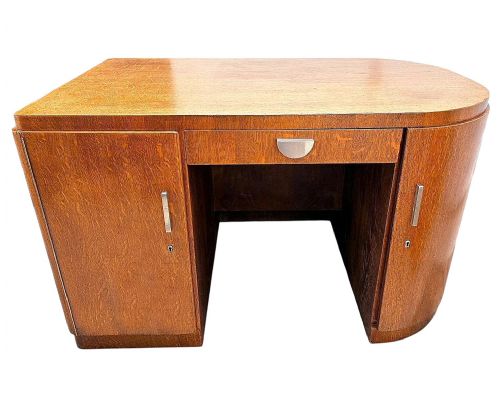
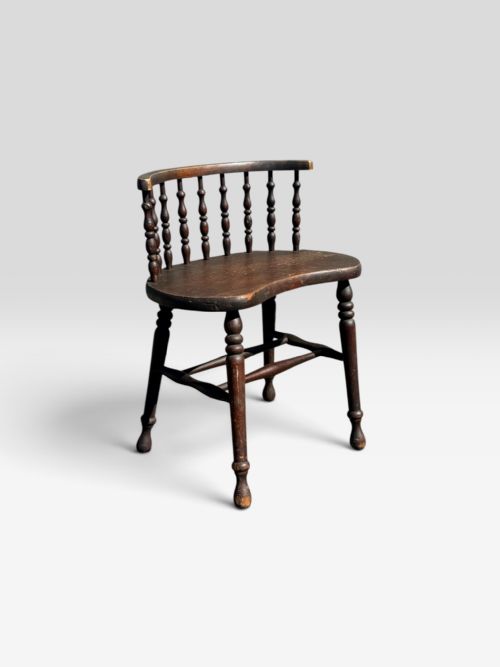
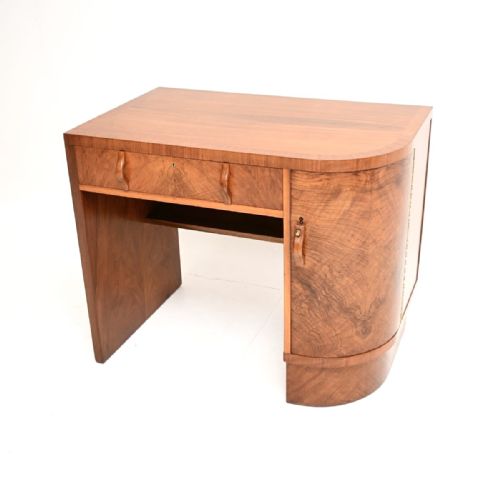
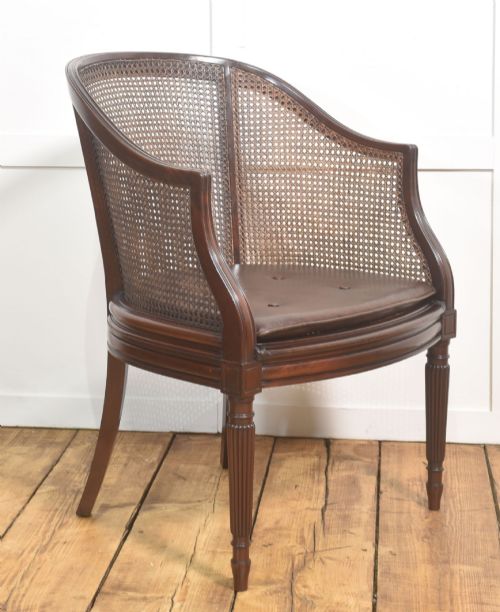
Antique Curved Desk
An antique curved desk offers an elegant sweep of timber and leather, designed to sit comfortably within a room rather than flat against a wall.
Antique Curved Desk
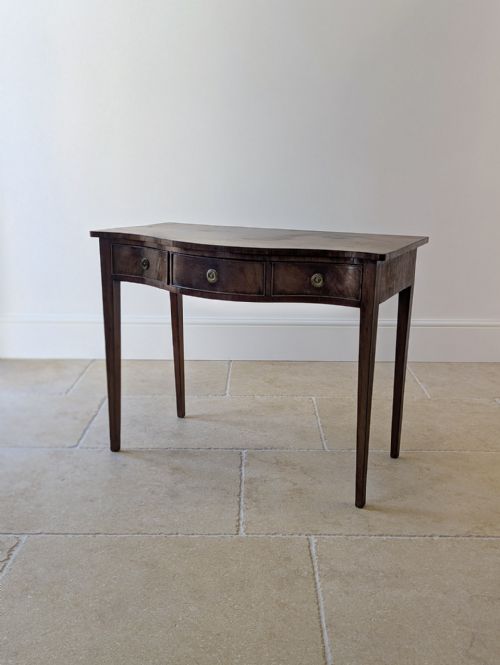
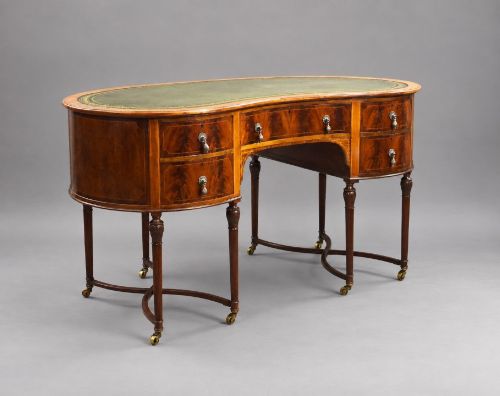
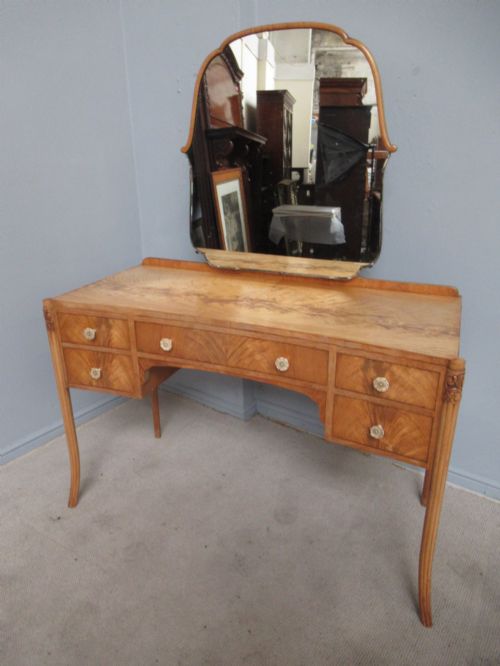
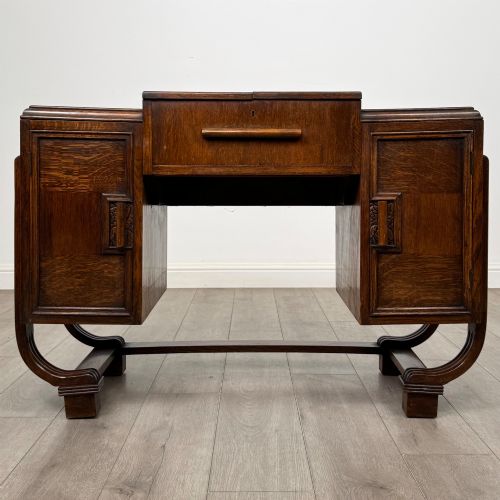
An antique curved desk encompasses graceful forms like kidney-shaped writing tables and serpentine or curved-front pedestals. These pieces emerge across the Georgian, Victorian, Edwardian, and Art Deco periods.
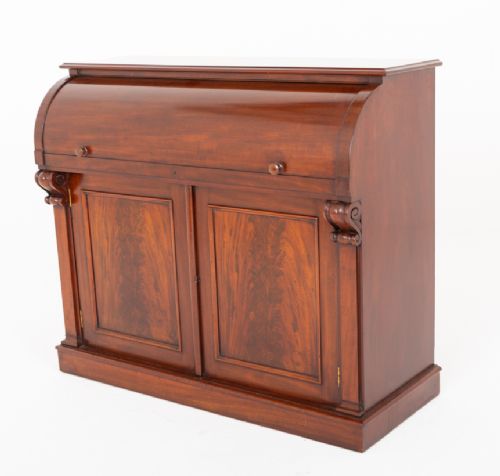
The Edwardian era contributes numerous kidney-shaped writing desks in mahogany and satinwood, while Victorian examples often feature cylinder fronts or twin pedestals with curved drawer sections.
Makers utilised these sweeping silhouettes to soften the geometry of a study or library, ensuring the furniture functions from multiple angles.
Materials and construction
Cabinet makers built these desks using foundational timbers such as mahogany, oak, walnut, and maple, frequently selecting flame mahogany or figured walnut for visible surfaces.
Inlaid details in satinwood and contrasting veneers define many Edwardian and Sheraton style pieces, whilst brass hardware and leather writing surfaces complete the construction.
Listings feature mahogany, oak, walnut, satinwood, maple, brass, and leather across periods spanning the Georgian era to Art Deco.
Judging the standard
Quality rests in the precision of the curved joinery and the selection of timber veneers, such as well-matched flame mahogany or figured walnut. Finer desks display seamless integration of drawers along a radius and retain original leather inserts.
Structural integrity in the carcase and refined inlay work distinguish superior examples from simpler utilitarian pieces produced across the periods.
Louis Auguste Moreau
The Antique Curved Desk Glossary
- Kidney-shaped
- A desk or table featuring a concave curve on the working side and a convex curve at the rear, resembling a bean. This form became particularly popular during the Edwardian and late nineteenth-century periods.
- Cylinder desk
- A writing table fitted with a rolling cylindrical wooden shutter that conceals the pigeonholes and writing surface when closed. Georgian and Victorian makers favoured this mechanism for a neat appearance.
- Serpentine
- A furniture front or edge shaped with a central convex curve flanked by two concave curves. This outline appears on Georgian and Victorian desks and side tables.
- Satinwood
- A dense, hard timber with a golden sheen used extensively for fine stringing, banding, and veneering on Edwardian and Sheraton revival furniture.
Antique Curved Desk: Frequently Asked Questions
What is a kidney desk?
A kidney desk takes its name from its characteristic kidney bean outline, featuring a curved front edge that wraps around the user.
Craftsmen produced these primarily in mahogany and satinwood during the Edwardian and late nineteenth-century eras for domestic studies.
How do I date a curved desk?
Dating relies on combining the timber species, secondary woods, hardware, and prevailing style, such as Georgian serpentine lines or Art Deco maple veneers.
Construction methods inside the drawers and the presence of hand-cut dovetails offer further chronological clues.
Are these desks practical for daily use?
Many curved writing desks provide ample surface area and integrated storage drawers suitable for contemporary writing and laptop use.
Original leather inserts often feature tool-stencilling and offer a durable, pleasant writing surface.
What is a Carlton House desk?
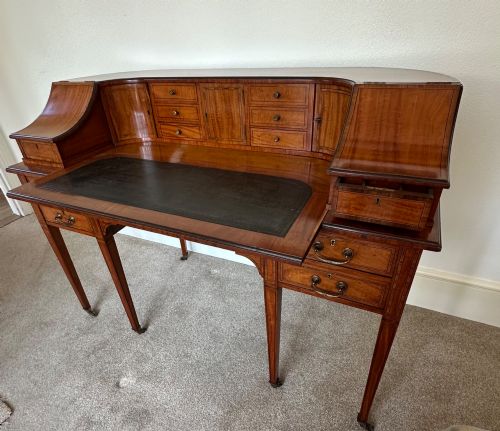
A Carlton House desk is a specific form of writing table featuring a curved superstructure of small drawers and compartments wrapping around the back and sides of the writing surface.
Originating in the Georgian period, Edwardian workshops later revived this complex and sought-after design.