


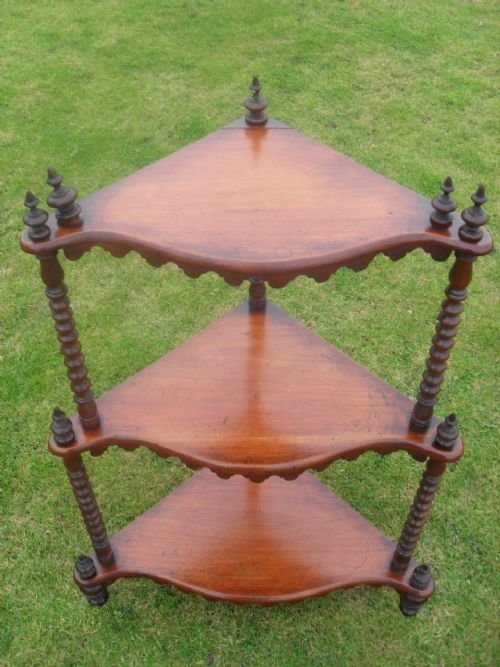
Antique Corner Bookshelf Unit
These antique corner bookshelf unit pieces are tiered display pieces and whatnots designed to fit snug against a room junction.
Antique Corner Bookshelf Unit
When you search for an antique corner bookshelf unit, you encounter multi-tiered display stands and whatnots designed to utilise unused room angles. These pieces offer vertical storage across graduated shelves, corner cabinets, and etagere forms.
The versions most commonly met on this page span the nineteenth century and the Edwardian era, predominantly built in mahogany or burr walnut. They range from open three-tier and four-tier shelving structures to enclosed cupboard variants.
How they were made
Cabinetmakers constructed these pieces primarily from solid and veneered hardwoods such as mahogany, rosewood, and burr walnut, frequently incorporating satinwood inlay for decorative contrast. Structural joints often rely on traditional cabinetmaking methods suited to weight-bearing tiers.
Hardware details such as brass fittings appear on specific variations, while glass and mirror elements integrate into display-oriented forms like corner cabinets and etageres.
At least one historic maker spelt the word as watnot, proving that even Victorian cabinetmakers occasionally struggled with their spelling after a long day at the workbench.
What varies in quality
The distinction between standard domestic examples and top-tier exhibition pieces rests on timber selection and decorative execution. Highly figured burr walnut and intricate satinwood inlay elevate a piece beyond plain mahogany construction.
The architectural complexity of the tiers, ranging from simple graduated open shelves to serpentine fronts and integrated cupboards, dictates the overall refinement of the design.
The Antique Corner Bookshelf Unit Glossary
- Whatnot
- A tiered movable set of shelves used for displaying ornaments or books. These pieces typically feature three or four levels supported by turned or carved uprights.
- Etagere
- A piece of furniture consisting of a number of open shelves for displaying small objects. This French term frequently overlaps with the traditional English whatnot.
- Burr walnut
- Timber taken from the warted growths on walnut trees, prized for its swirling grain patterns. Cabinetmakers sliced this wood into thin veneers for decorative surfaces.
- Serpentine front
- A furniture front characterised by a concave central section flanked by two convex curves, or the reverse. This flowing contour requires advanced woodworking skill.
Antique Corner Bookshelf Unit: Frequently Asked Questions
What is an antique corner bookshelf unit?
These items are tiered wooden storage structures designed specifically to slot into ninety-degree room angles. They provide vertical display space without dominating floor area.
Most examples feature graduated shelves supported by slender pillars, though some incorporate lower cupboards for concealed storage.
How were these corner units used historically?
Earlier households utilised them in parlours and drawing rooms to display books, ceramics, and decorative ornaments. The corner placement kept walkways clear while maximising display capacity.
They served as practical furniture for both decorative presentation and daily organisation in period interiors.
What woods should I expect to see?
Mahogany and walnut form the basis of most surviving nineteenth-century examples. Finer pieces incorporate burr walnut veneers or contrasting satinwood inlay.
Rosewood also appears on select etagere and tier variations from the same period.
How do I identify a Victorian whatnot?
Victorian pieces typically display distinct column supports and rich timber grains such as burr walnut or dark mahogany. Tier counts usually range between three and four levels.
Details like serpentine fronts and brass mounts help distinguish exhibition quality pieces from standard workshop builds.