
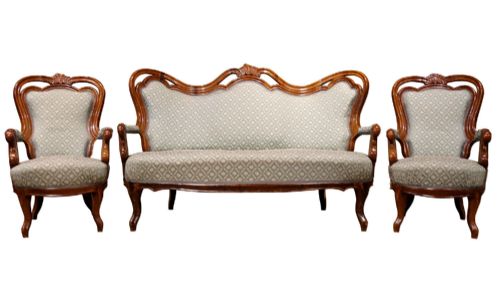
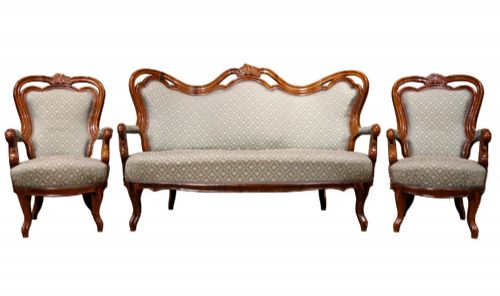


Antique Continental Sofa
An antique continental sofa brings warmth and historic craftsmanship to a room.

Antique Continental Sofa
When you search for an antique continental sofa, you encounter seating shaped by European cabinetmakers across the eighteenth and nineteenth centuries. These pieces encompass stately settees, salon suites, and wing settees originating from regions including Italy, Germany, and the Netherlands.
The version you are most likely to meet on this page is walnut or mahogany, with styles spanning Biedermeier restraint and elaborate Rococo revival curves. They serve as functional seating while carrying the distinct aesthetic of nineteenth-century European interiors.
How they were made
Cabinetmakers utilised robust structural timbers such as walnut, mahogany, and oak, often shaping the frames with hand tools. Decorative elements rely on natural wood grains, while marquetry details add precise surface patterns to specific pieces.
Upholstered sections depend on traditional textiles, velvet, and linen, secured over supportive frames. Brass accents occasionally appear as structural or decorative hardware, complementing the exposed woodwork.
Listings feature walnut and mahogany predominantly, spanning the eighteenth and nineteenth centuries with Biedermeier and Rococo styles.
What varies in quality
Quality rests upon the crispness of the timber carving and the architectural proportion of the frame. Pieces displaying fluid Rococo curves or restrained Biedermeier lines show the maker's command over the material.
The integrity of the structural timber and the retention of original surface patination distinguish finer examples from standard production. Upholstery choices and fabric selection further reflect the original commission's status.
The Antique Continental Sofa Glossary
- Biedermeier
- A style characterised by utilitarian comfort, clean lines, and minimal ornamentation that emerged in Central Europe during the nineteenth century. It focuses on the natural beauty of wood veneers over heavy carving.
- Rococo Revival
- A nineteenth-century revival movement mimicking the asymmetrical C-scrolls, naturalistic foliage, and flowing contours of the eighteenth-century French style. It dominates many salon suites and settees from this period.
- Marquetry
- The art and craft of applying pieces of veneer to a structure to form decorative patterns and pictures. It appears frequently on tabletops and decorative panels from the nineteenth century.
- Salon suite
- A matched set of seating furniture, typically comprising a larger settee and matching chairs. These groupings outfitted formal nineteenth-century reception rooms.
Antique Continental Sofa: Frequently Asked Questions
What is a continental sofa?
A continental sofa refers to seating produced in mainland Europe rather than Great Britain, encompassing diverse regional styles from the eighteenth and nineteenth centuries.
These pieces reflect the distinct design movements and local timber choices of countries such as Germany, Italy, and the Netherlands.
How do I identify a Biedermeier sofa?
Biedermeier sofas feature restrained lines, smooth surfaces, and a focus on clean architectural form rather than excessive ornamentation.
They typically utilise native timbers like walnut, mahogany, or ash, relying on wood grain rather than carved decoration for visual interest.
Were these sofas used in formal rooms?
Many of these pieces were created for formal reception rooms and parlours, often as part of larger matching salon suites.
Their decorative carvings and upholstered finishes made them suitable for entertaining guests in nineteenth-century homes.
What woods were commonly used?
Cabinetmakers predominantly relied on dense hardwoods such as walnut and mahogany for structural stability and fine carving.
Other materials like oak, maple, and ash also appear, occasionally enhanced with contrasting wood veneers and marquetry details.