


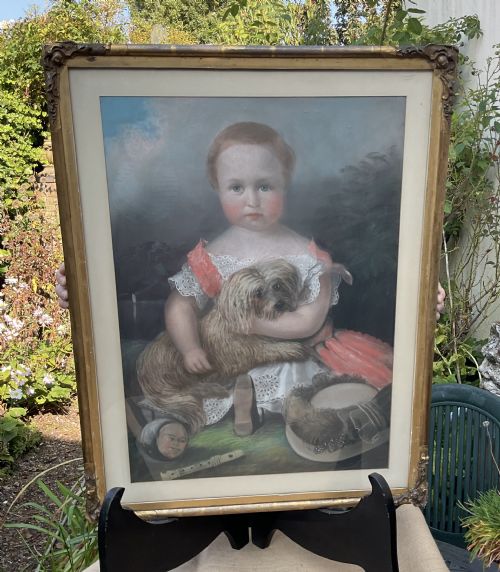


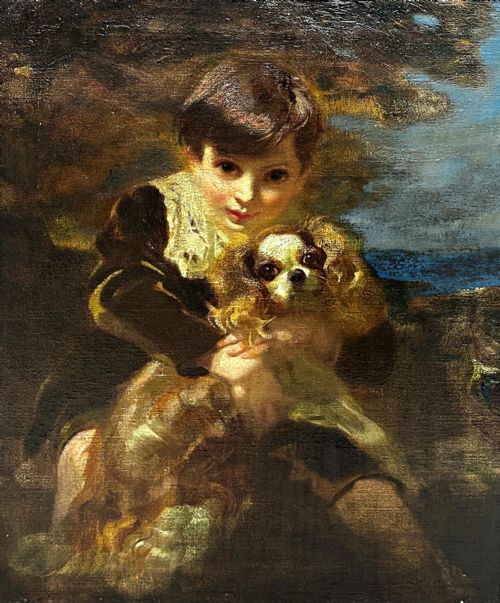


Antique Child Dog Painting
An antique child dog painting captures a timeless domestic bond through centuries of portraiture.
Antique Child Dog Painting
An antique child dog painting presents a historic visual record of young subjects accompanied by their pets, spanning from the seventeenth century through to the mid twentieth century. These works appear in various forms, including oil paintings on canvas, delicate watercolours, pastels, and framed silhouettes. Viewers frequently encounter provincial and naive folk art interpretations alongside academic works, depicting subjects ranging from royal youths to children in cottage gardens.
The compositions capture familial affection and status through the inclusion of spaniels, terriers, and ponies. Many pieces originate from British and Northern European schools, reflecting the shifting fashions of childhood dress and portraiture traditions. Whether rendered as a large Victorian canvas or an early provincial panel, each piece documents a specific moment in domestic history.
Materials and Technique
Artists primarily employed oil paint applied to canvas, wood panels, or paper, occasionally utilising pastel mediums for softer textures. Canvases are frequently housed in period giltwood frames, whilst earlier works on panel demonstrate historical wooden repairs on the reverse.
Watercolour and ink on paper appear in framed works, protected beneath glass. The execution ranges from the refined brushwork of academic portraitists to the direct, unpretentious methods seen in naive folk art.
Listings feature oil on canvas, paper, glass, and gilt wood across Victorian, Georgian, and seventeenth century periods.
Distinctions in Quality
Quality rests upon the artist's ability to render the personality and proportions of both child and animal with convincing life. Superior works display a careful handling of light across fabrics and fur, whereas lesser examples rely on formulaic gestures and rigid compositions.
The preservation of the original surface, pigment stability, and the integrity of the period frame significantly influence the standing of an individual piece.
John Alfred Wheeler·Mary Beale·Arthur Claude Strachan·Frank Owen Salisbury·Richard Buckner
The Antique Child Dog Painting Glossary
- Naive art
- A style of visual art created by a person without formal training, often characterised by a childlike simplicity in perspective and proportion.
- Provincial school
- Art produced by regional practitioners outside major metropolitan artistic centres, typically reflecting local tastes and traditions.
- Giltwood
- Wood that has been treated with a thin layer of gold leaf or gilt powder, commonly used for ornate historical picture frames.
- Silhouette
- A solid dark image of a subject's profile, typically cut from paper or painted against a pale background.
Antique Child Dog Painting: Frequently Asked Questions
What periods do these paintings cover?
The available selection spans from the seventeenth century through the Georgian and Victorian eras up to the mid twentieth century. Early examples include seventeenth century Northern European works alongside eighteenth century English school portraits.
Later pieces extend into Victorian folk art and twentieth century realism, offering a broad chronological range of domestic portraiture.
How were these artworks typically framed?
Many oil paintings are presented in period gilt wood frames that complement the age of the canvas. Other works utilise maple frames or simple wooden surrounds suited to watercolours and silhouettes.
The framing often reflects the domestic setting for which the portrait was originally commissioned.
What dog breeds appear in the paintings?
King Charles Spaniels and various terrier breeds frequently accompany the young subjects in these historic works. These animals often symbolised loyalty and companionship within family portraits.
Equestrian scenes also incorporate ponies alongside the family pets.
Are these works signed by the artists?
Some pieces bear signatures or attributions to named painters, whilst many historical works remain attributed to regional schools or anonymous makers. Provincial and naive pieces frequently lack explicit signatures.
Stylistic comparison and subject matter often help determine the origin of unsigned portraits.