





Antique Chandelier Wall Lights
These antique chandelier wall lights bring genuine sparkle to a room, combining the branching form of chandeliers with the practical placement of wall sconces.
Antique Chandelier Wall Lights
When you search for antique chandelier wall lights, you are looking at decorative fittings designed to mount directly onto vertical surfaces while mimicking the drop and branch structure of larger ceiling fixtures. These pieces combine multiple candle arms or light sources into a single sconce, bringing concentrated brilliance to a wall.
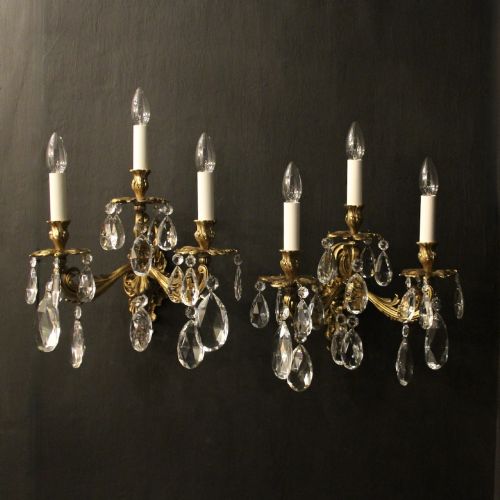
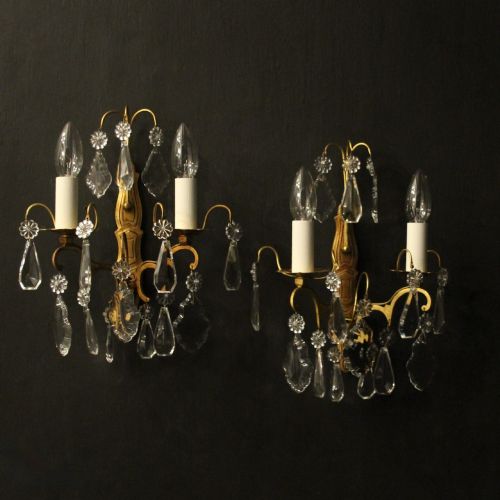
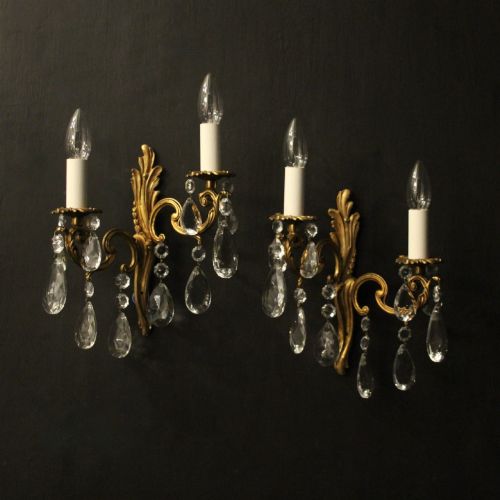
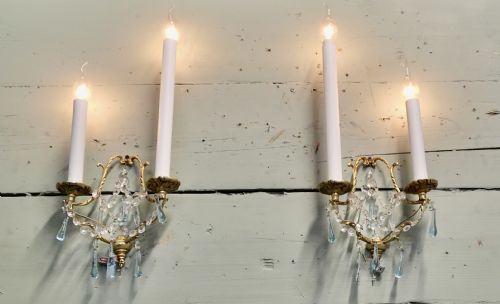
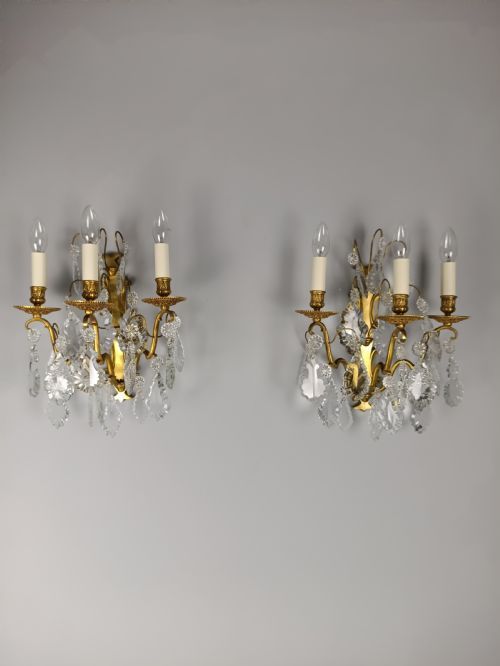
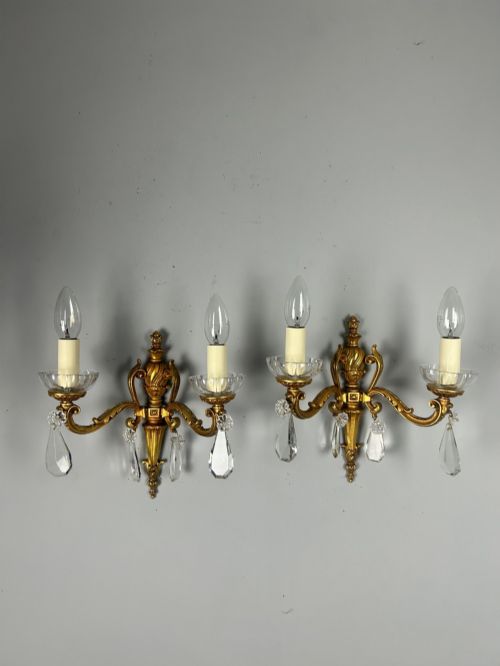
On this page, you are most likely to meet French pairs dating from the 1920 and 1930 decades, fashioned with twin or triple arms. They frequently incorporate cast metal frames and hanging crystal pendants, reflecting the enduring influence of the Louis XV style and French Rococo taste.
The selection ranges from intimate two light brackets to substantial four light and twelve light configurations framed in gilt bronze, brass, or dark metals. Alongside standard wall sconces, the listings also encompass distinct chandelier arms and related lighting assemblies.
How they were made
Makers constructed these wall lights using durable base metals such as brass and bronze, frequently applying a gilt finish to catch and reflect the candlelight. Artisans cast these metal components into ornate Baroque and Rococo scrolls, creating sturdy backplates and branching arms.
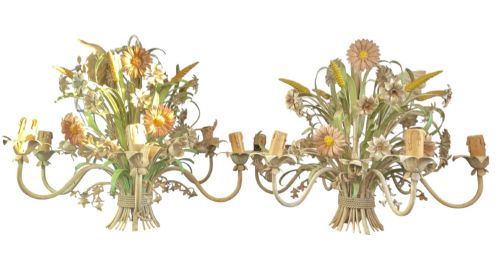
Glass and cut crystal elements form an essential part of the construction, suspended from the metal frames as pendants and drops to disperse illumination across the room. Certain pieces also integrate delicate porcelain flowers into their decorative metalwork.
Many of these vintage fittings have undergone rewiring to meet contemporary electrical standards while preserving their original period frames and decorative glass components.
Antique Chandelier Wall Lights Retail Price Guide 2026
Typical asking prices for chandelier wall lights among the pieces listed under this phrase on Sellingantiques today, from the lower quarter to the upper quarter. They describe what is for sale here now, not the wider market.
A few unexpected architectural survivors include etched and gilded angelic capitals, proving that illumination sometimes hides in heavenly places.
What varies in quality
The standard of metal casting sets the foundation for quality, distinguishing crisp, deeply chased Rococo and Baroque details from softer, shallower impressions. Finer pieces display meticulous hand-finishing on the gilt bronze or brass surfaces.
The clarity and cut of the crystal components also determine the overall caliber of the light. Precision-cut crystal drops refract light far more brilliantly than simpler moulded glass, elevating the visual impact of the fixture.
Coherence of design separates exceptional pairs and sets from assembled equivalents. Matched arms, uniform crystal drops, and intact porcelain floral additions indicate higher initial craftsmanship and better preservation.
The Antique Chandelier Wall Lights Glossary
- Gilt bronze
- Metal alloy cast into decorative shapes and coated with a thin layer of gold or gold-coloured finish. This technique provides a durable and radiant surface for French wall lights.
- Rococo style
- Design movement characterised by asymmetrical scrollwork, C-scrolls, and naturalistic motifs such as shells and foliage. It heavily influences the curved arms of these antique sconces.
- Cut crystal
- High-purity glass shaped with facets using a cutting wheel to maximise light refraction. It hangs from the arms and backplates to create a sparkling display.
- Wall sconce
- Lighting fixture fixed securely to a wall rather than suspended from a ceiling. These pieces often feature multiple branching arms to spread illumination.
Antique Chandelier Wall Lights: Frequently Asked Questions
How were these wall lights used?
These fittings were mounted in pairs or sets along reception room walls to supplement central ceiling chandeliers and provide localized illumination.
By placing them at eye level, rooms gained both functional brightness and decorative symmetry along wood-panelled or papered walls.
Are they difficult to install today?
Most of these fixtures mount directly onto standard wall junction boxes, though professional electrical installation is recommended due to their weight and period wiring.
Many pieces have already been rewired for modern use while retaining their historic frames and crystal drops.
How do I spot French styles?
French pieces often display characteristic Louis XV or Rococo influence through flowing asymmetrical scrollwork, gilt bronze casting, and abundant crystal pendeloques.
Makers frequently incorporated botanical motifs, such as porcelain flowers or acanthus leaves, into the metal armature.
Do they always come in pairs?
While many listings feature balanced pairs designed for flanking a mirror or fireplace, individual pieces and larger sets of four also appear.
Matching sets require careful comparison of arm counts and metal chasing to ensure visual consistency.