


Antique Ceramic Couple Statues
These antique ceramic couple statues span periods from the eighteenth century to the twentieth, offering character and history for domestic interiors.

Antique Ceramic Couple Statues
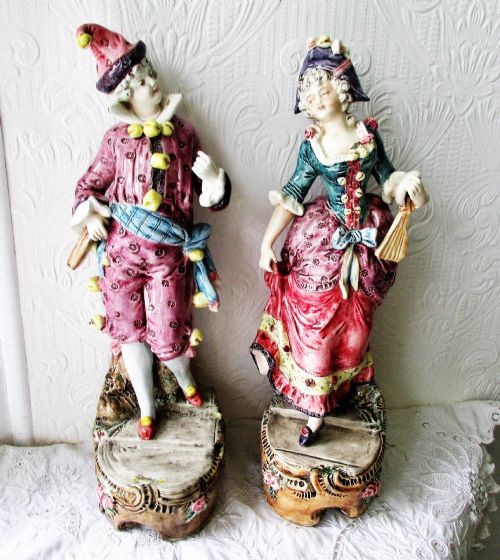
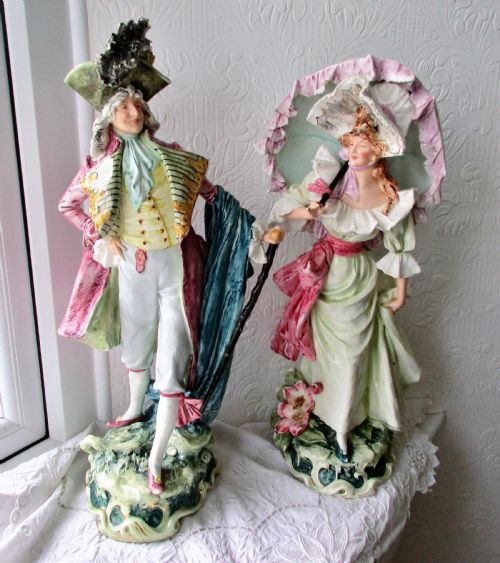
Antique ceramic couple statues comprise pairs and groupings of figures, often depicting gallants and ladies, musicians, harvesters, or theatrical companions. When you search for antique ceramic couple statues, you encounter forms ranging from large German hard-paste porcelain pieces to Staffordshire flatbacks and French faience pairs.
The selections span the eighteenth, nineteenth, and early twentieth centuries, reflecting styles such as Rococo Revival, Victorian folk art, and French Second Empire. Most examples take the form of standing or seated pairs designed for mantelpieces, sideboards, or cabinet display.
How they were made
Makers utilised earthenware, faience, and hard-paste porcelain, shaping the clay through moulding and hand-modelling before firing. Bisque porcelain provided an unglazed, matte white finish reminiscent of carved marble, whilst other pieces received glossy glaze, enamel painting, and gold leaf or gilt highlights.
Factories employed specialised artists to paint delicate facial expressions and costume details by hand over the glaze or enamel. Details such as lace elements, applied floral motifs, and structural supports required careful firing in kilns to prevent warping.
Listings feature 19th Century, Victorian, and 1830 to 1930 periods in porcelain, earthenware, and faience.
What varies in quality
Scale and ambition also distinguish the pieces, with large, finely modelled factory groups commanding greater presence than smaller, simpler folk art figures. The preservation of delicate extremities, such as fingers, instruments, and lace, determines the integrity of the surviving object.
Bourdois & Bloch Paris·Letu & Mauger Paris·Vion et Baury·C. G. Schierholz Plaue·Chantilly·Samson Paris·Royal Capodimonte Factory·Sitzendorf·Ludwigsburg
The Antique Ceramic Couple Statues Glossary
- Bisque porcelain
- Un-glazed porcelain fired once to create a matte, porous surface resembling marble. It became popular for neoclassical and romantic figures in the nineteenth century.
- Faience
- Tin-glazed earthenware produced widely in France and continental Europe. It offers an opaque white background for painted decoration.
- Flatback
- A ceramic figure modelled with a finished front and a plain, unpainted flat back designed to stand against a wall or mantelpiece.
- Hard-paste porcelain
- A durable ceramic composed of kaolin and petuntse fired at high temperatures. It originated in China and was later mastered at European kilns such as Meissen and Plaue.
- Staffordshire pottery
- Earthenware figures produced by numerous potteries in the English Midlands. They include portrait figures and theatrical pairs intended for domestic display.
Antique Ceramic Couple Statues: Frequently Asked Questions
Where were these figures displayed?
Owners placed these figures on mantelpieces, dining room sideboards, and glass-fronted display cabinets to demonstrate taste and refinement.
Pairs were often arranged symmetrically to frame a central clock or ornament.
How do I clean antique porcelain?
Dust the surface gently with a soft, dry brush to prevent dirt accumulation.
Avoid using water, harsh detergents, or immersion, particularly on pieces with enamel paint or gold leaf.
Are flatback figures hollow?
Most nineteenth-century Staffordshire flatback figures were cast as hollow forms to reduce weight and prevent cracking during the firing process.
Small ventilation holes on the underside or back allowed steam to escape from the kiln.
What is the difference between bisque and glaze?
Bisque porcelain remains unglazed after its initial firing, presenting a tactile, matte texture similar to carved stone.
Glazed porcelain receives a glassy coating that seals the ceramic body, providing a shiny, impervious finish.