



Antique Cattle Watercolour
When you buy an antique cattle watercolour, you acquire a finely rendered pastoral scene capturing rural British life across the nineteenth and early twentieth centuries.
Antique Cattle Watercolour
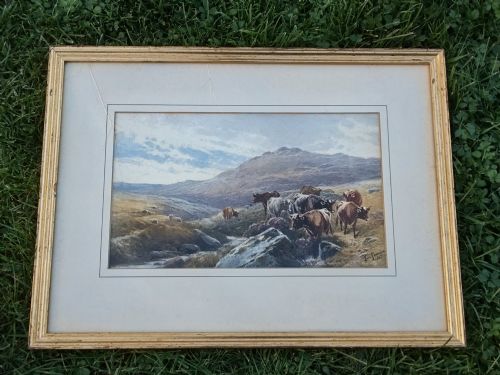
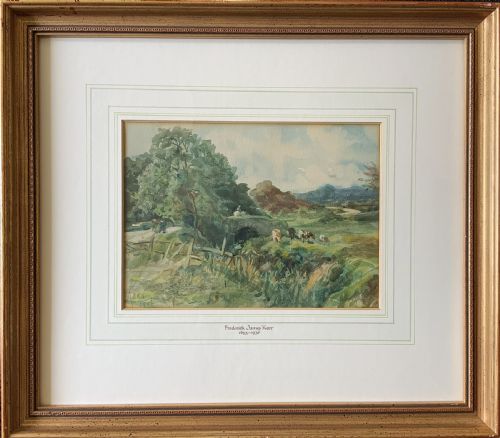
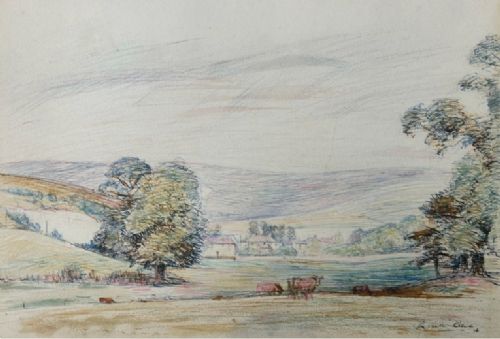
An antique cattle watercolour is an original work on paper depicting cows, bulls, or calves within British and European landscapes, ranging from quiet riverbanks to rugged highland scenes.
Most pieces encountered on this page date from the Victorian era through the early twentieth century, reflecting a period of intense artistic interest in pastoral realism and naturalism.
The compositions vary from intimate watercolours of a few watering cows to grand framed paintings showing herdsmen driving cattle across expansive rural valleys.
How They Were Made
Artists painted primarily with watercolour pigments and occasionally gouache on paper, applying washes to build luminous skies and detailed foregrounds.
Finished works were typically preserved under glass and mounted within period timber frames, often enhanced with gold leaf or gilt wood moulding.
Antique Cattle Watercolour Retail Price Guide 2026
Typical asking prices for cattle watercolour among the pieces listed under this phrase on Sellingantiques today, from the lower quarter to the upper quarter. They describe what is for sale here now, not the wider market.
The surviving works span the nineteenth century through the 1940s, executed on paper using watercolour pigment and gouache.
What Varies in Quality
Quality rests upon the artist's command of anatomical precision in the cattle and the atmospheric depth of the surrounding landscape.
Superior works demonstrate confident brushwork and harmonious colour palettes that capture specific lighting conditions, such as evening glows or river mists.
The integrity of the original framing, including period gilt wood and protective glass, also contributes to the standing of the piece.
Frederick James Kerr·Russell Sidney Reeves·Oswald Garside·Frederick Septimus Lewis·Ernest Pile Bucknall·Thomas Hunn·Robert Thorne Waite·Alfred Grey·Harold Lawes·Bernard Walter Evans·Basil Bradley·Thomas Sydney Cooper·Henry Earp Senior·John R. K. Duff·Henry Birtles·Milton Drinkwater·Henry John Kinnaird·John J. Hamer·Aster Richard Chilton Corbould·Thomas Pyne·George Graham·Stephen Enoch Hogley·David Cox Senior·Henry Charles Fox·Anthony Vandyke Copley Fielding
The Antique Cattle Watercolour Glossary
- Watercolour pigment
- Finely ground colour particles mixed with a water-soluble binder, applied in translucent washes to paper.
- Gouache
- An opaque watercolour medium containing added white pigment, used by artists to create solid highlights and dense areas of colour.
- Gilt wood
- Timber frames coated with a thin layer of gold leaf or metallic gilt, commonly used to frame Victorian fine art.
- Pastoral realism
- An artistic style focused on depicting rural life, agricultural workers, and livestock with everyday accuracy.
- Provenance
- The documented history of a painting's ownership and origin, establishing its authenticity over time.
Antique Cattle Watercolour: Frequently Asked Questions
How should I display my watercolour?
Keep your painting away from direct sunlight to prevent the watercolour pigments from fading over time.
Ensure it hangs in a stable environment with moderate humidity to protect both the paper and the original frame.
Are these paintings signed by the artist?
Many of the watercolours bear the original signature or monogram of the artist, often placed neatly in a lower corner.
Some period pieces remain unsigned or attributed to a specific school, yet retain strong stylistic qualities.
What subjects accompany the cattle?
Cattle frequently appear alongside herdsmen, milkmaids, or figures crossing rustic bridges in rural and agricultural settings.
Backgrounds often feature rivers, coastal views, ruined castles, or mountainous highland landscapes across Britain.
How do I identify the period of the painting?
Stylistic clues such as Victorian naturalism or early twentieth-century impressionism help date the execution of the artwork.
Framing materials, paper types, and artist biographical dates provide further confirmation of the historical era.