


Antique Carriage Lamps
Antique carriage lamps are robust functional lights built for travel, prized today for bringing industrial character and warm brass gleam to domestic walls.
Antique Carriage Lamps
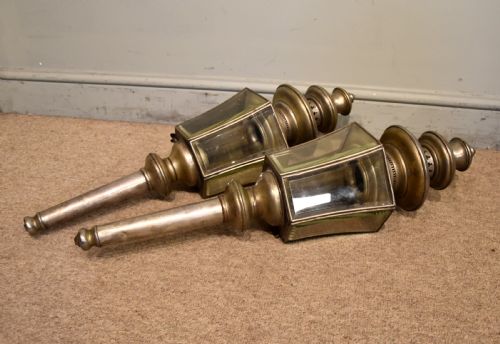
Antique carriage lamps encompass sturdy lighting fixtures originally designed for horse-drawn vehicles, trains, and maritime use, which now find a second life as striking interior wall lights and table lamps. When you search for antique carriage lamps, you encounter a diverse array of forms including pairs of coach lamps, railway carriage lights, and Pullman lamps that bridge travel history and interior decoration.
The pieces represented on this page date predominantly from the nineteenth century and the early decades of the twentieth century, spanning Victorian, Edwardian, and Arts and Crafts styles. You are most likely to meet brass and iron wall lanterns, gimbal lamps, and travelling reading lights that retain their original heavy glazing and metal frames.
Materials and construction
Makers utilised durable metals such as brass, cast iron, wrought iron, steel, and nickel plating to withstand the vibrations and weather exposure of transit. These heavy-duty materials were riveted, soldered, or cast to create rigid housings that protected the flame inside.
Glass played a central role, utilising thick clear panels, bevelled panes, or opaline shades designed to diffuse light safely while resisting wind and movement. Brass components were often polished or combined with iron elements for structural strength and visual contrast.
The selection includes specialised lighting forms such as gimbal lamps designed for ships and trains, alongside Pullman reading lights.
Evaluating quality and finish
The distinction between standard utility lighting and superior examples lies in the weight of the metalwork, the crispness of the casting, and the integrity of the original bevelled glass panes. Finer pieces demonstrate careful attention to structural joints, integrated mounting brackets, and surviving maker details.
Surface finish also dictates standing, with genuine period patination on brass and iron holding greater appeal than stripped or overly polished modern surfaces. Complete pairs with matching original fittings and uncompromised glazing command more attention than single converted lanterns.
Veritas Lamp Works·Daris
The Antique Carriage Lamps Glossary
- Gimbal
- A ring mechanism enabling a lamp to pivot and remain level despite the motion of a train, ship, or carriage. This ingenious engineering kept the flame stable during transit.
- Pullman
- A style of interior lighting associated with luxury railway carriages of the late nineteenth and early twentieth centuries. These fixtures often combined brass mounts with functional wall-mounting brackets.
- Opaline
- A milky, translucent white glass used in lamp shades to diffuse light softly without glare. It imparts a characteristic period warmth when illuminated.
- Coach lamp
- A heavy-duty exterior lantern mounted to the side of a horse-drawn vehicle to illuminate the road ahead. They typically feature robust brackets and protective glass housings.
- Wall sconce
- A lighting fixture fixed directly to a wall rather than resting on a table. In historical transport lighting, these were adapted with secure backplates for interior cabins.
Antique Carriage Lamps: Frequently Asked Questions
Can antique carriage lamps be used indoors?
These lamps transition easily into domestic interiors, frequently serving as wall-mounted accent lighting or unique table lamps in hallways and studies.
Most surviving examples have been safely converted to modern electrical wiring while preserving their original exterior metalwork and glass components.
How do I mount a carriage lamp on the wall?
Many carriage lamps retain their original iron or brass mounting brackets, designed to bolt securely onto flat exterior surfaces of vehicles or carriages.
For interior installation, a qualified electrician can adapt these historical mounting points to standard wall junction boxes safely.
What is the difference between railway and coach lamps?
Coach lamps were built to withstand outdoor weather on horse-drawn vehicles, often featuring prominent side lenses and heavy protective cowls.
Railway and Pullman carriage lamps were engineered for interior compartment lighting, prioritising compact wall-hugging profiles and gimbal stability.
How do I date a carriage lamp?
Dating relies on examining the transition from nineteenth-century hand-finished brass and ironwork to early twentieth-century industrial production methods.
Design motifs such as Arts and Crafts brackets, Edwardian opaline glass, or Victorian maritime brass provide reliable chronological markers.