
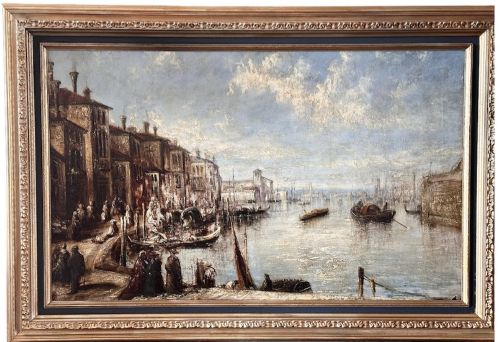


Antique Canal Scene Painting
An antique canal scene painting captures the historic waterways of Venice, Amsterdam, and British rivers through the eyes of nineteenth and twentieth-century artists.
Antique Canal Scene Painting
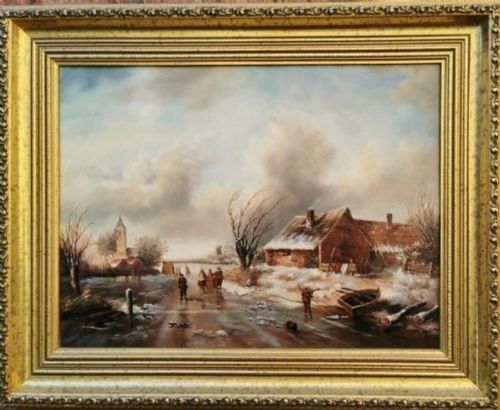
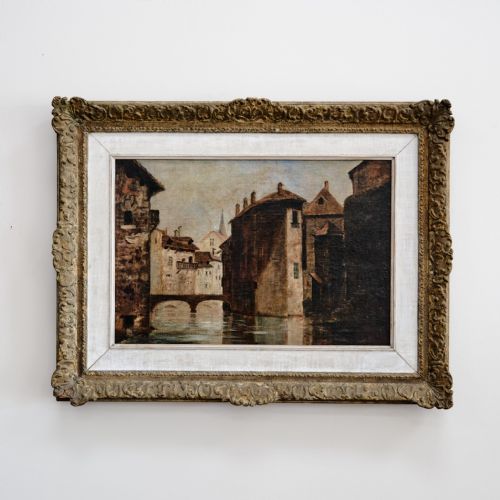
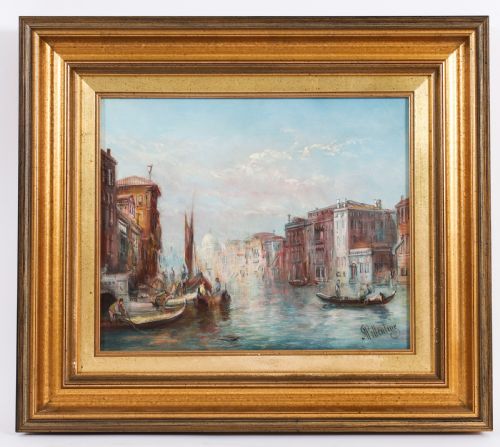
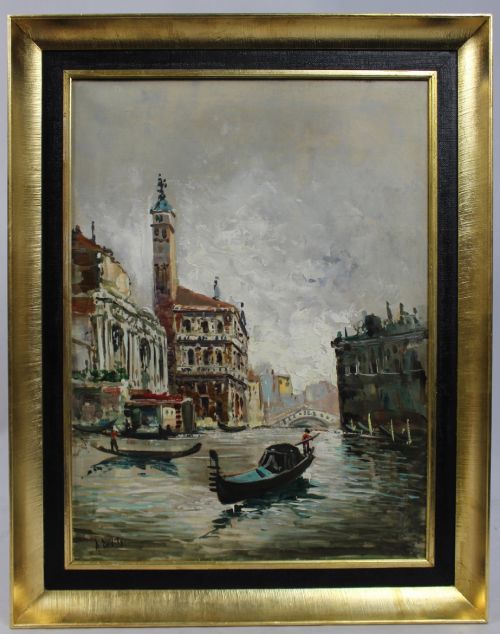
An antique canal scene painting depicts urban waterways, locks, and barges, with Venetian views dominating the selection alongside Dutch landscapes and British river towns. These works capture bustling commercial traffic, quiet winter waters, and grand architectural palazzos under various atmospheric conditions.
The pieces on this page span the Victorian era, the Edwardian period, and mid-twentieth-century movements, originating from British, French, Dutch, and German schools. Buyers frequently encounter watercolours on paper alongside oil paintings on canvas depicting iconic locations like the Grand Canal and local locks.
Domestic waterways appear alongside international vistas, showing figures at work on barges, locks, and quaysides. Painters record specific locations from Stratford-upon-Avon to Bruges and Venice, applying varied techniques from tight academic realism to loose impressionism.
How these paintings were made
Artists painted primarily with oil on canvas or applied watercolour to paper, occasionally employing pastel, gouache, and ink pen to capture atmospheric water reflections. Canvases are stretched over wood frames, while works on paper require protective glazing.
Giltwood and gesso frames frequently house these paintings, providing ornamental borders that complement the artistic styles of the nineteenth and twentieth centuries. Framing methods reflect the period of creation, ranging from heavy ornate mouldings to simpler wooden profiles.
Gondoliers navigate historic canvases past frozen Dutch windmills and sunlit Venetian palazzos.
What varies in quality
Quality rests upon the artist's ability to render the reflective quality of water and the correct perspective of surrounding architecture and bridges. Master painters balance light and shadow across canals to create depth, whereas lesser works rely on stiff, formulaic compositions.
The handling of atmospheric light, particularly in Venetian lagoon scenes and Dutch winter landscapes, distinguishes accomplished hands from standard decorative output. Fine brushwork and confident watercolour washes separate master practitioners from unsigned or derivative studio copies.
Alfred Pollentine·Francis Moltino·Edwin Lord Weeks·Thomas Baker·Fred Lawson·Claude Jousset·Frederick Tully Lott·Marc Aldine·Antoine Bouvard Senior·Jan van Couver·Jane Vivian·William Raymond Dommersen·Vittore Zanetti Zilla·Herbert Royle·Frank Wasley·Thomas Pyne·William Knox·GH Thompson·Arthur Netherwood·Ludwig Hermann·John D Walker
The Antique Canal Scene Painting Glossary
- Oil on Canvas
- Pigments bound in a drying oil medium applied to a stretched woven fabric support. This technique allows for rich colour blending and textured brushwork.
- Watercolour
- A painting method where fine pigments are suspended in a water-soluble binder on paper. It produces translucent washes and delicate tonal gradations.
- Giltwood
- Wood carved and coated with a thin layer of gold leaf or metallic powder. It forms the decorative surface of many traditional Victorian picture frames.
- Gesso
- A plaster-like mixture applied to wood frames to create a smooth surface for gilding. It enables intricate moulded relief details.
- Impressionism
- An art movement focusing on transient effects of light and spontaneous brushstrokes. Practitioners capture the immediate visual impression of a scene rather than meticulous detail.
Antique Canal Scene Painting: Frequently Asked Questions
Where were most canal scenes painted?
Venice remains the most frequent subject for these artists, particularly the Grand Canal, the Doge's Palace, and the Bridge of Sighs. Dutch waterways and British canals around Yorkshire and Stratford also appear regularly.
Artists travelled extensively to record European waterways, combining topographical accuracy with romantic atmospheric effects. Venice proved especially popular with British and French painters seeking dramatic light and historic architecture.
How should I hang an oil painting?
Hang paintings away from direct sunlight and steady heat sources to protect the canvas and the original giltwood frame. Ensure the wall fixings match the substantial weight of framed canvases.
Position the work at eye level where ambient lighting enhances the colours without causing distracting glare on the varnish or glass. Stable indoor humidity prevents wood warping and canvas tension issues.
How do I distinguish watercolours from oils?
Watercolours are painted on paper and require glass protection, showing transparent washes where the texture of the paper remains visible beneath the pigment. Oil paintings use a heavier paint layer on canvas or wood panels and lack glass.
Oils display visible brush texture and impasto, whereas watercolours rely on fluid application and paper brightness for highlights. Examining the surface closely under good light reveals these fundamental medium differences.
What periods do these paintings cover?
The selection spans from the nineteenth-century Victorian era through the Edwardian period into mid-twentieth-century modernist interpretations. Most works date from the late 1800s to the 1930s.
Styles shift from academic realism and detailed topographical views towards impressionist and expressionist approaches by the mid-twentieth century. Dates are often recorded in signatures or archive records accompanying the pieces.