



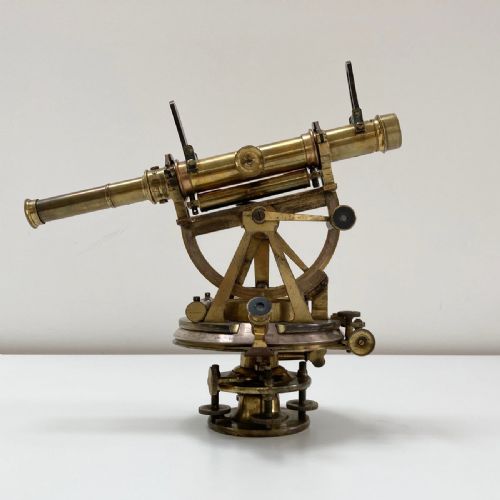

Antique Brass Transit
An antique brass transit is a precision surveying and navigation instrument built to measure angles, designed for the field and observatory alike.
Antique Brass Transit
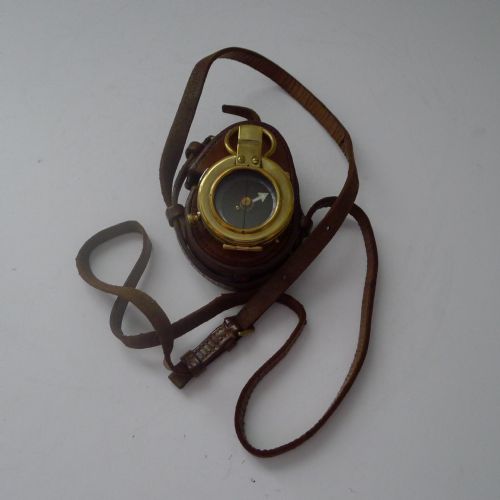
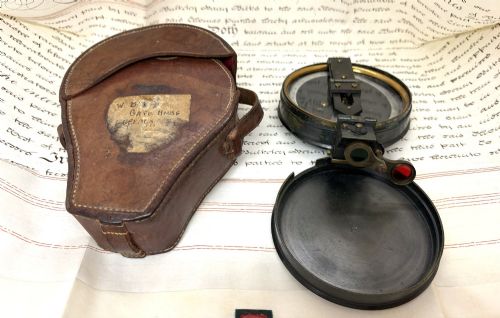
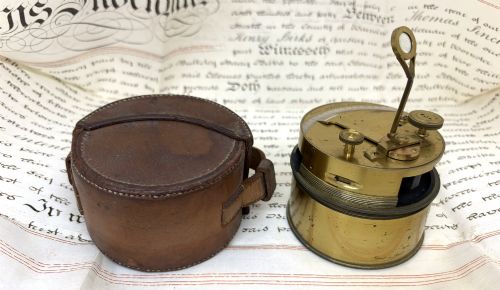
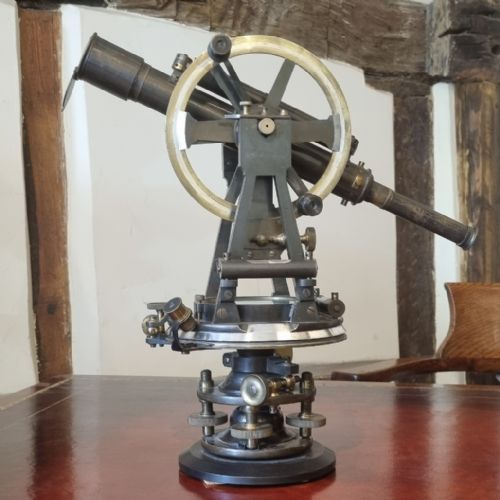
When you search for an antique brass transit, you are looking at nineteenth-century and early twentieth-century scientific instruments. These pieces include portable transit instruments, theodolites, altazimuth theodolites, levels, and military prismatic compasses.
The versions you are most likely to meet on this page hail from the Victorian era and the early twentieth century, alongside a smaller number from the Georgian and William IV periods. They span periods from 1800 to 1910 and take the form of precision scientific instruments used in land surveying, engineering, and military operations.
Makers represented in these types include notable instrument houses such as W&S Jones, Negretti & Zambra, Elliott Bros., Alexander Adie, and WF Stanley. They frequently arrive in fitted wooden cases made of mahogany, complete with glass optics and silvered metal dials.
What varies in quality
Quality rests in the crispness of the engraved divisions on the silvered metal and the smoothness of the rotational movements. Finer examples maintain original lacquered finishes on the brass and retain their matching mahogany fitted cases.
Maker signature engraving marks the distinction between standard workshop output and top-tier scientific commissions. Instruments signed by prominent London and regional makers demonstrate superior mechanical tolerances and optical clarity.
Many portable transits survived decades of rough military and field use simply because their heavy mahogany boxes took all the knocks.
French Ltd·P Orr Madras·Baker London·W&S Jones·Negretti & Zambra·Elliott Bros of London·Alexander Adie of Edinburgh·Cox of Devonport·WF Stanley
The Antique Brass Transit Glossary
- Transit instrument
- An optical instrument mounted on an axis perpendicular to the line of sight, used for measuring celestial or terrestrial horizontal angles. It allows astronomers and surveyors to time the precise passage of stars or landmarks across the meridian.
- Theodolite
- A precision surveying instrument with a rotatable telescope used to measure horizontal and vertical angles. It sits on a tripod and incorporates graduated circles read with verniers.
- Altazimuth theodolite
- A variation of the standard theodolite designed to measure both altitude and azimuth coordinates. These instruments are particularly useful in navigation and field astronomy.
- Prismatic compass
- A magnetic compass fitted with a prism that allows the user to view the sighting target and the compass bearing simultaneously. This design ensures accurate field mapping and military navigation.
- Vernier
- A secondary auxiliary scale that provides exact measurements down to a fraction of the primary graduated scale. It enables surveyors to read fractional angles with high precision.
Antique Brass Transit: Frequently Asked Questions
What is a brass transit used for?
These instruments were utilised by surveyors, engineers, and military officers to measure horizontal and vertical angles for mapping, construction, and navigation.
They allowed professionals to establish precise boundary lines, lay out infrastructure, and calculate precise positions in the field.
How do I date a brass transit?
Dating relies on maker signatures, style evolution, and engraved presentation dates found on the instrument or its fitted mahogany case.
Changes in optical design, materials such as gunmetal versus brass, and the complexity of the vernier scales help place the piece within the nineteenth or early twentieth century.
Are these instruments still accurate?
While many retain their mechanical movement and optical clarity, they are collected today as historical scientific artefacts rather than for modern professional surveying.
Careful handling is required due to the age of the delicate glass optics, spirit levels, and silvered metal scales.
How should I display a cased transit?
These pieces look best placed on a sturdy desk, table, or within a cabinet where the polished brass and fitted mahogany case can be appreciated together.
Keeping them away from direct sunlight and excessive moisture protects the original lacquered brass surfaces and the wood grain.