
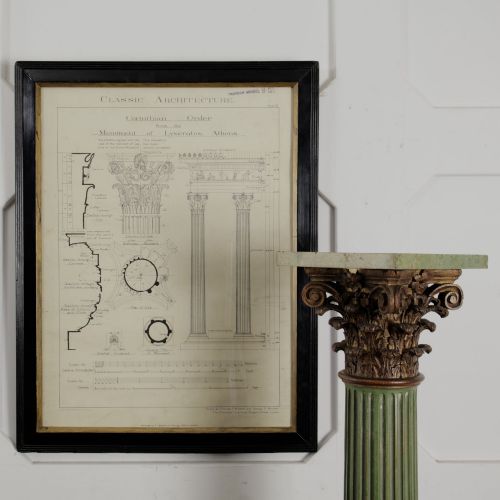


Antique Architectural Drawing Print
An antique architectural drawing print records the precision of past design, offering disciplined compositions that suit studies and libraries.
Antique Architectural Drawing Print
An antique architectural drawing print captures classical facades, monumental arches, and grand elevations upon paper. These works range from small notebook plates to large framed sheets executed with ruler and compass.
The selections span the eighteenth and nineteenth centuries, taking in Regency neoclassicism and Victorian Gothic revival. Buyers encounter both printed folio plates and original hand-drawn watercolours or ink studies.
French and English subjects dominate the selection, showing classical orders, cathedral interiors, and royal palaces. Many examples arrive already framed in wood, giltwood, or birds eye maple.
Materials and technique
Draftsmen worked primarily in ink, monochrome wash, or watercolour upon heavy paper sheets. Fine lines were laid down with ruling pens, whilst washes of pigment added depth and shadow to stone elevations.
Many items utilise engraving or lithography to multiply plans and elevations for publication in folios. Hand-colouring in watercolour or ink was frequently added afterward to accentuate specific details of the design.
Frames employ traditional materials such as giltwood, birds eye maple, and plain wood fitted with protective glass. These surrounds frequently reflect the period of the drawing itself, from Regency mouldings to later framing.
A seventeen-year-old named H. H Wyatt carefully inked a royal palace design for the South Kensington School.
The standard of execution
Superior works demonstrate exceptional draughtsmanship with steady ink lines and precise geometric perspective. Hand-drawn watercolours by named individuals or students show greater artistic engagement than standard published plates.
The depth of historical detail marks out the finest pieces, such as meticulously rendered stonework, legible lettering, and complex decorative schemes. Scale and ambition also separate simple book illustrations from large original elevations.
Condition of the paper and integrity of the original framing influence the overall character of the piece. Clean paper without heavy discolouration preserves the crispness of the architectural draughting.
H. H Wyatt·John Scott Russell·Joseph Hansom·Giovanni Ottaviani
The Antique Architectural Drawing Print Glossary
- Lithography
- A planographic printing process using stone or metal plates to produce multiple impressions of architectural plans. This technique allowed fine tonal gradations and faithful reproduction of ink drawings.
- Engraving
- A method of incising a design into a copper or metal plate to hold ink for printing. It produces sharp, precise lines well suited to architectural elevations and technical drawings.
- Giltwood
- Wood carved and coated with gold leaf or metallic paint to create a decorative frame finish. It appears frequently on nineteenth-century framing.
- Birds Eye Maple
- A figured timber exhibiting small circular markings resembling birds eyes. It is utilised for decorative furniture and fine picture frames.
- Neoclassical
- A style drawing inspiration from the classical art and architecture of ancient Greece and Rome. It manifests in columns, symmetry, and restrained ornament across many plates.
Antique Architectural Drawing Print: Frequently Asked Questions
What is an antique architectural drawing print?
These works are original hand-drawn studies, engravings, or lithographs depicting buildings, plans, and classical orders. They served as working documents for architects or illustrative plates within substantial architectural folios.
Today they function as decorative wall art, preserving the meticulous penwork and wash techniques of past draftsmen.
How were these drawings used originally?
Architects, students, and patrons utilised these drawings to study classical proportions, construction details, and historical styles. Large scale elevations recorded completed buildings or proposed royal palaces for educational display.
Published engravings and lithographs allowed designers across Europe to share architectural innovations and archaeological discoveries from sites like Athens and Rome.
How do I date an architectural print?
Dating relies upon paper characteristics, printing techniques, and stylistic markers such as Regency neoclassicism or Victorian Gothic revival. Signed inscriptions, dates written by the artist, and framing materials also provide firm chronological indicators.
Subject matter often reflects contemporary interest in specific historical periods, such as eighteenth-century excavations or nineteenth-century cathedral restorations.
How should I display framed drawings?
These works require placement away from direct sunlight to prevent fading of the delicate inks and watercolours on paper. Stable indoor humidity protects both the paper substrate and the antique wooden or giltwood frames.
Grouping complementary subjects, such as classical orders or cathedral interiors, creates a balanced display within a study or library.