
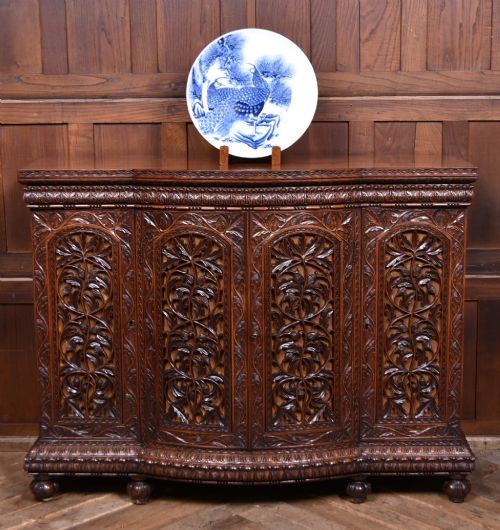


Anglo Indian Credenza
An anglo indian credenza brings together British cabinet forms and intricate eastern carving, offering substantial storage and striking visual presence.
Anglo Indian Credenza
An anglo indian credenza covers the carved sideboards, cabinets, and bookcases seen in the nineteenth century, including specific Victorian Gothic Revival and Anglo-Burmese examples. These large display and storage items combine Western architectural shapes with dense native ornamentation.
The pieces listed on this page span the Regency, Victorian, and later nineteenth century periods, arriving from colonial workshops. Buyers will most frequently encounter padouk wood and teak sideboards finished with deep relief carving.
How they were made
Workshops utilised dense timbers such as padouk wood, teak, rosewood, and satinwood, selected for their stability and capacity to hold crisp, intricate chisel work. Craftsmen carved these hardwoods directly to cover doors, panels, and cornices with flora, fauna, and geometric motifs.
Construction methods merged British carcass forms, such as inverted breakfront pedestals and chiffoniers, with traditional Indian and Burmese joinery. Certain cabinets integrate marble tops or glazed sections alongside the heavy timber frames.
Listings span the nineteenth century, including specific years like 1860 and 1880, alongside broader Victorian and Regency periods.
What varies in quality
The depth and sharpness of the hand carving dictate the quality tier, as shallow or hurried work lacks the dimensional richness found in the best examples. The choice of timber also sets pieces apart, with heavily figured padouk wood and solid satinwood commanding greater visual weight than plainer hardwoods.
Proportion and structural integrity define the higher range, where massive sideboards and bookcases retain balanced architectural lines despite heavy ornamentation. Finer examples maintain crisp mouldings and tightly fitted doors that align properly within the carved framework.
The Anglo Indian Credenza Glossary
- Padouk
- A dense tropical hardwood with a reddish-brown tone that darkens with age. It forms the primary material for the majority of these carved sideboards.
- Inverted breakfront
- A cabinet design where the central section recedes rather than projects forward. This layout creates varied planes across the front of a pedestal sideboard.
- Satinwood
- A lustrous yellow-brown timber used for high-status cabinet work. It provides a striking, pale contrast to darker tropical hardwoods.
- Chiffonier
- A small sideboard or low cabinet equipped with shelves or enclosed storage. These items appeared in nineteenth-century interiors for serving or display.
Anglo Indian Credenza: Frequently Asked Questions
What is an anglo indian credenza?
These items are nineteenth-century sideboards, cabinets, and bookcases created in India and Burma for British colonial use. They merge traditional European furniture shapes with dense, native hand-carving.
Craftsmen built them from durable tropical hardwoods like padouk and teak to withstand regional climates while serving formal dining rooms or libraries.
How do I date these cabinets?
Dating relies on stylistic markers such as Regency proportions, Victorian Gothic Revival motifs, or specific production years noted in the nineteenth century. Cabinet construction and secondary woods also offer clues to the decade of manufacture.
Examining the depth of the carving and the integration of marble tops helps place the piece within the broader Victorian timeline.
Which woods were used?
Makers relied heavily on padouk wood, teak, rosewood, and hardwood for their structural stability and deep colour. Satinwood appears in specific cabinets to provide a lighter contrasting surface.
These timbers allowed artisans to execute intricate, deep-relief carvings that remain crisp across the panels and doors.
Where were they made?
The pieces originated in workshops across India and Burma during the nineteenth century, operating under British colonial influence. Local artisans combined European furniture blueprints with indigenous decorative traditions.
This exchange produced distinct hybrid styles that catered to British residents abroad and export markets back home.