

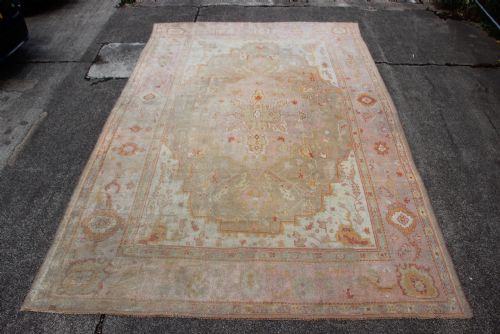


Anatolian Floral Carpet
An anatolian floral carpet brings warmth and rich pattern to a room, offering traditional motifs woven across decades of regional craftsmanship.
Anatolian Floral Carpet
An anatolian floral carpet encompasses floor coverings originating from Turkey, spanning distinct weaving centres and workshops. Buyers encounter examples ranging from room-sized carpets down to smaller scatter rugs.
The inventory on this page relies heavily on nineteenth-century pieces alongside early twentieth-century examples. Common regional attributions include Oushak, Sivas, Kayseri, Kirsehir, and Ghiordes.
Traditional formats vary from grand palatial carpets measuring over four metres to compact prayer rugs. Woven structures incorporate classic medallion layouts and repeating floral patterns.
Materials and Construction
Wool serves as the primary pile material, frequently paired with cotton foundations for stability and strength. Certain pieces utilise art silk, mercerised cotton, or pure silk to achieve finer detail.
Weavers employed hand-knotting techniques across traditional regional looms, producing varied pile densities. Angora wool also appears, offering a softer texture within specific carpet types.
Anatolian Floral Carpet Retail Price Guide 2026
Typical asking prices for anatolian floral carpet among the pieces listed under this phrase on Sellingantiques today, from the lower quarter to the upper quarter. They describe what is for sale here now, not the wider market.
Listings span production dates from the eighteenth century through to the 1930s.
Assessing Quality and Execution
Knot density and structural tightness dictate the refinement of the weave, particularly in Sivas and Kayseri productions. Finer knotting permits sharper rendering of intricate floral borders and central medallions.
Material selection divides standard wool floor coverings from pieces incorporating silk or mercerised cotton highlights. The handling of natural dyes and the consistency of wool spinning further distinguish superior examples.
The Anatolian Floral Carpet Glossary
- Oushak
- A major carpet-production centre in western Turkey known for large-scale floral designs and muted colour palettes. Pieces from this region often feature soft wool and expansive fields.
- Prayer rug
- A small format rug featuring a mihrab or arch design indicating the direction of prayer. These pieces were traditionally used for personal devotion.
- Medallion
- A central ornamental motif set within the field of a carpet. This design element anchors the surrounding floral and geometric composition.
- Angora wool
- A soft fibre derived from Angora goats, utilised in specific antique carpets to impart a distinct texture and lustre. It enhances the tactile quality of the pile.
- Mihrab
- The arched niche depicted on prayer rugs, symbolising a doorway or sanctuary. Its orientation guides the layout of the surrounding pattern.
Anatolian Floral Carpet: Frequently Asked Questions
How do I clean an antique carpet?
Professional specialist cleaning is essential for antique textiles to protect delicate wool and cotton foundations.
Regular gentle surface vacuuming without a beater bar helps remove dust without stressing the fibres.
Where were these carpets made?
These pieces originate from various regions across Turkey, including Oushak, Sivas, Kayseri, and Ghiordes.
Each weaving centre developed distinct patterns, colour schemes, and knotting techniques over generations.
Are these carpets suitable for heavy traffic?
Standard wool pile carpets offer natural durability and resilience for everyday floor placement.
Finer silk or art silk examples require more careful placement in lower-traffic areas to preserve the pile.
How do I identify a prayer rug?
Prayer rugs are distinguished by a clearly defined architectural arch or mihrab at one end of the field.
This format is typically smaller than a full room-sized carpet and was designed for individual use.