


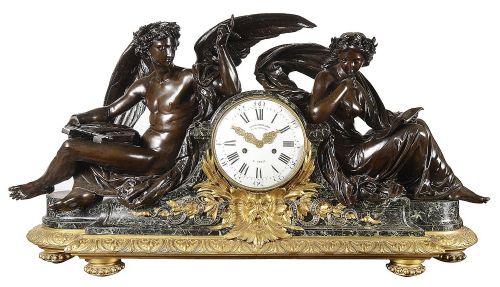


Allegorical Bronze Clock
An allegorical bronze clock brings classical mythology and moral philosophy into the room through figurative metalwork.
Allegorical Bronze Clock
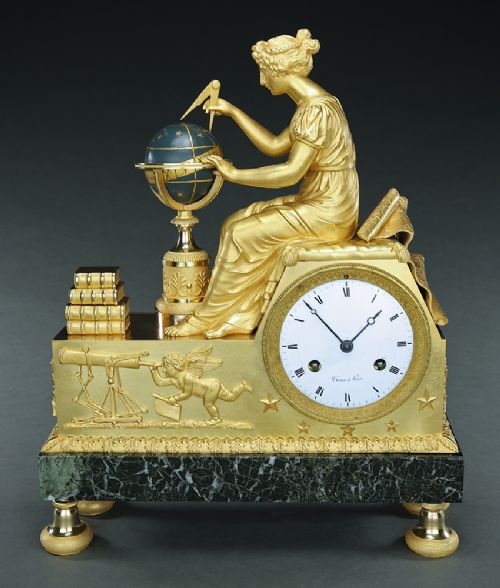
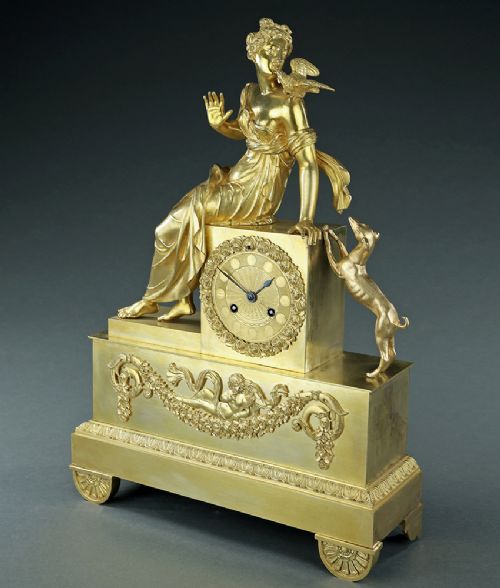
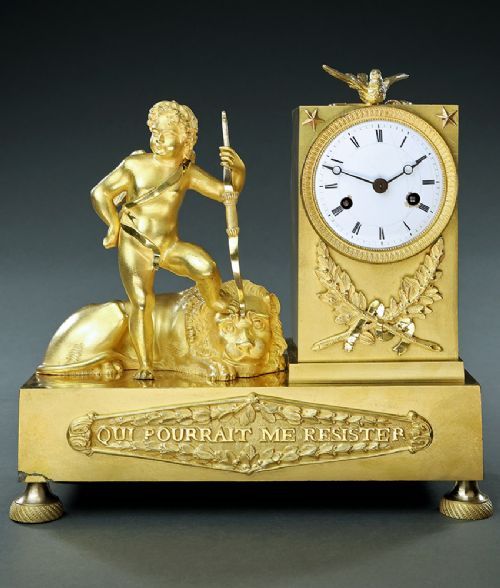
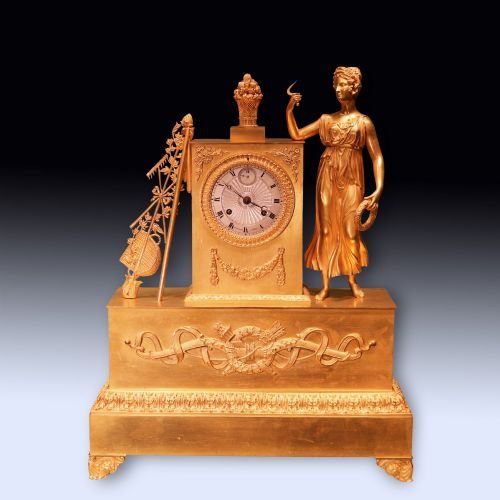
An allegorical bronze clock serves as a mantel timepiece whose figural composition depicts classical themes, virtues, or historical subjects like astronomy and literature. These pieces appear most frequently as 19th-century French mantel clocks and clock garnitures cast in bronze, ormolu, and gilt bronze, often paired with marble bases.
The sculptural subjects draw upon French Empire, Louis XVI, and Neoclassical styles, with specific iconographic figures representing concepts such as love, fidelity, chastity, and knowledge. Makers incorporated enamel dials and intricate cast ornaments to frame these narrative scenes for domestic display.
Buyers encounter single mantel clocks alongside larger three-piece garniture sets featuring matching side ornaments. The physical form ranges from compact Victorian table pieces to substantial architectural works produced by prominent Paris workshops.
Materials and construction methods
Foundries utilised bronze and spelter for the sculptural figures, applying fire-gilding or ormolu finishes to achieve a bright, uniform golden surface. These metallic elements were combined with solid marble bases in white or rouge varieties to provide structural weight and contrast.
Movements were paired with white enamel dials bearing Roman or Arabic numerals, framed by cast bezels. Artisans integrated the clockworks directly into sculptural housings depicting subjects like literature, astronomy, or allegorical personifications.
Chastity points firmly at a font of Holy Water while time ticks steadily on.
Factors of distinction
The partnership between the bronze sculpture and the mechanical movement defines the standing of the work. Signed pieces associated with documented Paris makers or established Parisian foundries exhibit greater architectural harmony and superior finishing on both the case and the internal brass mechanisms.
Reiche·Remond·Deniere Et Fils·Victor Paillard
The Allegorical Bronze Clock Glossary
- Ormolu
- A gold-coloured alloy of copper, zinc, and sometimes tin applied to bronze objects through mercury gilding. This technique produced a durable metallic lustre characteristic of luxury French clocks from the eighteenth and nineteenth centuries.
- Garniture
- A coordinated set consisting of a central clock flanked by matching decorative objects such as urns or candelabra. These sets were designed to create a balanced display across a mantelpiece.
- Spelter
- An inexpensive zinc-based metal alloy utilised as a substitute for bronze in figural clock castings. It accepts patination and metallic paint finishes well, though it lacks the density and structural strength of true bronze.
- Enamel dial
- A metal dial face coated with fused powdered glass, fired at high temperatures to create a smooth white surface. Numerals were subsequently painted and re-fired for permanence.
- Chasing
- The manual process of refining a cast metal surface using small steel punches and hammers. This technique restores crispness to details lost during the casting process.
Allegorical Bronze Clock: Frequently Asked Questions
How do I identify the allegorical subject?
Examine the attributes held by the main bronze figure, such as celestial charts for astronomy or books for literature. Inscribed titles on bases or distinct symbols like anchors and fountains clarify the specific virtue or theme.
Reference contemporary nineteenth-century French design motifs to connect recurring visual tropes with classical mythology or moral philosophy.
Are clock garnitures complete sets?
A complete clock garniture includes the central timepiece accompanied by two matching side pieces, typically vases or candelabra. These three items were manufactured together to sit harmoniously on a mantel.
Individual mantel clocks appear separately without side ornaments, representing standalone sculptural works rather than garniture sets.
What is the difference between bronze and ormolu?
Bronze refers to the underlying copper alloy used to cast the figures and decorative mounts of the clock. Ormolu describes the specific mercury-gilding process applied to that bronze to give it a rich gold appearance.
Many pieces combine areas of dark patinated bronze with bright ormolu highlights to create visual depth across the sculptural composition.
How should I care for a marble and bronze clock?
Keep the clock away from direct sunlight and fluctuating heat sources to protect the delicate enamel dial and the integrity of the marble. Dust the bronze and marble gently with a dry, soft cloth without applying commercial cleaning chemicals.
Mechanical movements require professional servicing every few years to ensure proper lubrication and timekeeping accuracy.