


Agricultural Scene Artwork
Agricultural scene artwork captures rural labour and working animals across the nineteenth and twentieth centuries.
Agricultural Scene Artwork
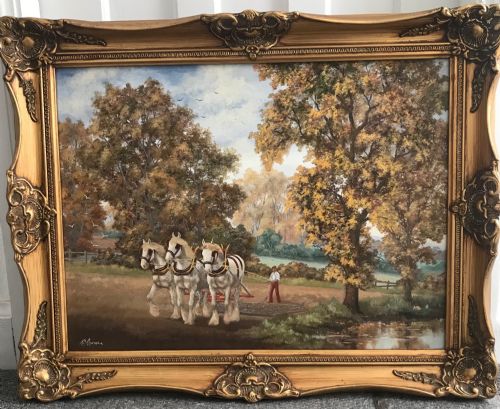
An agricultural scene artwork brings rural labour, harvest time and working animals into domestic spaces through painted depictions of farmyards, ploughing teams and haymaking. Buyers search for these pieces to connect with traditional pastoral life and historical British and European countryside landscapes.
The selection here draws primarily from the nineteenth, twentieth, and Victorian periods, with works dated across the decades from the mid-nineteenth century through to the nineteen-sixties. Forms range from intimate watercolours on paper to large oil paintings on canvas framed in wood or ebonised surrounds.
Representations span British Impressionism, Victorian Realism, French Provincial and Traditional Country styles. Common subjects include shire horses, farm hands, cattle in stables, and harvest fields rendered by regional artists working within distinct local landscapes.
Materials and Techniques
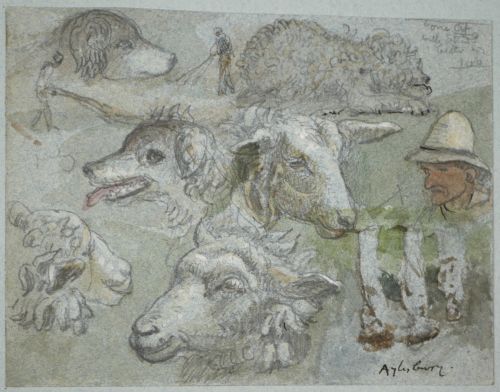
Makers utilised oil paint on canvas and watercolour on paper as primary mediums, applying pigment with varying brushwork to capture the light and texture of rural environments. Oils provide depth and opacity for large farmyard scenes, whilst watercolours offer lighter, transparent washes suited to pastoral landscapes.
Supports include prepared canvas stretched over wooden frames and heavy paper sheets housed beneath glass within traditional wooden or burr frames. These materials reflect standard studio practices of the Victorian and Edwardian eras, ensuring physical stability for surviving pieces.
Listings span works dated from the nineteenth century through the nineteen-sixties, using canvas and paper supports.
Judging Quality
Quality rests upon the artist's ability to render human figures, working animals and atmospheric conditions with anatomical accuracy and compositional balance. Superior works display confident brushwork and a coherent sense of light, distinguishing accomplished academic or regional painters from naive or formulaic studio output.
Condition of the pigment and support influences the standing of a piece, with well-preserved canvases showing minimal craquelure and watercolours retaining their original paper tone without excessive fading. Original period framing also contributes to the integrity of the surviving object.
James Smetham·Raimond Louis Lecourt·James Kyd·James William Booth·Henry Bailey·Percival Glenfern·JOHN ATKINSON·J.C. Grey·George Soper·Arthur Winter Shaw·Thomas Sidney Cooper·Arthur Charles Dodd·Herbert Royle·Rowland Henry Hill·JOSEPH KIRKPATRICK·Joseph Paulman·Frederick William Jackson·JOHN PERCY COOKE·Ernest Higgins Rigg·WALTER DUNCAN·GEORGE HAMILTON CONSTANTINE·William Greaves·Owen Bowen·George Cole·Fred Lawson
The Agricultural Scene Artwork Glossary
- Oil on Canvas
- A painting medium where pigments are suspended in drying oil, applied to a stretched cloth support. This technique allows for rich colour blending and textured impasto work.
- Watercolour Painting
- Works created using water-soluble pigments on paper. This medium produces transparent washes and delicate tonal gradations.
- British Impressionism
- A painting style influenced by the French movement, characterised by visible brushstrokes and an emphasis on natural light. Artists working in this manner often depicted outdoor rural scenes and agricultural labour.
- Victorian Pastoral
- A genre focusing on idealised or realistic depictions of rural life, farming and countryside scenery. These works frequently feature agricultural workers, livestock and harvest activities.
- Ebonised Frame
- A wooden picture surround treated to imitate ebony wood, typically finished in a deep black polish. This framing style was common for nineteenth-century and mid-century paintings.
Agricultural Scene Artwork: Frequently Asked Questions
What subjects appear in agricultural artwork?
These works typically depict farm hands, ploughing teams with shire horses, cattle in stables, and harvesting activities like haymaking. The imagery records traditional rural labour and nineteenth and twentieth-century farming methods.
Scenes frequently capture specific regional landscapes across Britain and Normandy, reflecting the daily realities of agricultural communities before mechanisation.
How do I date an agricultural painting?
Dating relies on stylistic markers, costume details of the figures, framing materials, and artist signatures recorded in the provenance. Victorian and Edwardian works often display specific academic techniques or period framing styles.
Nineteenth-century pieces tend toward darker palettes and detailed realism, while twentieth-century examples incorporate brighter palettes and looser brushwork associated with British Impressionism.
Where should I hang these paintings?
These pieces suit traditional dining rooms, studies or living spaces where rural subjects complement classic interior decor. Large oil paintings on canvas require adequate wall space and sturdy fixings due to their substantial wooden frames.
Watercolours on paper need protection from direct sunlight to prevent the fading of pigments over time, making shaded wall placements ideal.
Are watercolours as durable as oils?
Watercolours utilise paper supports and water-soluble pigments that remain sensitive to moisture and light exposure. They require framing behind glass with acid-free mounts to ensure long-term preservation.
Oils on canvas offer greater resilience against environmental factors, though both mediums benefit from stable indoor humidity and temperature levels.